
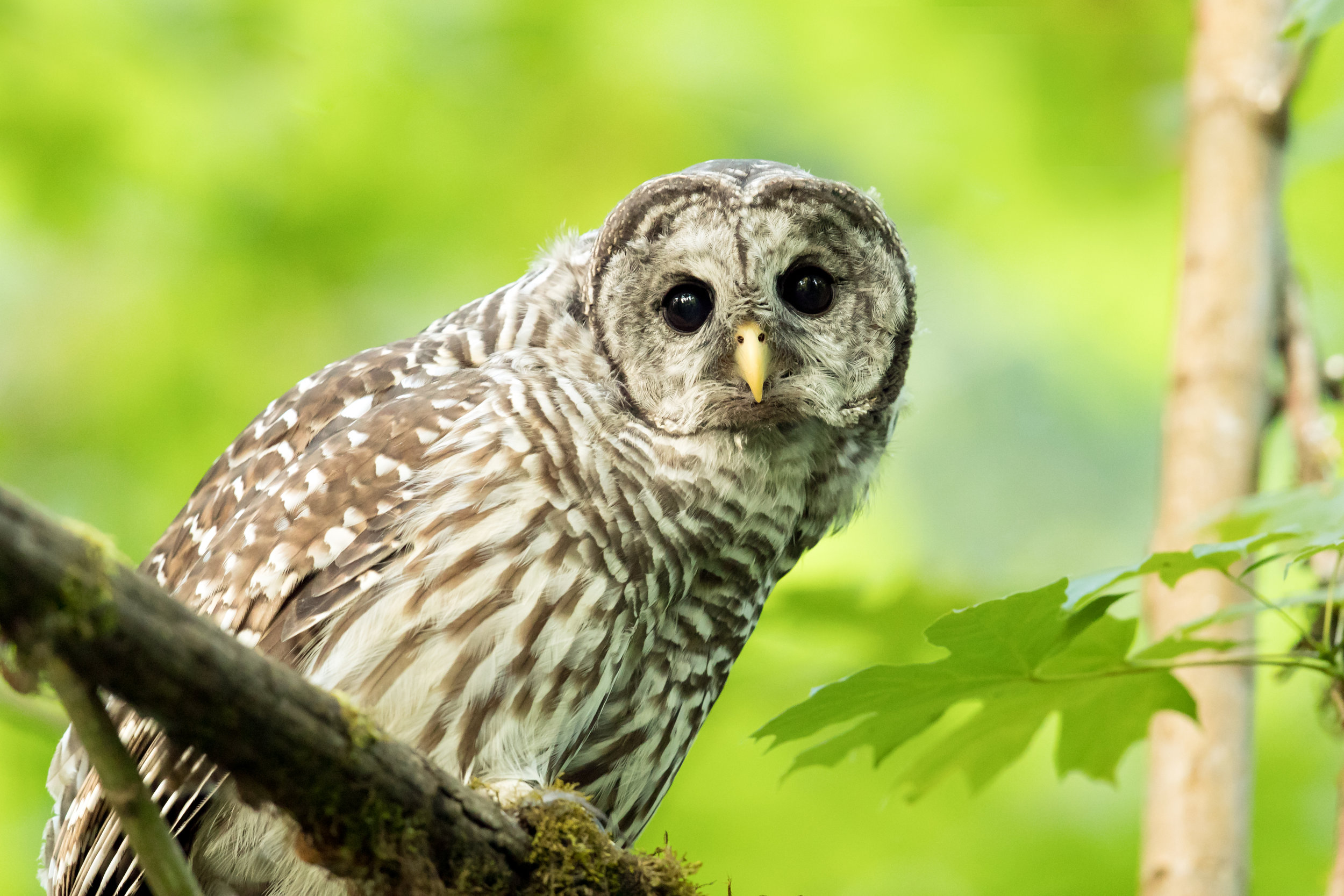
Where does the Barred Owl live?
Strix varia
Spotted a bird? Identify it instantly with the Birdby app
Open the appThe Barred Owl lives in specific habitats and regions. Knowing where, and when, to look improves your chances of a successful sighting.
Biomes
Temperate forests, boreal forests, swamps, riparian woodlands.
Geographic range
Primarily eastern North America, extending from southeastern Canada south through the eastern United States to Florida and west to Texas. In recent decades, its range has expanded westward into the Pacific Northwest, often displacing Spotted Owls (Strix occidentalis).
Preferred environments
Mature, dense forests with a mix of deciduous and coniferous trees, often near water sources such as rivers, swamps, or lakes. They require large trees for nesting and roosting, and an open understory for hunting.
Elevation range
Sea level up to approximately 2,500 meters (8,200 feet), though most common in lower to mid-elevations.
Where to look
Mature Forests
Look in old-growth or mature deciduous and mixed forests with large trees for nesting and roosting.
Riparian Areas
Areas along rivers, streams, and swamps are prime habitats due to abundant prey and suitable nesting sites.
Wooded Parks and Suburbs
In some areas, they have adapted to suburban environments with large, mature trees and sufficient green space.
Field tips
- Listen for Calls. The Barred Owl's distinctive call is often heard at dawn, dusk, or throughout the night. Learning this call is crucial for identification.
- Look for Roosting Sites. During the day, they often roost quietly in dense foliage close to the trunk of a large tree. Look for whitewash (droppings) or pellets on the ground beneath potential roosts.
- Scan for Movement. Despite being nocturnal, they are often active during the day. Look for movement in the canopy or listen for alarm calls from smaller birds, which might indicate an owl's presence.
- Use Playback Sparingly. While playing their call can elicit a response, use it very sparingly and ethically, as it can stress the birds.
Migration
Mostly resident throughout their range, though some northern populations may make short-distance movements in harsh winters or in response to prey scarcity (irruptions).
Explore the Barred Owl
Identify birds anywhere
Free on iOS, Android, and Web. Photo & sound identification, full species database, and your personal life list.