
Spotted a bird? Identify it instantly with the Birdby app
Open the appAbout
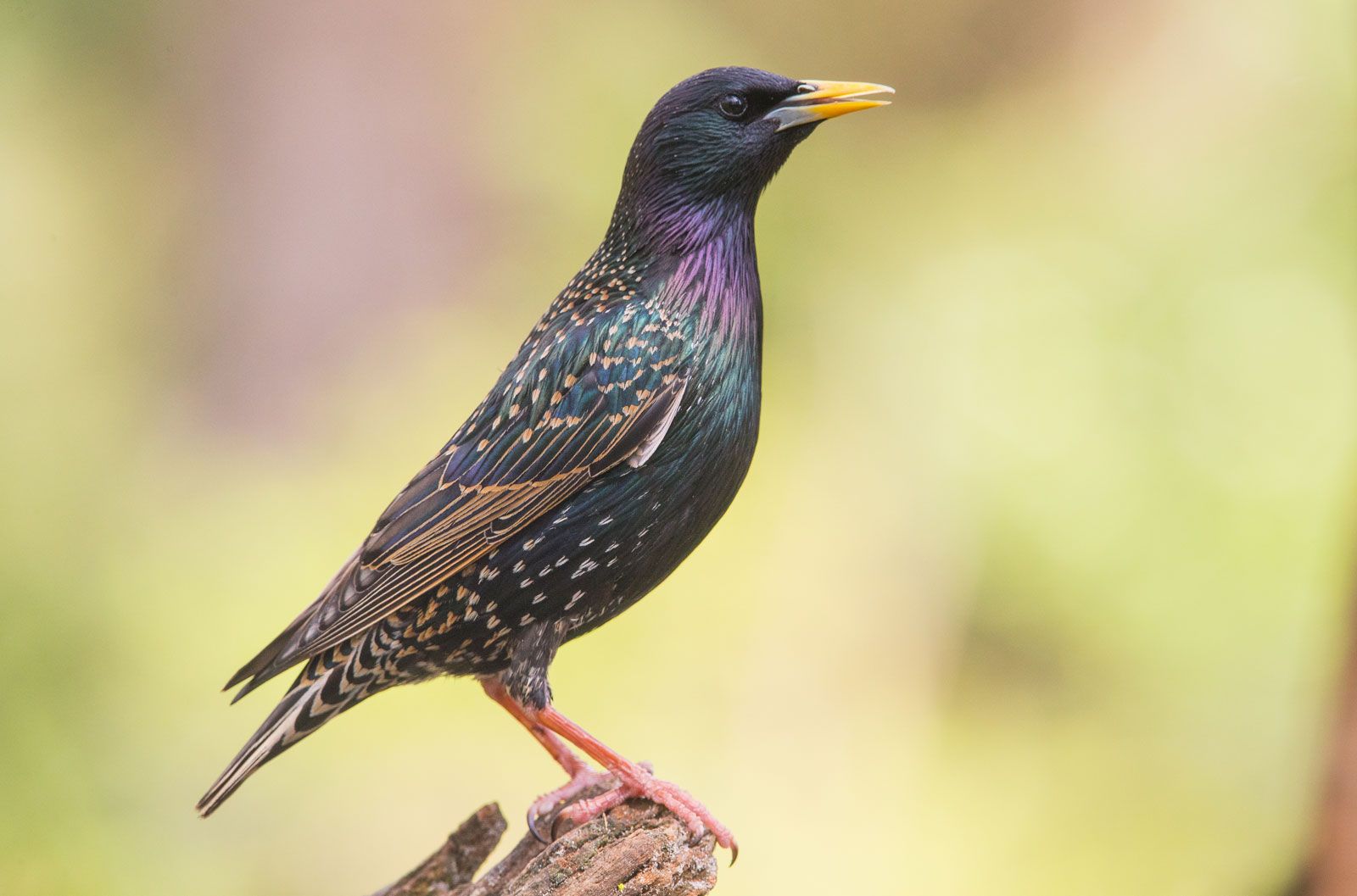
The European Starling is a medium-sized passerine bird native to Eurasia, widely introduced elsewhere. Known for its iridescent plumage, distinctive calls, and often large, synchronized flocks (murmurations), it is a highly adaptable and opportunistic species.
Size & lifespan
- Length
- 19-23 cm (7.5-9.1 in)
- Wingspan
- 31-44 cm (12-17 in)
- Weight
- 60-90 g (2.1-3.2 oz)
- Lifespan
- 2-3 years in the wild, up to 15 years in captivity
- Diet
- Omnivore, primarily insects and other invertebrates, fruits, seeds, and human scraps.
Physical characteristics
- Plumage
- Adult breeding plumage is glossy black with iridescent purple and green sheens, often appearing speckled with small white spots, especially on the flanks and undertail coverts. Non-breeding plumage is heavily spotted with white or buff on the head, back, and underparts, with less iridescence. The iridescence is due to structural coloration.
- Beak shape
- Conical and pointed. In breeding season, the bill is bright yellow with a bluish base in males and a pinkish base in females. In non-breeding season, the bill is dark brown to blackish.
- Eye color
- Dark brown.
- Leg color
- Reddish-brown to pinkish-brown.
- Distinguishing features
- Short tail, triangular wings in flight, direct and powerful flight, and a distinctive waddling gait on the ground. The iridescent plumage and speckled appearance (especially in winter) are key. The yellow bill in breeding season is also a strong identifier.
- Juvenile appearance
- Juveniles are dull, uniform grey-brown overall, lacking iridescence and speckling. Their bill is dark brown to black. They gradually molt into adult non-breeding plumage during their first autumn.
- Seasonal changes
- Breeding plumage (spring/summer) is glossy black with strong iridescence and minimal spotting. Non-breeding plumage (autumn/winter) is heavily spotted with white or buff, and the bill is dark. The white spots are due to pale tips on new feathers, which wear off by spring, revealing the underlying iridescent black.
- Sexual dimorphism
- Subtle. Males tend to have a bluer base to the bill during breeding season, while females have a pinker base. Males may also have slightly longer, less dense speckling in non-breeding plumage. Otherwise, sexes are very similar in size and plumage.
How to identify
- 1
Size and Shape
Medium-sized, chunky bird with a short tail, pointed wings, and a somewhat elongated head. Appears stocky.
- 2
Plumage (Adult Breeding)
Look for glossy black plumage with iridescent purple and green sheens. Minimal or no white spotting. Yellow bill with a dark tip.
- 3
Plumage (Adult Non-breeding)
Look for heavy white or buff speckling over the entire body, especially noticeable on the head and back. Bill is dark brown to black.
- 4
Plumage (Juvenile)
Uniform dull grey-brown plumage, lacking iridescence and speckling. Dark bill. Often seen in flocks with adults.
- 5
Bill Color
Bright yellow bill in breeding adults (spring/summer), dark bill in non-breeding adults (autumn/winter) and juveniles.
- 6
Flight
Direct, fast flight with rapid wingbeats. Often flies in dense, synchronized flocks (murmurations) at dawn and dusk.
- 7
Vocalizations
Listen for a complex, varied song including whistles, clicks, rattles, and mimicry. Harsh 'churrr' and 'tcheer' calls are common.
- 8
Behavior
Often seen foraging on lawns and open ground, probing with their bill. Highly social, forming large flocks, especially outside the breeding season.
Habitat & range
- Biomes
- Temperate forests, grasslands, urban and suburban areas, agricultural lands, coastal areas.
- Geographic range
- Native to Europe, Asia, and North Africa. Introduced and established in North America, Australia, New Zealand, South Africa, and parts of South America.
- Elevation range
- Sea level up to 2,500 meters (8,200 feet), primarily in lowlands and disturbed areas.
- Preferred environments
- Highly adaptable, preferring open country with scattered trees, parks, gardens, cultivated land, pastures, and urban environments. Requires cavities for nesting, often utilizing tree holes, nest boxes, or crevices in buildings.
Behavior
- Activity time
- Diurnal.
- Feeding habits
- Forages primarily on the ground, probing with its bill for invertebrates. Diet includes beetles, caterpillars, grasshoppers, spiders, earthworms, snails, as well as fruits (cherries, berries, grapes), seeds, and grains. In urban areas, they readily consume human food scraps.
- Social behavior
- Highly social, especially outside the breeding season. Forms large, often massive, flocks (murmurations) for roosting and foraging. During breeding, they are typically monogamous, but polygyny can occur. They are aggressive competitors for nest sites.
- Flight pattern
- Strong, direct, and fast flight with rapid wingbeats. In large flocks, they perform spectacular aerial displays known as murmurations, characterized by highly synchronized, fluid movements.
- Migration pattern
- Northern and eastern European populations are migratory, moving south and west for winter. Western and southern European populations are largely resident. Introduced populations in North America are partially migratory, with northern birds moving south, while southern birds are resident.
- Territoriality
- Males establish small territories around nest sites during the breeding season, defending them from rivals. Flocks are not territorial outside of breeding.
Song & calls
- Song
- Complex and varied, a mixture of whistles, clicks, rattles, chattering, and mimicry of other birds and even mechanical sounds. Often includes clear, descending whistles and harsh, scratchy notes. Males sing from prominent perches to attract mates.
- Call
- A wide range of calls, including a harsh 'churrr', a sharp 'tcheer', and various contact calls within flocks. Alarm calls are typically harsh and abrupt.
- When they vocalize
- Most vocal during the breeding season (spring and early summer). Flocks are noisy year-round, especially at roosts.
Breeding & reproduction
- Breeding season
- Typically April to July in the Northern Hemisphere.
- Nesting habits
- Cavity nesters, utilizing natural tree holes, old woodpecker holes, nest boxes, and crevices in buildings. Both sexes build the nest, which is a messy cup of grass, leaves, twigs, and feathers, often lined with softer materials. They are aggressive competitors for nest sites, often evicting native cavity nesters.
- Clutch size
- 4-6 eggs, typically 1-2 broods per year.
- Egg description
- 4-6 eggs, pale blue or greenish-blue, unspotted, glossy. Approximately 30 x 21 mm.
- Incubation period
- 11-13 days, primarily by the female, but both parents participate.
- Fledging period
- 20-22 days after hatching. Young are fed by both parents.
- Parental care
- Both parents feed and care for the nestlings. After fledging, the young remain dependent on parents for a short period before joining juvenile flocks.
Where to find
Urban and Suburban Areas
Parks, gardens, residential areas, city centers, and industrial zones. They thrive in human-modified landscapes.
Agricultural Lands
Pastures, cultivated fields, orchards, and vineyards, where they forage for insects and fruits.
Open Woodlands and Edges
Areas with scattered trees, forest edges, and clearings, especially those with suitable nesting cavities.
Coastal Areas
Cliffs, dunes, and coastal towns, particularly in their native range.
Field tips
- Look for Flocks. Starlings are highly social. Look for large flocks foraging on lawns or gathering at roost sites, especially in late afternoon/early evening.
- Listen for Vocalizations. Their varied and often mimetic songs are distinctive. Listen for their chattering and whistling from prominent perches or in flocks.
- Observe Foraging Behavior. Watch for them probing the ground with their bills in open grassy areas. Their waddling gait is characteristic.
- Check Roost Sites. In winter, large numbers of starlings gather at communal roosts in trees, reeds, or on buildings. These can be spectacular to observe.
- Note Seasonal Changes. Pay attention to bill color (yellow in spring/summer, dark in autumn/winter) and plumage speckling (minimal in spring/summer, heavy in autumn/winter) for accurate identification.
Similar species
Common Grackle
Quiscalus quiscula
Grackles are larger, have longer tails, and a more slender body shape. Their iridescence is typically more purplish-blue, and they lack the distinct white speckling of non-breeding starlings. Grackles have pale yellow eyes, whereas starlings have dark eyes. Grackle bills are longer and more robust.
Red-winged Blackbird
Agelaius phoeniceus
Males are easily distinguished by their red and yellow shoulder patches. Females are streaky brown and lack the starling's iridescent black plumage and short tail. Red-winged Blackbirds have a more pointed, conical bill.
Brewer's Blackbird
Euphagus cyanocephalus
Males are glossy black with purplish iridescence on the head and greenish on the body, but lack the starling's speckling. They have bright yellow eyes. Females are duller brown. Brewer's Blackbirds have a longer tail and a more slender build than starlings.
Spotless Starling
Sturnus unicolor
Found in southwestern Europe and North Africa. Very similar to European Starling but lacks the white spots in non-breeding plumage, appearing uniformly glossy black year-round. Its bill is also yellow with a dark tip in breeding season, and dark in winter. Hybridization can occur where ranges overlap.
Quick facts
- Introduced Species:
- Widely introduced outside its native range, notably in North America, where it is considered invasive.
- Murmurations:
- Famous for forming large, synchronized flocks called murmurations, especially at dusk before roosting.
- Mimicry:
- Known for its ability to mimic the calls and songs of other birds, and even human speech or mechanical sounds.
- Cavity Nester:
- Relies on tree cavities or artificial structures for nesting, often outcompeting native species.
- Dietary Flexibility:
- Highly adaptable omnivore, contributing to its success in diverse environments.
Fun facts
- All European Starlings in North America are believed to be descendants of 100 birds released in New York City's Central Park in 1890 and 1891 by an admirer of Shakespeare, who wanted to introduce all birds mentioned in his plays to the continent.
- A single murmuration can consist of tens of thousands to over a million individual birds, creating breathtaking aerial ballets.
- Starlings have a unique bill-probing technique called 'gaping,' where they insert their closed bill into the ground or a crevice and then force it open to expose hidden food.
- Despite their commonness, the intricate iridescence of a starling's plumage is often overlooked until seen up close in good light.
- They are highly intelligent birds, capable of solving complex problems and learning new behaviors.
Scientific classification
- Kingdom
- Animalia
- Phylum
- Chordata
- Class
- Aves
- Order
- Passeriformes
- Family
- Sturnidae
- Genus
- Sturnus
- Species
- Sturnus vulgaris
Explore the European Starling
Identify birds anywhere
Free on iOS, Android, and Web. Photo & sound identification, full species database, and your personal life list.