
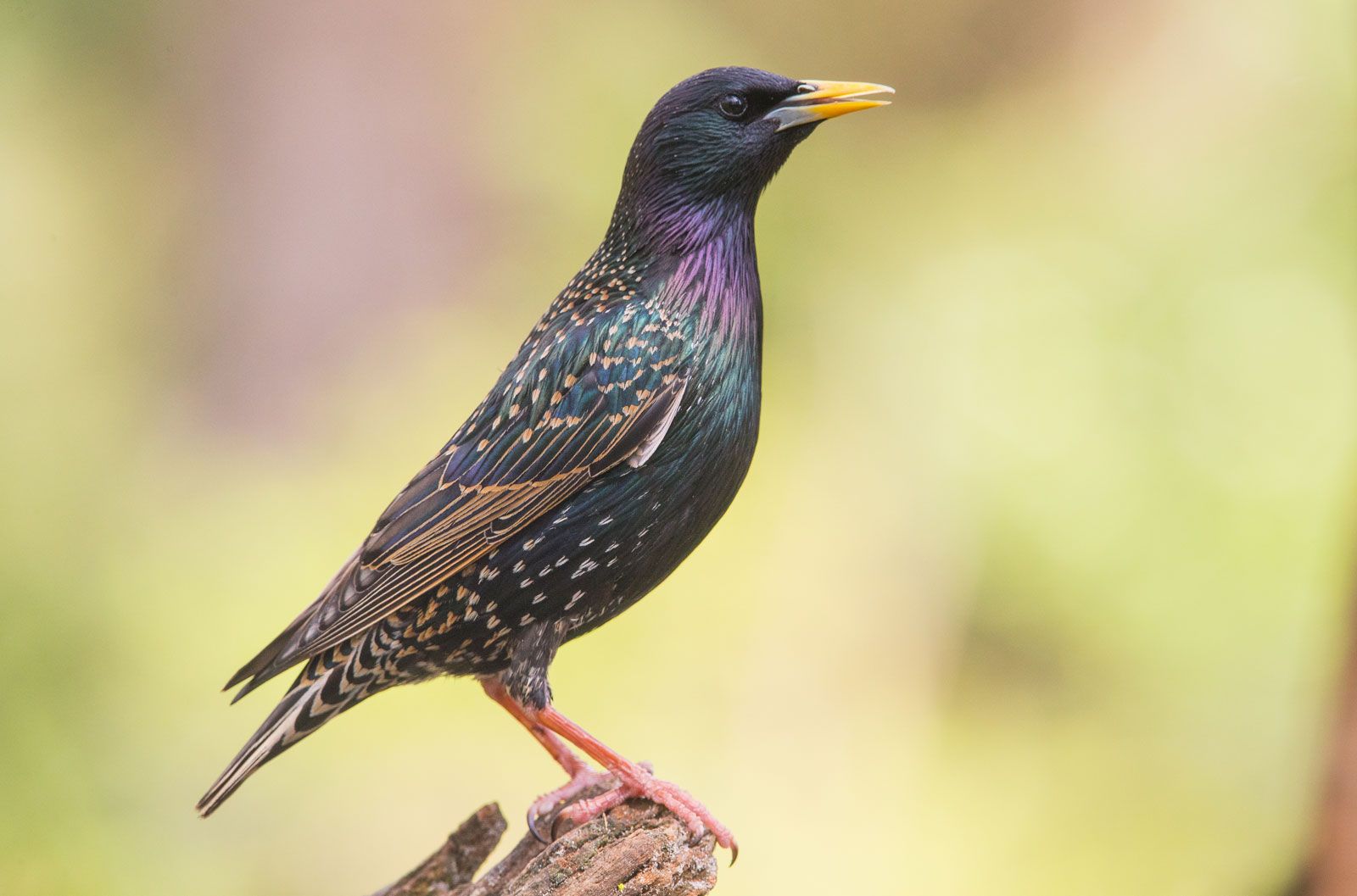
How to identify the European Starling
Sturnus vulgaris
Spotted a bird? Identify it instantly with the Birdby app
Open the appTo correctly identify the European Starling (Sturnus vulgaris), check each of these features. Birds can be tricky: habit, habitat, and call often confirm a sighting that a single photo cannot.
Size at a glance
- Length
- 19-23 cm (7.5-9.1 in)
- Wingspan
- 31-44 cm (12-17 in)
- Weight
- 60-90 g (2.1-3.2 oz)
Physical features to check
- 1
Plumage
Overall feather coloration and pattern.
Adult breeding plumage is glossy black with iridescent purple and green sheens, often appearing speckled with small white spots, especially on the flanks and undertail coverts. Non-breeding plumage is heavily spotted with white or buff on the head, back, and underparts, with less iridescence. The iridescence is due to structural coloration.
- 2
Beak shape
Shape and color of the bill: a key field mark.
Conical and pointed. In breeding season, the bill is bright yellow with a bluish base in males and a pinkish base in females. In non-breeding season, the bill is dark brown to blackish.
- 3
Eye color
Iris color and any distinctive eye markings.
Dark brown.
- 4
Leg color
Leg and foot color.
Reddish-brown to pinkish-brown.
- 5
Distinguishing features
Standout features that separate this species.
Short tail, triangular wings in flight, direct and powerful flight, and a distinctive waddling gait on the ground. The iridescent plumage and speckled appearance (especially in winter) are key. The yellow bill in breeding season is also a strong identifier.
- 6
Juvenile appearance
How young birds differ from adults.
Juveniles are dull, uniform grey-brown overall, lacking iridescence and speckling. Their bill is dark brown to black. They gradually molt into adult non-breeding plumage during their first autumn.
- 7
Seasonal changes
Plumage variation between breeding and non-breeding seasons.
Breeding plumage (spring/summer) is glossy black with strong iridescence and minimal spotting. Non-breeding plumage (autumn/winter) is heavily spotted with white or buff, and the bill is dark. The white spots are due to pale tips on new feathers, which wear off by spring, revealing the underlying iridescent black.
- 8
Sexual dimorphism
How males and females differ.
Subtle. Males tend to have a bluer base to the bill during breeding season, while females have a pinker base. Males may also have slightly longer, less dense speckling in non-breeding plumage. Otherwise, sexes are very similar in size and plumage.
Key field marks
- Size and Shape. Medium-sized, chunky bird with a short tail, pointed wings, and a somewhat elongated head. Appears stocky.
- Plumage (Adult Breeding). Look for glossy black plumage with iridescent purple and green sheens. Minimal or no white spotting. Yellow bill with a dark tip.
- Plumage (Adult Non-breeding). Look for heavy white or buff speckling over the entire body, especially noticeable on the head and back. Bill is dark brown to black.
- Plumage (Juvenile). Uniform dull grey-brown plumage, lacking iridescence and speckling. Dark bill. Often seen in flocks with adults.
- Bill Color. Bright yellow bill in breeding adults (spring/summer), dark bill in non-breeding adults (autumn/winter) and juveniles.
- Flight. Direct, fast flight with rapid wingbeats. Often flies in dense, synchronized flocks (murmurations) at dawn and dusk.
- Vocalizations. Listen for a complex, varied song including whistles, clicks, rattles, and mimicry. Harsh 'churrr' and 'tcheer' calls are common.
- Behavior. Often seen foraging on lawns and open ground, probing with their bill. Highly social, forming large flocks, especially outside the breeding season.
Explore the European Starling
Identify birds anywhere
Free on iOS, Android, and Web. Photo & sound identification, full species database, and your personal life list.