
Spotted a bird? Identify it instantly with the Birdby app
Open the appAbout
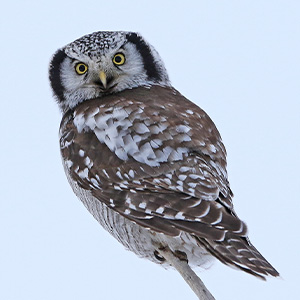
The Northern Hawk-Owl is a medium-sized owl with a distinctive hawk-like appearance, characterized by its long tail, relatively small head, and diurnal hunting habits. It is a circumpolar species found in boreal forests.
Size & lifespan
- Length
- 35-43 cm (14-17 in)
- Wingspan
- 69-82 cm (27-32 in)
- Weight
- 215-400 g (7.6-14.1 oz)
- Lifespan
- Up to 10 years in the wild
- Diet
- Carnivore
Physical characteristics
- Plumage
- Adults have dark brown upperparts heavily spotted with white, and white underparts with dense, narrow dark brown barring. The back of the head has two prominent black patches resembling eyes (occipital spots). The facial disc is white with a black border and fine concentric barring, and a distinct black 'moustache' stripe on each side of the bill. The tail is long and barred.
- Beak shape
- Small, strongly hooked, yellowish-horn colored bill.
- Eye color
- Bright yellow eyes.
- Leg color
- Feathered legs and feet, typically grayish-brown.
- Distinguishing features
- Hawk-like silhouette with a long tail, small head, and diurnal activity. The prominent black 'moustache' stripes and occipital spots are key identifiers.
- Juvenile appearance
- Juveniles resemble adults but have a more uniformly dusky-brown crown and nape, less distinct facial markings, and often a buffier wash on the underparts. The barring on the underparts may be less defined.
- Seasonal changes
- No significant seasonal plumage changes.
- Sexual dimorphism
- Females are typically slightly larger and heavier than males, but plumage is identical.
How to identify
- 1
Silhouette and Flight
Look for a medium-sized raptor with a relatively small head and a long, graduated tail. Its flight is direct and powerful, often with rapid wing beats, resembling a hawk more than a typical owl.
- 2
Diurnal Activity
Unlike most owls, the Northern Hawk-Owl is primarily active during the day, especially in the morning and late afternoon. This makes it easier to spot perched openly.
- 3
Facial Markings
Observe the distinct white facial disc bordered by black, and especially the prominent black 'moustache' stripes extending from the bill. Bright yellow eyes are also characteristic.
- 4
Occipital Spots
Check the back of the head for two black patches that resemble eyes. These 'false eyes' are thought to deter predators.
- 5
Plumage Pattern
Note the dark brown upperparts with white spotting and the heavily barred white underparts. The long, barred tail is also a key feature.
- 6
Perching Behavior
Often perches conspicuously on the very top of a tall snag, pole, or tree, scanning its surroundings for prey.
Habitat & range
- Biomes
- Boreal forest, taiga, open coniferous and mixed forests.
- Geographic range
- Circumpolar, found across the northern Holarctic. In North America, from Alaska across Canada to Newfoundland. In Eurasia, from Scandinavia across Russia to Siberia. Irregular irruptions can bring them south of their typical breeding range.
- Elevation range
- Typically low to moderate elevations, generally below 1,000 meters (3,300 feet).
- Preferred environments
- Prefers open coniferous or mixed forests, often near clearings, bogs, burns, or recent logging areas. Requires snags or tall trees for perching and nesting.
Behavior
- Activity time
- Diurnal, active during daylight hours, especially morning and late afternoon.
- Feeding habits
- Primarily a diurnal hunter, though it can hunt at dawn and dusk. It typically perches on a prominent snag or treetop, scanning for prey. Once prey is spotted, it swoops down in a swift, direct flight. Diet consists mainly of voles, lemmings, and other small rodents, but also takes shrews, small birds, and occasionally insects.
- Social behavior
- Generally solitary outside of the breeding season. Pairs form for breeding.
- Flight pattern
- Direct, powerful, and hawk-like flight with rapid wing beats, often interspersed with glides. Can hover briefly while hunting.
- Migration pattern
- Mostly resident throughout its range, but exhibits irruptive movements southwards in response to prey shortages (especially voles) in its northern breeding grounds. These irruptions are irregular and can be quite dramatic.
- Territoriality
- Territorial during the breeding season, defending nesting and hunting areas. Males perform territorial calls and displays.
Song & calls
- Song
- The male's primary song is a rapid, rolling series of 'hoo-hoo-hoo-hoo' notes, often described as a trill or a rapid hooting, lasting several seconds. It can be heard from a distance.
- Call
- Various calls include a sharp 'kew-kew-kew' alarm call, a softer 'whi-whi-whi' contact call, and a 'chittering' sound during courtship or when agitated.
- When they vocalize
- Most vocal during the breeding season (late winter to early summer), but can be heard year-round, especially during irruptive years.
Breeding & reproduction
- Breeding season
- Typically March to June, with peak egg-laying in April-May, depending on latitude and prey availability.
- Nesting habits
- Does not build a nest. Uses natural tree cavities, old broken-topped snags, or abandoned nests of other large birds (e.g., Northern Goshawk, Common Raven). Nests are usually in tall trees, often conifers, near open areas.
- Clutch size
- 3-13 eggs, typically 5-9. Clutch size is highly dependent on prey abundance, with larger clutches laid in years of high vole populations.
- Egg description
- White, unspotted, elliptical to oval. Average size is about 36-40 mm x 29-32 mm.
- Incubation period
- 25-30 days, primarily by the female.
- Fledging period
- Young leave the nest (fledge) at 23-34 days old, but remain dependent on parents for several weeks thereafter.
- Parental care
- Female incubates and broods, while the male provides food. Both parents feed the young after hatching. Young are cared for by both parents for several weeks post-fledging.
Where to find
Boreal Forests
Search in open coniferous and mixed forests, especially those with clearings, recent burns, or logging activity. Look along forest edges and near bogs.
Irruption Zones
During irruptive years, they can be found south of their typical range in more open country, agricultural areas with woodlots, or even suburban areas with suitable habitat. Monitor local birding alerts during these events.
Field tips
- Scan Tall Perches. Northern Hawk-Owls frequently perch on the highest point of a tree or snag, often at the edge of a clearing. Use binoculars to scan these prominent perches.
- Look for Movement. Being diurnal, they are often seen actively hunting. Watch for their characteristic direct flight or hovering behavior.
- Listen for Calls. During the breeding season, listen for the male's rapid, rolling hooting song. In irruptive years, they may be more vocal even outside the breeding season.
- Check for Prey. If you see small rodents or birds reacting to something unseen, it might indicate the presence of a hawk-owl.
- Be Patient and Persistent. While often conspicuous, they can blend into their surroundings. Patience and thorough scanning of suitable habitat are key.
Similar species
Great Gray Owl
Strix nebulosa
Much larger, lacks the long tail and hawk-like silhouette. Has a very large, round head with prominent concentric facial disc rings and small yellow eyes. Strictly nocturnal. Lacks the 'moustache' stripes.
Boreal Owl
Aegolius funereus
Much smaller, strictly nocturnal. Has a larger, rounder head, less distinct facial disc, and lacks the long tail and 'moustache' stripes. Plumage is more mottled brown and white.
American Kestrel
Falco sparverius
While also a diurnal raptor with a somewhat similar silhouette, the Kestrel is much smaller, has pointed wings, and distinct facial markings (two black vertical stripes on each side of the face). It is a falcon, not an owl.
Quick facts
- Hunting Style:
- Diurnal, hawk-like hunter
- Tail Length:
- Unusually long for an owl
- Facial Markings:
- Prominent 'moustache' stripes and occipital spots
- Diet Specialization:
- Primarily voles and lemmings
- Migration:
- Irruptive movements in response to prey
Fun facts
- The Northern Hawk-Owl is one of the few owl species that is primarily diurnal, meaning it hunts during the day, much like a hawk.
- Its scientific name 'Surnia ulula' refers to its owl-like nature ('ulula' is Latin for 'screech owl') and its hawk-like appearance ('Surnia' is thought to be derived from a Greek word for a type of hawk).
- The 'false eyes' on the back of its head are believed to deter predators, making it appear as if the owl is always watching.
- Northern Hawk-Owls can detect prey under a foot of snow, using their acute hearing to pinpoint the location of voles and then plunging headfirst into the snow to catch them.
- Their breeding success and population numbers are strongly linked to the cyclical populations of their primary prey, voles and lemmings.
Scientific classification
- Kingdom
- Animalia
- Phylum
- Chordata
- Class
- Aves
- Order
- Strigiformes
- Family
- Strigidae
- Genus
- Surnia
- Species
- Surnia ulula
Explore the Northern Hawk-Owl
Identify birds anywhere
Free on iOS, Android, and Web. Photo & sound identification, full species database, and your personal life list.