
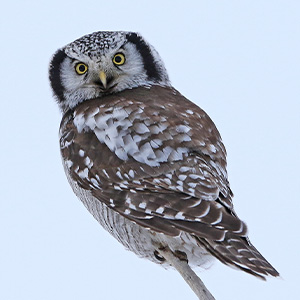
Where does the Northern Hawk-Owl live?
Surnia ulula
Spotted a bird? Identify it instantly with the Birdby app
Open the appThe Northern Hawk-Owl lives in specific habitats and regions. Knowing where, and when, to look improves your chances of a successful sighting.
Biomes
Boreal forest, taiga, open coniferous and mixed forests.
Geographic range
Circumpolar, found across the northern Holarctic. In North America, from Alaska across Canada to Newfoundland. In Eurasia, from Scandinavia across Russia to Siberia. Irregular irruptions can bring them south of their typical breeding range.
Preferred environments
Prefers open coniferous or mixed forests, often near clearings, bogs, burns, or recent logging areas. Requires snags or tall trees for perching and nesting.
Elevation range
Typically low to moderate elevations, generally below 1,000 meters (3,300 feet).
Where to look
Boreal Forests
Search in open coniferous and mixed forests, especially those with clearings, recent burns, or logging activity. Look along forest edges and near bogs.
Irruption Zones
During irruptive years, they can be found south of their typical range in more open country, agricultural areas with woodlots, or even suburban areas with suitable habitat. Monitor local birding alerts during these events.
Field tips
- Scan Tall Perches. Northern Hawk-Owls frequently perch on the highest point of a tree or snag, often at the edge of a clearing. Use binoculars to scan these prominent perches.
- Look for Movement. Being diurnal, they are often seen actively hunting. Watch for their characteristic direct flight or hovering behavior.
- Listen for Calls. During the breeding season, listen for the male's rapid, rolling hooting song. In irruptive years, they may be more vocal even outside the breeding season.
- Check for Prey. If you see small rodents or birds reacting to something unseen, it might indicate the presence of a hawk-owl.
- Be Patient and Persistent. While often conspicuous, they can blend into their surroundings. Patience and thorough scanning of suitable habitat are key.
Migration
Mostly resident throughout its range, but exhibits irruptive movements southwards in response to prey shortages (especially voles) in its northern breeding grounds. These irruptions are irregular and can be quite dramatic.
Explore the Northern Hawk-Owl
Identify birds anywhere
Free on iOS, Android, and Web. Photo & sound identification, full species database, and your personal life list.