
How to identify the Northern Hawk-Owl
Surnia ulula
Spotted a bird? Identify it instantly with the Birdby app
Open the appTo correctly identify the Northern Hawk-Owl (Surnia ulula), check each of these features. Birds can be tricky: habit, habitat, and call often confirm a sighting that a single photo cannot.
Size at a glance
- Length
- 35-43 cm (14-17 in)
- Wingspan
- 69-82 cm (27-32 in)
- Weight
- 215-400 g (7.6-14.1 oz)
Physical features to check
- 1
Plumage
Overall feather coloration and pattern.
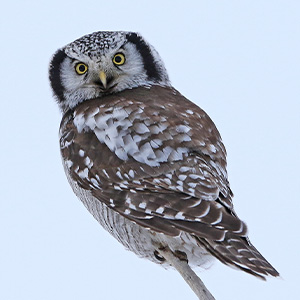
Adults have dark brown upperparts heavily spotted with white, and white underparts with dense, narrow dark brown barring. The back of the head has two prominent black patches resembling eyes (occipital spots). The facial disc is white with a black border and fine concentric barring, and a distinct black 'moustache' stripe on each side of the bill. The tail is long and barred.
- 2
Beak shape
Shape and color of the bill: a key field mark.
Small, strongly hooked, yellowish-horn colored bill.
- 3
Eye color
Iris color and any distinctive eye markings.
Bright yellow eyes.
- 4
Leg color
Leg and foot color.
Feathered legs and feet, typically grayish-brown.
- 5
Distinguishing features
Standout features that separate this species.
Hawk-like silhouette with a long tail, small head, and diurnal activity. The prominent black 'moustache' stripes and occipital spots are key identifiers.
- 6
Juvenile appearance
How young birds differ from adults.
Juveniles resemble adults but have a more uniformly dusky-brown crown and nape, less distinct facial markings, and often a buffier wash on the underparts. The barring on the underparts may be less defined.
- 7
Seasonal changes
Plumage variation between breeding and non-breeding seasons.
No significant seasonal plumage changes.
- 8
Sexual dimorphism
How males and females differ.
Females are typically slightly larger and heavier than males, but plumage is identical.
Key field marks
- Silhouette and Flight. Look for a medium-sized raptor with a relatively small head and a long, graduated tail. Its flight is direct and powerful, often with rapid wing beats, resembling a hawk more than a typical owl.
- Diurnal Activity. Unlike most owls, the Northern Hawk-Owl is primarily active during the day, especially in the morning and late afternoon. This makes it easier to spot perched openly.
- Facial Markings. Observe the distinct white facial disc bordered by black, and especially the prominent black 'moustache' stripes extending from the bill. Bright yellow eyes are also characteristic.
- Occipital Spots. Check the back of the head for two black patches that resemble eyes. These 'false eyes' are thought to deter predators.
- Plumage Pattern. Note the dark brown upperparts with white spotting and the heavily barred white underparts. The long, barred tail is also a key feature.
- Perching Behavior. Often perches conspicuously on the very top of a tall snag, pole, or tree, scanning its surroundings for prey.
Explore the Northern Hawk-Owl
Identify birds anywhere
Free on iOS, Android, and Web. Photo & sound identification, full species database, and your personal life list.