
Spotted a bird? Identify it instantly with the Birdby app
Open the appAbout
The Blackcap is a medium-sized, rather plain warbler, best known for the distinctive cap of the male, which is glossy black, and the rufous-brown cap of the female. It is a widespread and common species across much of Europe and parts of Asia and Africa, renowned for its beautiful, fluty song.
Size & lifespan
- Length
- 13-15 cm
- Wingspan
- 20-23 cm
- Weight
- 14-20 g
- Lifespan
- Up to 10 years in the wild, typically 2-5 years
- Diet
- Omnivore (primarily insects and berries)
Physical characteristics
- Plumage
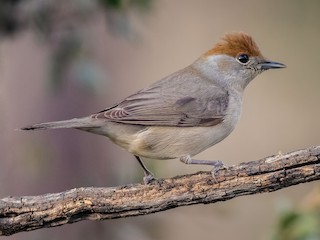
- Males have a greyish body with a distinctive glossy black cap. Females have a brownish-grey body with a rufous-brown cap. Both sexes have pale grey underparts, slightly darker on the flanks, and a pale throat. The back is olive-grey. The wings and tail are dark grey-brown.
- Beak shape
- Slender, pointed, and dark grey to blackish.
- Eye color
- Dark brown.
- Leg color
- Dark grey to blackish.
- Distinguishing features
- The most distinguishing feature is the cap color: black for males, rufous-brown for females. Otherwise, it's a rather plain, greyish warbler.
- Juvenile appearance
- Juveniles resemble females, with a rufous-brown cap, but their plumage is generally duller and browner overall. The cap may be less distinct initially.
- Seasonal changes
- No significant seasonal plumage changes; the breeding and non-breeding plumages are essentially the same.
- Sexual dimorphism
- Pronounced, with males having a black cap and females a rufous-brown cap. Body plumage is also slightly browner in females.
How to identify
- 1
Cap Color
The most reliable field mark: glossy black cap for males, rufous-brown cap for females and juveniles. No other common European warbler has such a distinct cap.
- 2
Plumage
Overall greyish body (males) or brownish-grey (females), with pale underparts. Look for the absence of strong streaking or wing bars.
- 3
Song
Learn its distinctive, rich, fluty song with clear, pure ending notes. This is often the first way to detect a Blackcap, especially when it's hidden in foliage.
- 4
Behavior
Active foraging in dense foliage, often flicking its tail. Can be quite shy but will often sing from exposed perches.
Habitat & range
- Biomes
- Temperate forests, woodlands, scrublands, parks, gardens, hedgerows.
- Geographic range
- Breeds across most of Europe, western Asia, and northwestern Africa. Winters in southern Europe, North Africa, and sub-Saharan Africa.
- Elevation range
- Sea level up to 2,000 meters, occasionally higher in mountainous regions.
- Preferred environments
- Prefers deciduous and mixed woodlands with dense undergrowth, mature gardens, orchards, and parks. Requires good shrub cover for nesting and foraging.
Behavior
- Activity time
- Diurnal.
- Feeding habits
- Primarily insectivorous during the breeding season, feeding on caterpillars, aphids, beetles, and other invertebrates. During autumn and winter, their diet shifts to a high proportion of fruits and berries (e.g., elderberries, blackberries, ivy berries). They forage actively in foliage, gleaning insects from leaves and twigs.
- Social behavior
- Generally solitary or found in pairs during the breeding season. Can form small, loose flocks during migration and in winter, especially around abundant food sources.
- Flight pattern
- Undulating, rather weak, and often short flights between bushes or trees. When migrating, flight is more direct and sustained.
- Migration pattern
- Most populations are migratory, moving south for the winter. Western European populations, particularly in the UK and Ireland, have shown an increasing trend towards partial residency or shorter migrations, with some individuals overwintering. Eastern populations undertake longer migrations to Africa. They are nocturnal migrants.
- Territoriality
- Males are highly territorial during the breeding season, defending their nesting area with song and displays.
Song & calls
- Song
- A rich, clear, and fluty song, often starting with a scratchy warble before developing into a series of pure, melodious notes. It has a distinctive, almost operatic quality, often described as 'liquid' or 'bell-like'. It can be confused with the Garden Warbler, but the Blackcap's song is typically more varied and ends with a flourish of clear notes.
- Call
- Common calls include a sharp, hard 'tack' or 'check', often repeated rapidly when alarmed. Also a soft 'churr' or 'chick-chick'.
- When they vocalize
- Males sing frequently from prominent perches during the breeding season (April to July). Calls are given year-round, especially when foraging or alarmed.
Breeding & reproduction
- Breeding season
- April to July, typically two broods per year.
- Nesting habits
- Nests are typically built low down in dense bushes, brambles, or small trees, usually less than 2 meters from the ground. The nest is a neat, cup-shaped structure made of grass, leaves, rootlets, and moss, lined with finer materials like hair and plant down.
- Clutch size
- 3-6 eggs (usually 4-5).
- Egg description
- 3-6 eggs, typically 4-5. Eggs are whitish or pale buff, speckled and blotched with shades of brown, grey, or purple, often concentrated at the broad end. Size: approximately 19 x 14 mm.
- Incubation period
- 10-12 days, shared by both parents.
- Fledging period
- 10-14 days after hatching.
- Parental care
- Both parents share incubation duties and feed the nestlings. After fledging, young are fed by parents for a short period before becoming independent.
Where to find
Deciduous Woodlands
Look in the understory and shrub layer of mature deciduous and mixed forests.
Gardens and Parks
Often found in well-vegetated gardens, orchards, and urban parks, especially those with dense shrubs and fruit-bearing plants.
Hedgerows and Scrub
Dense hedgerows and areas of scrub provide ideal nesting and foraging habitat.
Field tips
- Listen for the song. The Blackcap's song is very distinctive and often given from hidden perches. Learning its song is key to finding it.
- Look in dense cover. Blackcaps prefer dense vegetation. Scan the lower to mid-levels of bushes and trees, especially where there are berries or insects.
- Be patient and quiet. They can be shy. Remain still and listen, and they may reveal themselves as they move through the foliage.
- Check berry bushes in autumn/winter. During the non-breeding season, they are often attracted to bushes laden with berries, making them easier to spot.
Similar species
Garden Warbler
Sylvia borin
The Garden Warbler lacks any cap coloration, appearing uniformly brownish-grey above and paler below. Its song is also rich and melodious but typically lacks the clear, fluty ending notes of the Blackcap and is often described as more rambling or continuous.
Whitethroat
Sylvia communis
The Whitethroat has a grey head (not a distinct cap), a white throat, and rufous patches on its wings. Its song is a short, scratchy, and often hurried warble, very different from the Blackcap's fluty song.
Quick facts
- Cap Color (Male):
- Glossy Black
- Cap Color (Female):
- Rufous-brown
- Song:
- Rich, fluty, melodious
- Diet Shift:
- Insects in summer, berries in winter
- Migration:
- Partial to full migrant, increasing overwintering in Western Europe
Fun facts
- Some Blackcaps in Central Europe have altered their migration routes, now flying northwest to winter in the UK instead of southwest to the Mediterranean, likely due to climate change and garden bird feeding.
- The Blackcap's song is often considered one of the most beautiful among European warblers, sometimes earning it the nickname 'Northern Nightingale'.
- They are known to be quite acrobatic when foraging for insects and berries, often hanging upside down to reach food.
- In some areas, Blackcaps are among the earliest spring migrants to arrive and one of the last to depart in autumn.
Scientific classification
- Kingdom
- Animalia
- Phylum
- Chordata
- Class
- Aves
- Order
- Passeriformes
- Family
- Sylviidae
- Genus
- Sylvia
- Species
- Sylvia atricapilla
Explore the Blackcap
Identify birds anywhere
Free on iOS, Android, and Web. Photo & sound identification, full species database, and your personal life list.