
Spotted a bird? Identify it instantly with the Birdby app
Open the appAbout
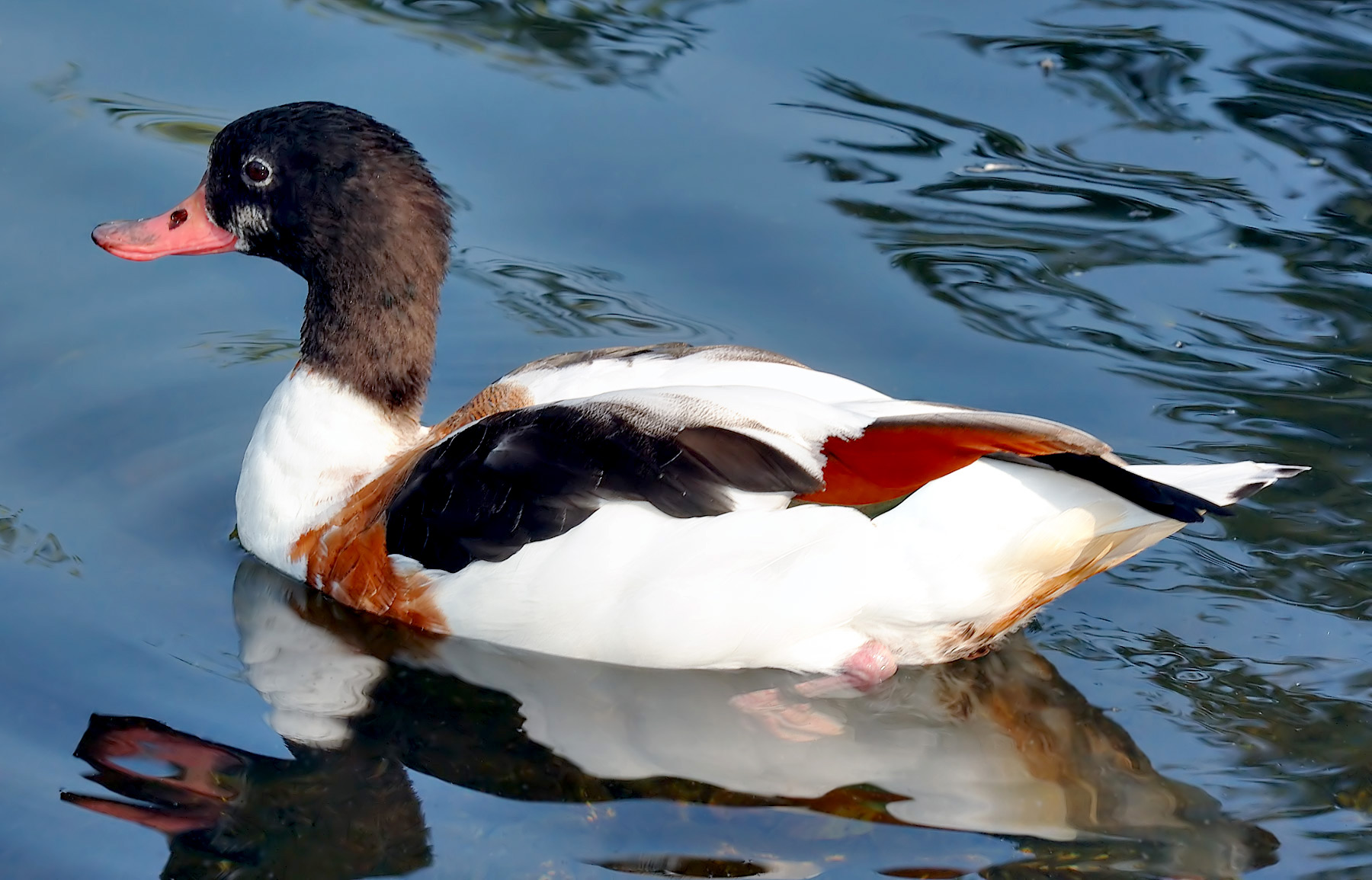
The Common Shelduck is a large, goose-like duck with striking, distinctive plumage. It is known for its bright red bill, dark green head, and prominent chestnut band across its white breast. Unlike most ducks, it often nests in burrows, including rabbit holes, and is frequently seen in coastal and estuarine habitats.
Size & lifespan
- Length
- 58-71 cm (23-28 in)
- Wingspan
- 110-133 cm (43-52 in)
- Weight
- 800-1600 g (1.8-3.5 lbs)
- Lifespan
- Up to 15 years in the wild
- Diet
- Omnivore (primarily invertebrates, some plant matter)
Physical characteristics
- Plumage
- Adults have a dark, iridescent green head and upper neck, a broad white collar, and a prominent chestnut-brown band across the breast and upper back. The rest of the body is largely white, with black primary and secondary flight feathers (visible as a black trailing edge in flight) and a black stripe along the belly. The scapulars are black, and there is a green speculum. The undertail coverts are chestnut.
- Beak shape
- Conical, bright red, with a prominent knob at the base of the upper mandible, especially pronounced in breeding males.
- Eye color
- Dark brown
- Leg color
- Pinkish-red
- Distinguishing features
- The unique combination of dark green head, white body, chestnut breast band, and bright red bill with a knob makes it unmistakable. In flight, the black primaries and secondaries contrasting with white wing coverts are distinctive.
- Juvenile appearance
- Juveniles are duller overall, lacking the iridescent green head and chestnut breast band. Their head and neck are dusky brown, and the body is mottled grey-brown and white. The bill is dull pinkish-grey, lacking the knob. They gradually acquire adult plumage over their first year.
- Seasonal changes
- Plumage remains largely consistent year-round. The most notable seasonal change is the size and color intensity of the male's bill knob, which is most prominent and brightest during the breeding season. After breeding, adults undergo a complete moult, becoming flightless for several weeks, often congregating in large numbers at specific moulting sites (e.g., Wadden Sea).
- Sexual dimorphism
- Males are slightly larger than females and have a more prominent, brighter red knob on the bill during the breeding season. Females have a slightly duller bill knob and may show some white feathering around the base of the bill, particularly outside the breeding season.
How to identify
- 1
Plumage Pattern
Look for the striking combination of a dark, iridescent green head, white body, broad chestnut breast band, and black flight feathers. This pattern is unique among ducks.
- 2
Bill Color and Knob
The bright red bill with a prominent knob at the base (especially on breeding males) is a key identifier. Juveniles have a duller, knob-less bill.
- 3
Habitat
Often found in coastal and estuarine environments, particularly on mudflats and sandy shores. If you see a large, goose-like duck in such a habitat, it's likely a Shelduck.
- 4
Flight Profile
In flight, the strong, direct flight and the contrasting black and white wing pattern (black primaries/secondaries against white coverts) are very distinctive.
- 5
Behavior
Observe its feeding behavior – dabbling and head-dipping in shallow water, often sifting through mud. Its upright posture when walking on land is also characteristic.
Habitat & range
- Biomes
- Coastal areas, estuaries, saltmarshes, mudflats, sandy shores, brackish lagoons, and occasionally inland freshwater lakes and rivers.
- Geographic range
- Widespread across temperate Eurasia. Breeding range extends from Western Europe (including the UK and Ireland) eastward through Central Asia to China and Japan. Winters mainly in Western Europe, the Mediterranean, Black Sea, Caspian Sea, and parts of East Asia.
- Elevation range
- Primarily found at sea level, occasionally up to a few hundred meters inland along large rivers or lakes.
- Preferred environments
- Prefers sheltered coastal waters with extensive mudflats for feeding, and nearby sandy banks or dunes for nesting. Also utilizes saltmarsh creeks and brackish pools.
Behavior
- Activity time
- Diurnal, with feeding activity often concentrated around low tide.
- Feeding habits
- Feeds by dabbling, head-dipping, and sometimes up-ending in shallow water, primarily on small invertebrates. Its diet consists mainly of small snails (Hydrobia ulvae), bivalves, crustaceans, and marine worms. It also consumes some algae and seeds. It often uses its bill to sift through mud and sand.
- Social behavior
- Highly social, especially outside the breeding season, forming large flocks on estuaries and coastal mudflats. During breeding, pairs become territorial, but often nest in loose colonies. Post-breeding, adults gather in large numbers at specific moulting sites.
- Flight pattern
- Strong, direct flight with relatively slow, powerful wingbeats. Often flies in V-formations or lines, especially during migration. The black and white wing pattern is very conspicuous in flight.
- Migration pattern
- Partially migratory. Western European populations are largely resident or undertake short-distance movements. Eastern populations are more migratory, moving south and west for winter. Many birds from northern breeding grounds migrate to the Wadden Sea for their annual moult.
- Territoriality
- Breeding pairs are territorial around their nest site and immediate feeding areas, often defending these vigorously against other shelducks. Outside the breeding season, they are gregarious.
Song & calls
- Song
- Males have a distinctive, far-carrying, whistling 'hoo-hoo-hoo' or 'tsoo-tsoo-tsoo' call, often given in display flights or when agitated. Females have a harsher, more guttural 'gak-gak-gak' or 'rattle' call, sometimes described as a 'quack-quack-quack' but more resonant than a typical duck's.
- Call
- Both sexes produce alarm calls, which are typically a series of rapid, harsh notes. Females often give a rapid, chattering 'rattle' when disturbed or in flight. Males' calls are generally softer and more whistling.
- When they vocalize
- Most vocal during the breeding season and when displaying or defending territory. Also vocal in flight and when disturbed.
Breeding & reproduction
- Breeding season
- Typically April to July, with peak egg-laying in April-May.
- Nesting habits
- Unusual for a duck, they primarily nest in burrows, often utilizing disused rabbit burrows, fox earths, or badger setts. They may also nest in hollow trees, haystacks, or dense vegetation. The nest is a scrape lined with down and vegetation, usually located at the end of a tunnel.
- Clutch size
- Typically 8-10 eggs, but can range from 5 to 16. Larger clutches may result from 'dump nesting' by multiple females.
- Egg description
- 8-10 (sometimes up to 16) smooth, glossy, creamy-white eggs, measuring approximately 68 x 49 mm.
- Incubation period
- 29-31 days, primarily by the female.
- Fledging period
- 45-50 days. Ducklings are precocial and leave the nest shortly after hatching. They are cared for by both parents, and sometimes by 'crèches' where multiple broods are tended by a few adults.
- Parental care
- Both parents care for the ducklings, leading them to feeding areas. They are known for forming 'crèches' where several broods are aggregated and guarded by a few adults, while other adults may leave to moult.
Where to find
Estuaries and Mudflats
These are prime feeding grounds, especially at low tide, where they forage for invertebrates. Look for them along the edges of the water or spread out across exposed mud.
Saltmarshes and Coastal Lagoons
Used for feeding, roosting, and sometimes nesting, particularly in areas with creeks and pools.
Sandy Shores and Dunes
Important for nesting, as they often utilize burrows in these areas. You might see pairs or families near these habitats during the breeding season.
Inland Wetlands (less common)
Occasionally found on large freshwater lakes or slow-moving rivers, especially during migration or in areas where coastal habitats are limited.
Field tips
- Tide Watching. Common Shelducks are often most active and visible on mudflats during low tide when their food sources are exposed. Plan your visit to coincide with falling or low tide.
- Look for Families. During late spring and summer, look for adults with broods of ducklings, sometimes forming large 'crèches' with multiple families together.
- Scan Large Flocks. Outside the breeding season, they often gather in large, conspicuous flocks. Use binoculars or a scope to scan these groups for individuals.
- Listen for Calls. Learn their distinctive whistling (male) and harsh rattling (female) calls, which can help locate them, especially when they are hidden by vegetation or at a distance.
Similar species
Ruddy Shelduck
Tadorna ferruginea
The Ruddy Shelduck is largely orange-brown with a paler head and a black bill. It lacks the Common Shelduck's distinctive dark green head, white collar, and chestnut breast band. Ruddy Shelducks are more often found on freshwater and are less coastal.
Cape Shelduck
Tadorna cana
Found in southern Africa. Males have a grey head and neck, while females have a white face and black crown/nape. Both sexes lack the Common Shelduck's dark green head and chestnut breast band.
Quick facts
- Distinctive Feature:
- Bright red bill with knob, dark green head, chestnut breast band.
- Nesting Habit:
- Primarily nests in burrows (e.g., rabbit holes).
- Diet Focus:
- Small marine invertebrates, especially snails.
- Social Behavior:
- Highly gregarious outside breeding season, forms large moulting flocks.
- Conservation Status:
- Least Concern (stable population).
Fun facts
- The Common Shelduck is sometimes referred to as a 'sheld-duck' or 'sheldrake' (for the male), reflecting its intermediate appearance between a duck and a goose.
- They are one of the few duck species that regularly nest in burrows, a behavior more typical of some seabirds or mammals.
- Large numbers of Common Shelducks, particularly from northern Europe, gather annually in the Wadden Sea (a UNESCO World Heritage site) to undergo their flightless moult, making it a critical site for the species.
- The 'crèche' system, where multiple broods are cared for by a few adults, is a fascinating social adaptation that likely helps protect young from predators.
Scientific classification
- Kingdom
- Animalia
- Phylum
- Chordata
- Class
- Aves
- Order
- Anseriformes
- Family
- Anatidae
- Genus
- Tadorna
- Species
- Tadorna tadorna
Explore the Common Shelduck
Identify birds anywhere
Free on iOS, Android, and Web. Photo & sound identification, full species database, and your personal life list.