
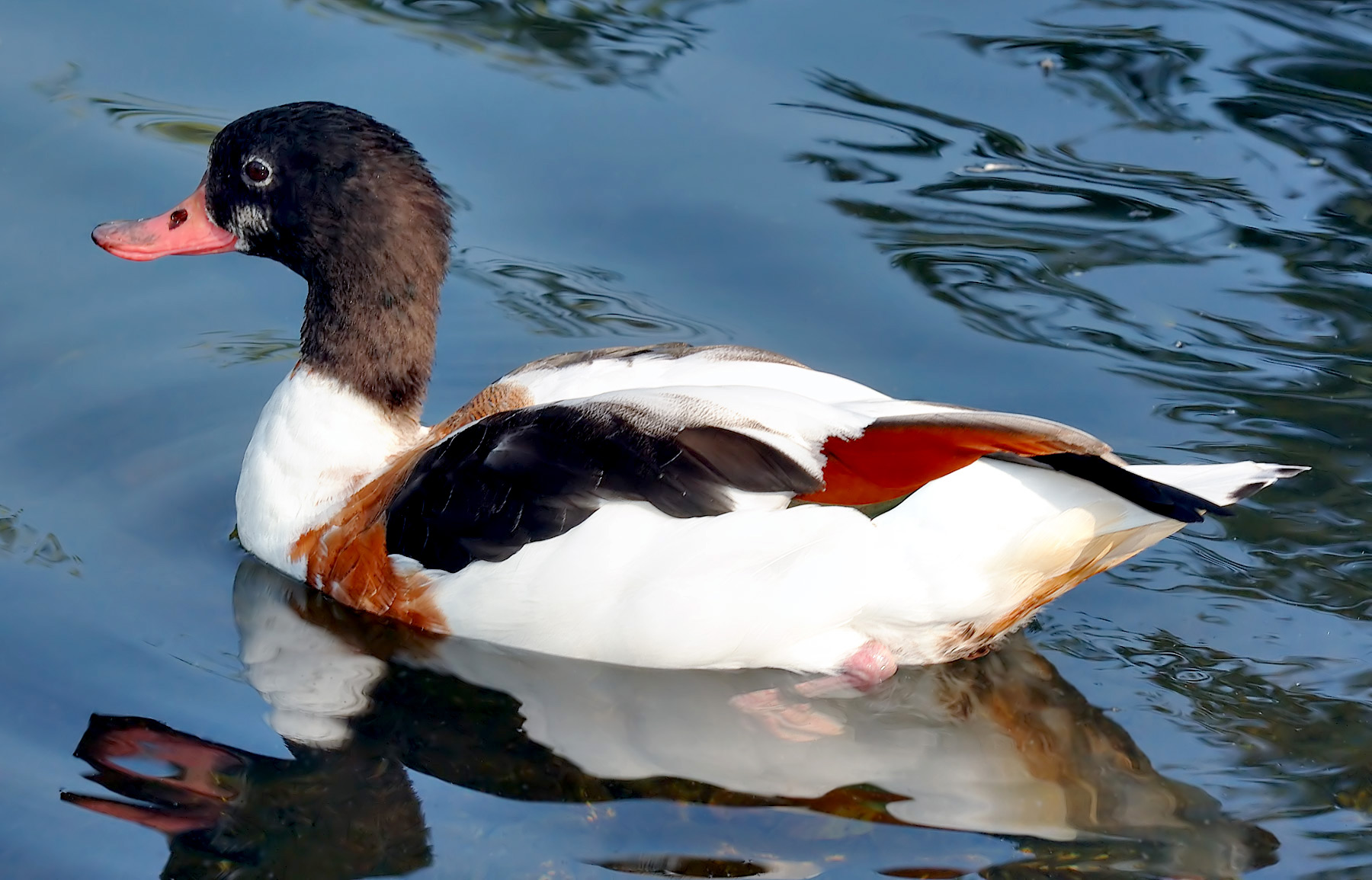
How to identify the Common Shelduck
Tadorna tadorna
Spotted a bird? Identify it instantly with the Birdby app
Open the appTo correctly identify the Common Shelduck (Tadorna tadorna), check each of these features. Birds can be tricky: habit, habitat, and call often confirm a sighting that a single photo cannot.
Size at a glance
- Length
- 58-71 cm (23-28 in)
- Wingspan
- 110-133 cm (43-52 in)
- Weight
- 800-1600 g (1.8-3.5 lbs)
Physical features to check
- 1
Plumage
Overall feather coloration and pattern.
Adults have a dark, iridescent green head and upper neck, a broad white collar, and a prominent chestnut-brown band across the breast and upper back. The rest of the body is largely white, with black primary and secondary flight feathers (visible as a black trailing edge in flight) and a black stripe along the belly. The scapulars are black, and there is a green speculum. The undertail coverts are chestnut.
- 2
Beak shape
Shape and color of the bill: a key field mark.
Conical, bright red, with a prominent knob at the base of the upper mandible, especially pronounced in breeding males.
- 3
Eye color
Iris color and any distinctive eye markings.
Dark brown
- 4
Leg color
Leg and foot color.
Pinkish-red
- 5
Distinguishing features
Standout features that separate this species.
The unique combination of dark green head, white body, chestnut breast band, and bright red bill with a knob makes it unmistakable. In flight, the black primaries and secondaries contrasting with white wing coverts are distinctive.
- 6
Juvenile appearance
How young birds differ from adults.
Juveniles are duller overall, lacking the iridescent green head and chestnut breast band. Their head and neck are dusky brown, and the body is mottled grey-brown and white. The bill is dull pinkish-grey, lacking the knob. They gradually acquire adult plumage over their first year.
- 7
Seasonal changes
Plumage variation between breeding and non-breeding seasons.
Plumage remains largely consistent year-round. The most notable seasonal change is the size and color intensity of the male's bill knob, which is most prominent and brightest during the breeding season. After breeding, adults undergo a complete moult, becoming flightless for several weeks, often congregating in large numbers at specific moulting sites (e.g., Wadden Sea).
- 8
Sexual dimorphism
How males and females differ.
Males are slightly larger than females and have a more prominent, brighter red knob on the bill during the breeding season. Females have a slightly duller bill knob and may show some white feathering around the base of the bill, particularly outside the breeding season.
Key field marks
- Plumage Pattern. Look for the striking combination of a dark, iridescent green head, white body, broad chestnut breast band, and black flight feathers. This pattern is unique among ducks.
- Bill Color and Knob. The bright red bill with a prominent knob at the base (especially on breeding males) is a key identifier. Juveniles have a duller, knob-less bill.
- Habitat. Often found in coastal and estuarine environments, particularly on mudflats and sandy shores. If you see a large, goose-like duck in such a habitat, it's likely a Shelduck.
- Flight Profile. In flight, the strong, direct flight and the contrasting black and white wing pattern (black primaries/secondaries against white coverts) are very distinctive.
- Behavior. Observe its feeding behavior – dabbling and head-dipping in shallow water, often sifting through mud. Its upright posture when walking on land is also characteristic.
Explore the Common Shelduck
Identify birds anywhere
Free on iOS, Android, and Web. Photo & sound identification, full species database, and your personal life list.