
Spotted a bird? Identify it instantly with the Birdby app
Open the appAbout
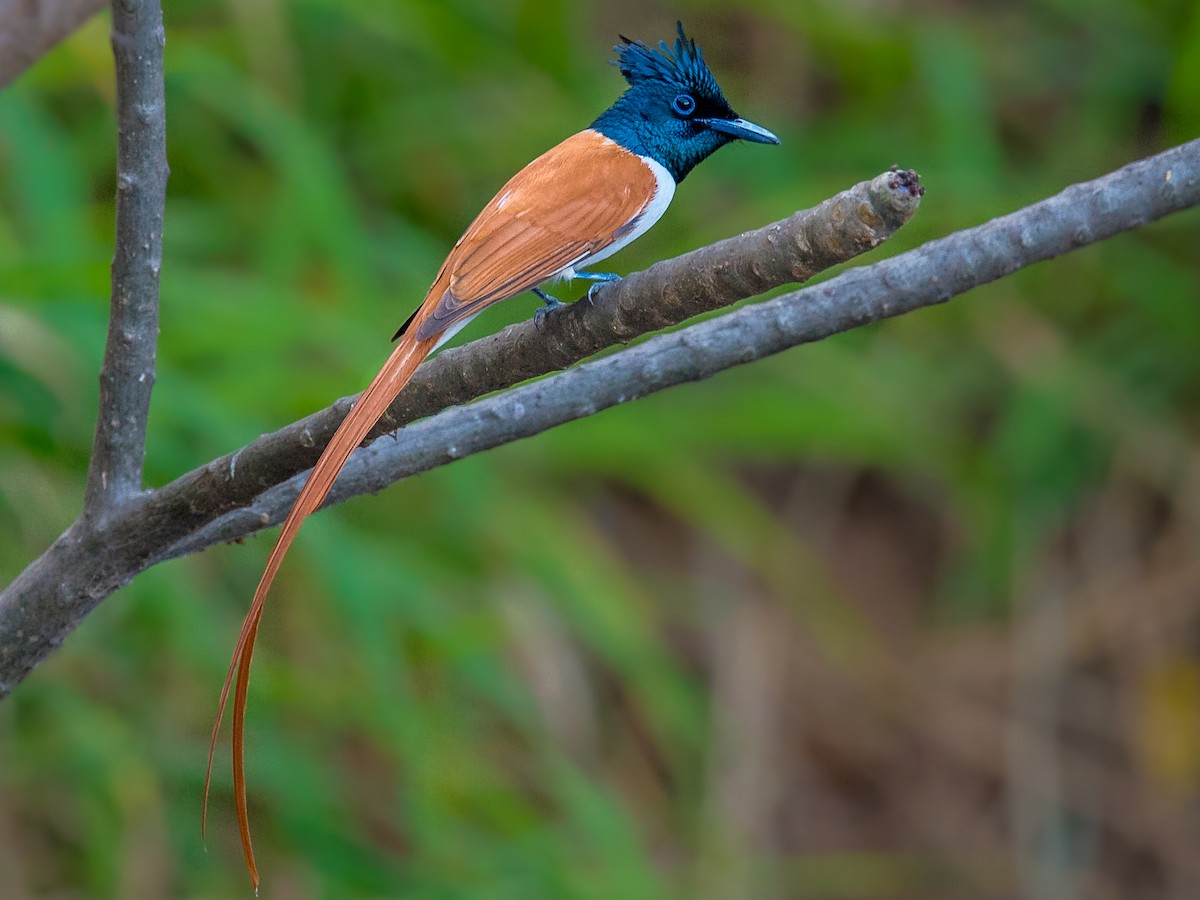
The Indian Paradise Flycatcher is a medium-sized passerine bird renowned for the exceptionally long tail streamers of the adult male. It is an arboreal insectivore, known for its agile flight and striking plumage. This species exhibits significant sexual dimorphism, with males often displaying two distinct morphs, a white and a rufous form, with exceptionally long tail feathers dramatically increasing their overall length. It is a migratory bird across much of its range, undertaking seasonal movements related to breeding and non-breeding grounds.
Size & lifespan
- Length
- Up to 20 cm (8 in) for body, males with tail streamers up to 50 cm (20 in); females up to 21 cm (8.3 in)
- Wingspan
- 25-30 cm (10-12 in)
- Weight
- 19-23 g (0.67-0.81 oz)
- Lifespan
- Typically 5-7 years in the wild, though can live longer
- Diet
- Exclusively insectivorous, primarily feeding on flying insects
Physical characteristics
- Plumage
- Adult males occur in two distinct morphs: a rufous morph and a white morph. In the rufous morph, the head and crest are glossy black with a bluish sheen, the underparts are greyish-white, and the upperparts, wings, and tail (excluding the two central streamers) are rich chestnut or rufous. The two central tail streamers (rectrices) are exceedingly long, reaching up to 30 cm, and are also chestnut. In the white morph, the head and crest are glossy black, and the entire body, wings, and tail (including streamers) are pure white, with black primary flight feathers. Females are similar to the rufous male but lack the long tail streamers, having a proportionally shorter tail. Their head and crest are glossy black, throat and breast greyish, and upperparts and tail (short) are rufous. The underparts become whitish towards the vent.
- Beak shape
- Conical, broad at the base, and slightly hooked at the tip; purplish-blue with a black tip.
- Eye color
- Dark brown, with a prominent blue orbital ring (eye-ring).
- Leg color
- Bluish-grey to blackish.
- Distinguishing features
- Adult males' extremely long tail streamers, unique among flycatchers, are the most distinguishing feature. The glossy black head with a crest and prominent blue eye-ring are also key. The rufous and white morphs are distinct. Females lack the long streamers but share the same head coloration and blue eye-ring.
- Juvenile appearance
- Juveniles resemble adult females but have duller plumage. The head is brownish-black (lacking the strong glossy sheen), and the upperparts are a duller rufous. They also lack the elongated tail streamers, and the eye-ring may be less pronounced or absent.
- Seasonal changes
- No significant seasonal changes in plumage coloration; however, males usually grow their full, ornate tail streamers for the breeding season, which may be shed or damaged during the non-breeding period or molted annually.
- Sexual dimorphism
- Highly sexually dimorphic. Adult males possess exceedingly long tail streamers, which are absent in females. Males display two color morphs (rufous and white), while females are consistently rufous.
How to identify
- 1
Long Tail Streamers (Males)
The most definitive feature for adult males, the two central tail feathers can extend to five times the body length. This is unique among flycatchers in its range.
- 2
Color Morphs (Males)
Observe whether the male is entirely white (except for the black head and primaries) or rufous (with a black head). Both morphs are distinctive.
- 3
Crested Glossy Black Head
Both sexes possess a glossy black head with a distinct crest, giving it a somewhat regal appearance. This contrasts with the body plumage.
- 4
Blue Eye-ring
A prominent pale blue eye-ring is characteristic of adults, offering a subtle but consistent field mark.
- 5
Flight Pattern
Watch for its acrobatic, undulating flight while sallying for insects, often returning to the same perch. The long tail streamers of the male are very noticeable in flight.
- 6
Vocalizations
Learn its distinctive, sweet, whistling song and sharp, scolding calls. These are often heard before the bird is seen.
Habitat & range
- Biomes
- Tropical and subtropical moist lowland forests, mangroves, moist montane forests, deciduous forests, open woodlands, scrublands, plantations, gardens, and urban parks.
- Geographic range
- Widespread across Asia, from Turkmenistan and Afghanistan eastward through the Indian subcontinent, Sri Lanka, Southeast Asia, to Manchuria, Korea, and parts of Indonesia.
- Elevation range
- Sea level up to 1,500 meters (5,000 feet), occasionally higher in certain regions, largely depending on specific subspecies and local conditions.
- Preferred environments
- Prefers well-wooded areas with dense undergrowth, especially near water bodies. Often found along forest edges, in riparian forests, and in areas with mature trees providing ample perching and foraging opportunities.
Behavior
- Activity time
- Diurnal, most active during the cooler parts of the day, particularly morning and late afternoon. Less active during the hottest midday hours.
- Feeding habits
- Aerial hawkers, catching insects in flight. They perch on an exposed branch, observe passing insects, and sally forth to snatch them in mid-air before returning to the same or a nearby perch. They also glean insects from foliage occasionally.
- Social behavior
- Generally solitary or found in pairs, especially during the breeding season. Outside of breeding, they can occasionally join mixed-species foraging flocks, particularly during migration.
- Flight pattern
- Flight is strong and undulating, especially when sallying for insects. The long tail streamers of the male create a distinctive flowing appearance in flight, making them very conspicuous.
- Migration pattern
- Many populations are migratory. Northern populations (e.g., from Central Asia, northern India, China) migrate south to the Indian subcontinent and Southeast Asia for the winter. Resident populations exist in parts of southern India, Sri Lanka, and some Southeast Asian islands. Migration occurs during spring and autumn.
- Territoriality
- Territorial during the breeding season, with males defending their nesting area through vocalizations and displays, including aerial chases. Non-breeding territoriality is less pronounced.
Song & calls
- Song
- The song is a series of sweet, musical, whistling notes and churring sounds, often described as 'whee-whee-whit' or 'wee-tee-tee-chee'. It can be quite varied and melodious. The song is typically delivered from a prominent perch.
- Call
- Common calls include harsh, scolding 'skreek' or 'chew-tchew' notes, and sharp 'tchick' or 'chik' calls, particularly when agitated or mobbing a predator. A 'cree-crank' or 'zweet' note is also common.
- When they vocalize
- Most vocal during the breeding season, from pre-dawn to mid-morning, and again in the late afternoon. Calls can be heard throughout the day, especially if disturbed.
Breeding & reproduction
- Breeding season
- Varies geographically: typically April to June in northern India, March to May in southern India, and April to August in Southeast Asia.
- Nesting habits
- Builds a neat, cup-shaped nest in the fork of a small tree or bush, typically 1.5-3 meters (5-10 feet) above the ground. The nest is constructed from fine twigs, rootlets, leaves, and spider silk, often decorated with lichen fragments on the exterior for camouflage.
- Clutch size
- Typically 3-4 eggs, sometimes 2 or 5.
- Egg description
- Eggs are typically creamy white to pinkish-white, often covered with fine reddish-brown or purple spots and blotches, denser towards the broad end. Usually oval-shaped.
- Incubation period
- Approximately 14-16 days. Both parents participate in incubation.
- Fledging period
- Chicks fledge around 12-14 days after hatching.
- Parental care
- Both male and female share parental duties, including nest building, incubation, feeding the young, and defense of the nest. Males often perform spectacular display flights near the nest.
Where to find
Forest Edges
Look along the edges of deciduous and evergreen forests, where there is a mix of dense trees and open areas for foraging.
Riparian Zones
Often found near rivers, streams, and other water bodies, where insect activity is high.
Gardens and Parks
During migration or in areas with sufficient tree cover, they can be found in well-wooded gardens, orchards, and urban parks.
Plantations
Rubber, coffee, and other plantations with mature trees and a diverse understory can also host these birds.
Field tips
- Listen for its call. Their distinctive, often loud calls and songs are a primary way to locate them before seeing them, especially in dense foliage.
- Look for movement in the canopy. They are active insectivores and can be seen darting out from perches to catch insects. The long tail streamers of males make them quite noticeable even from a distance.
- Scan mid-story to canopy. They typically forage in the mid-story to canopy layers of trees. Use binoculars to scan these areas attentively.
- Visit during migration seasons. During spring and autumn migration, their numbers can increase in certain areas, making them easier to spot.
- Observe near water sources. Paradise flycatchers are frequently found near water, which supports a rich insect population, their primary food source.
Similar species
Black-naped Monarch
Hypothymis azurea
The Black-naped Monarch is smaller, lacks the long tail streamers of male paradise flycatchers, and has a more distinct black nape patch and breast band instead of the full black crest. Its plumage is predominantly a vibrant azure blue, without the rufous or white body coloration of the Paradise Flycatcher.
Asian Paradise Flycatcher (other subspecies)
Terpsiphone paradisi
Different subspecies of Terpsiphone paradisi may show slight variations in size, precise plumage shades (especially rufous coloration), or the extent of black on the crown. However, the core morphological features, including the long streamers of the male and the two morphs, remain consistent. Distinguishing between subspecies requires expert knowledge and often involves geographical context.
Japanese Paradise Flycatcher
Terpsiphone atrocaudata
The Japanese Paradise Flycatcher is distinct through its darker, purplish-black head and chest, and in males, the tail streamers are often shorter and more purplish-chestnut rather than pure rufous or white. The female is also distinctly darker on the head and lacks the bright rufous upperparts of the Indian Paradise Flycatcher female.
Quick facts
- Distinctive Trait (Male):
- Extremely long, flowing tail streamers
- Color Morphs:
- Rufous and White (males only)
- Diet:
- Strictly insectivorous
- Nesting Style:
- Neat, cup-shaped nest adorned with lichen
- Migration:
- Partially migratory throughout its range
- Ecological Role:
- Important insect predator, helping to control insect populations
Fun facts
- The male's tail streamers can grow to be more than twice the length of its body, making it one of the most dramatically ornamented birds in its range.
- Despite their elaborate tails, males are agile flyers, masterfully hawking insects in mid-air.
- The two distinct color morphs (rufous and white) in males can occur within the same population, and a male can transition from rufous to white over successive molts as it ages, although this is rare and not fully understood.
- These birds often decorate the exterior of their nests with spider webs and lichen, which helps camouflage the nest from predators.
- In some cultures, seeing the Indian Paradise Flycatcher is considered a good omen due to its beautiful appearance and graceful flight.
Scientific classification
- Kingdom
- Animalia
- Phylum
- Chordata
- Class
- Aves
- Order
- Passeriformes
- Family
- Monarchidae
- Genus
- Terpsiphone
- Species
- Terpsiphone paradisi
Explore the Indian Paradise Flycatcher
Identify birds anywhere
Free on iOS, Android, and Web. Photo & sound identification, full species database, and your personal life list.