
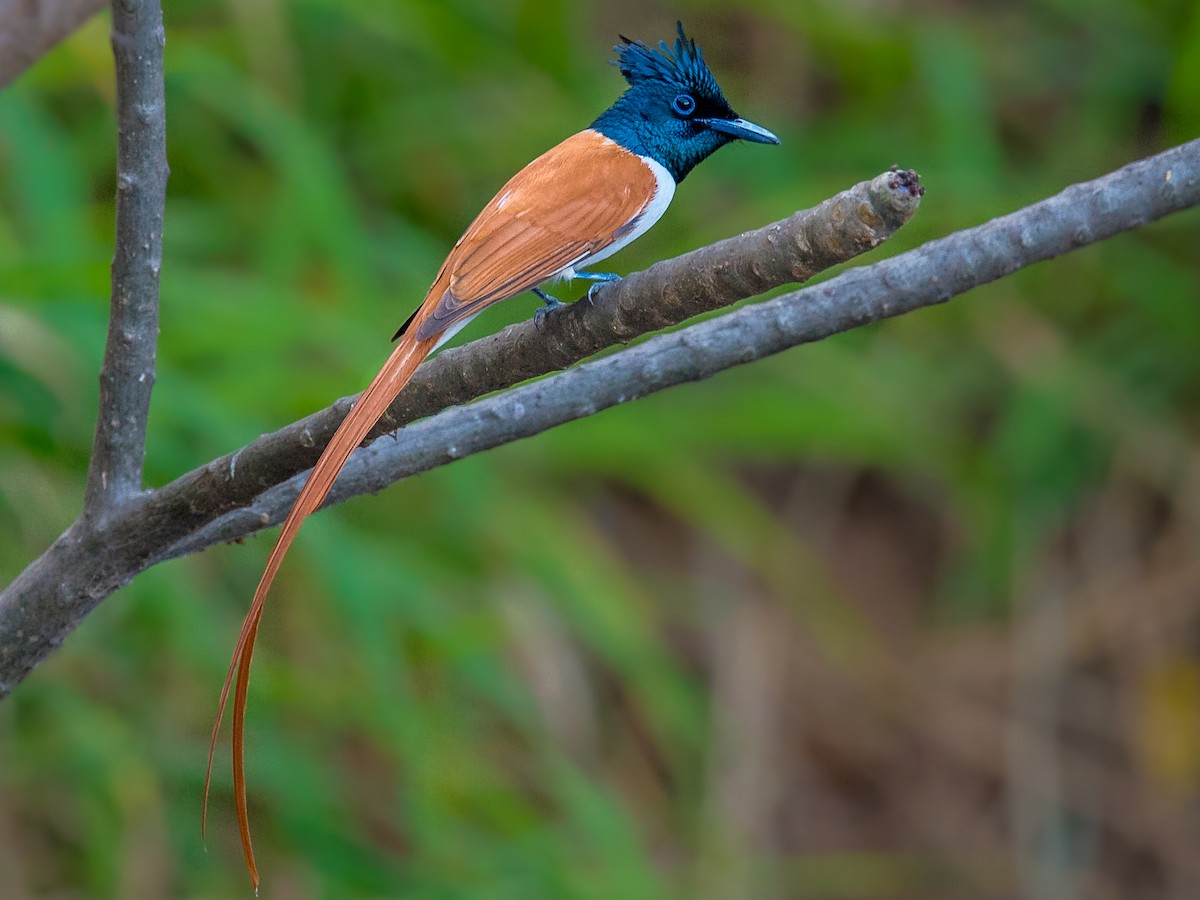
Where does the Indian Paradise Flycatcher live?
Terpsiphone paradisi
Spotted a bird? Identify it instantly with the Birdby app
Open the appThe Indian Paradise Flycatcher lives in specific habitats and regions. Knowing where, and when, to look improves your chances of a successful sighting.
Biomes
Tropical and subtropical moist lowland forests, mangroves, moist montane forests, deciduous forests, open woodlands, scrublands, plantations, gardens, and urban parks.
Geographic range
Widespread across Asia, from Turkmenistan and Afghanistan eastward through the Indian subcontinent, Sri Lanka, Southeast Asia, to Manchuria, Korea, and parts of Indonesia.
Preferred environments
Prefers well-wooded areas with dense undergrowth, especially near water bodies. Often found along forest edges, in riparian forests, and in areas with mature trees providing ample perching and foraging opportunities.
Elevation range
Sea level up to 1,500 meters (5,000 feet), occasionally higher in certain regions, largely depending on specific subspecies and local conditions.
Where to look
Forest Edges
Look along the edges of deciduous and evergreen forests, where there is a mix of dense trees and open areas for foraging.
Riparian Zones
Often found near rivers, streams, and other water bodies, where insect activity is high.
Gardens and Parks
During migration or in areas with sufficient tree cover, they can be found in well-wooded gardens, orchards, and urban parks.
Plantations
Rubber, coffee, and other plantations with mature trees and a diverse understory can also host these birds.
Field tips
- Listen for its call. Their distinctive, often loud calls and songs are a primary way to locate them before seeing them, especially in dense foliage.
- Look for movement in the canopy. They are active insectivores and can be seen darting out from perches to catch insects. The long tail streamers of males make them quite noticeable even from a distance.
- Scan mid-story to canopy. They typically forage in the mid-story to canopy layers of trees. Use binoculars to scan these areas attentively.
- Visit during migration seasons. During spring and autumn migration, their numbers can increase in certain areas, making them easier to spot.
- Observe near water sources. Paradise flycatchers are frequently found near water, which supports a rich insect population, their primary food source.
Migration
Many populations are migratory. Northern populations (e.g., from Central Asia, northern India, China) migrate south to the Indian subcontinent and Southeast Asia for the winter. Resident populations exist in parts of southern India, Sri Lanka, and some Southeast Asian islands. Migration occurs during spring and autumn.
Explore the Indian Paradise Flycatcher
Identify birds anywhere
Free on iOS, Android, and Web. Photo & sound identification, full species database, and your personal life list.