
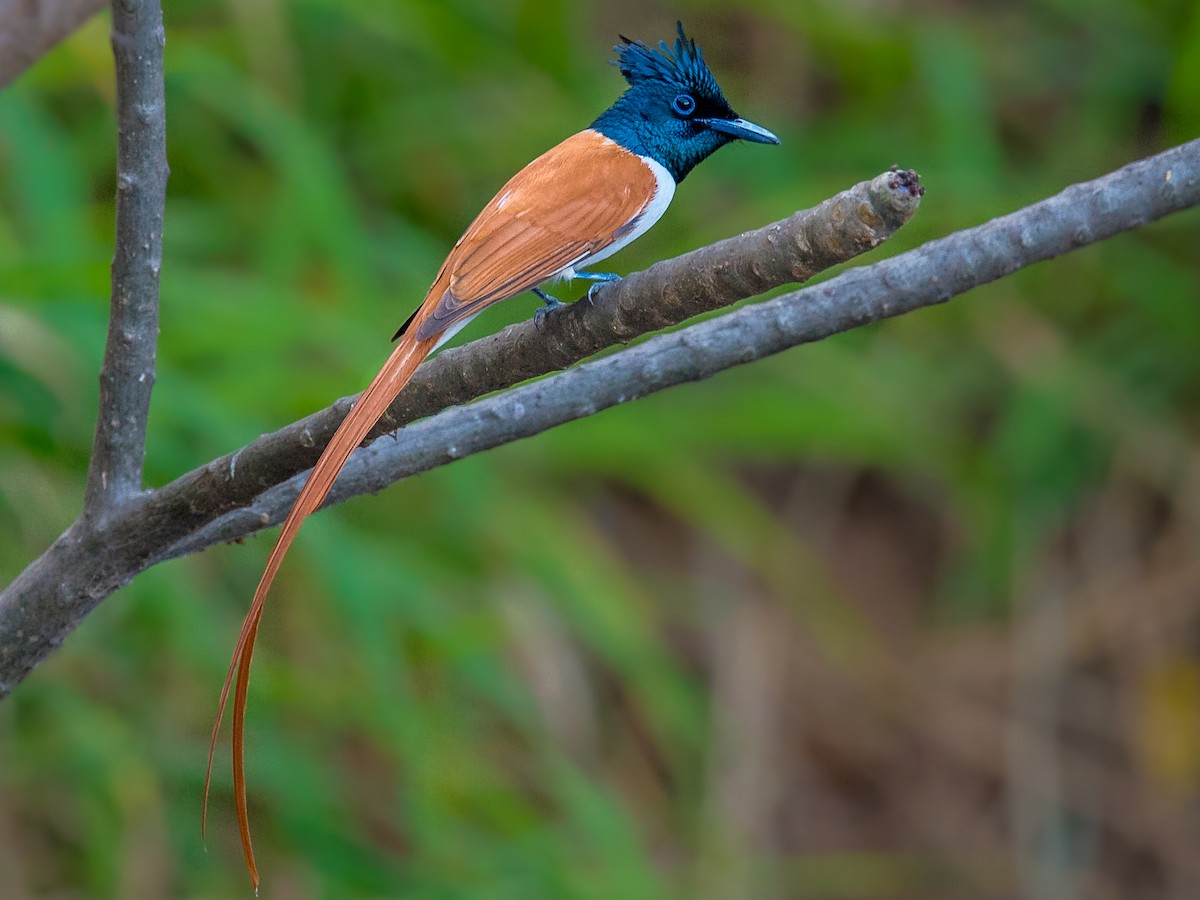
How to identify the Indian Paradise Flycatcher
Terpsiphone paradisi
Spotted a bird? Identify it instantly with the Birdby app
Open the appTo correctly identify the Indian Paradise Flycatcher (Terpsiphone paradisi), check each of these features. Birds can be tricky: habit, habitat, and call often confirm a sighting that a single photo cannot.
Size at a glance
- Length
- Up to 20 cm (8 in) for body, males with tail streamers up to 50 cm (20 in); females up to 21 cm (8.3 in)
- Wingspan
- 25-30 cm (10-12 in)
- Weight
- 19-23 g (0.67-0.81 oz)
Physical features to check
- 1
Plumage
Overall feather coloration and pattern.
Adult males occur in two distinct morphs: a rufous morph and a white morph. In the rufous morph, the head and crest are glossy black with a bluish sheen, the underparts are greyish-white, and the upperparts, wings, and tail (excluding the two central streamers) are rich chestnut or rufous. The two central tail streamers (rectrices) are exceedingly long, reaching up to 30 cm, and are also chestnut. In the white morph, the head and crest are glossy black, and the entire body, wings, and tail (including streamers) are pure white, with black primary flight feathers. Females are similar to the rufous male but lack the long tail streamers, having a proportionally shorter tail. Their head and crest are glossy black, throat and breast greyish, and upperparts and tail (short) are rufous. The underparts become whitish towards the vent.
- 2
Beak shape
Shape and color of the bill: a key field mark.
Conical, broad at the base, and slightly hooked at the tip; purplish-blue with a black tip.
- 3
Eye color
Iris color and any distinctive eye markings.
Dark brown, with a prominent blue orbital ring (eye-ring).
- 4
Leg color
Leg and foot color.
Bluish-grey to blackish.
- 5
Distinguishing features
Standout features that separate this species.
Adult males' extremely long tail streamers, unique among flycatchers, are the most distinguishing feature. The glossy black head with a crest and prominent blue eye-ring are also key. The rufous and white morphs are distinct. Females lack the long streamers but share the same head coloration and blue eye-ring.
- 6
Juvenile appearance
How young birds differ from adults.
Juveniles resemble adult females but have duller plumage. The head is brownish-black (lacking the strong glossy sheen), and the upperparts are a duller rufous. They also lack the elongated tail streamers, and the eye-ring may be less pronounced or absent.
- 7
Seasonal changes
Plumage variation between breeding and non-breeding seasons.
No significant seasonal changes in plumage coloration; however, males usually grow their full, ornate tail streamers for the breeding season, which may be shed or damaged during the non-breeding period or molted annually.
- 8
Sexual dimorphism
How males and females differ.
Highly sexually dimorphic. Adult males possess exceedingly long tail streamers, which are absent in females. Males display two color morphs (rufous and white), while females are consistently rufous.
Key field marks
- Long Tail Streamers (Males). The most definitive feature for adult males, the two central tail feathers can extend to five times the body length. This is unique among flycatchers in its range.
- Color Morphs (Males). Observe whether the male is entirely white (except for the black head and primaries) or rufous (with a black head). Both morphs are distinctive.
- Crested Glossy Black Head. Both sexes possess a glossy black head with a distinct crest, giving it a somewhat regal appearance. This contrasts with the body plumage.
- Blue Eye-ring. A prominent pale blue eye-ring is characteristic of adults, offering a subtle but consistent field mark.
- Flight Pattern. Watch for its acrobatic, undulating flight while sallying for insects, often returning to the same perch. The long tail streamers of the male are very noticeable in flight.
- Vocalizations. Learn its distinctive, sweet, whistling song and sharp, scolding calls. These are often heard before the bird is seen.
Explore the Indian Paradise Flycatcher
Identify birds anywhere
Free on iOS, Android, and Web. Photo & sound identification, full species database, and your personal life list.