
Spotted a bird? Identify it instantly with the Birdby app
Open the appAbout
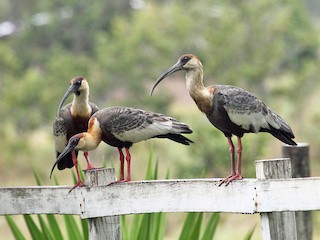
The Buff-necked Ibis, locally known as Curicaca, is a large, striking ibis species found across a wide range of open habitats in South America. It is characterized by its long, decurved bill, buff-colored neck, and iridescent dark plumage. These birds are often seen foraging in wetlands, grasslands, and agricultural fields, typically in small groups.
Size & lifespan
- Length
- 71-79 cm (28-31 in)
- Wingspan
- 120-130 cm (47-51 in)
- Weight
- 1.2-1.7 kg (2.6-3.7 lbs)
- Lifespan
- Up to 15-20 years in the wild
- Diet
- Omnivore, primarily insectivore and carnivore
Physical characteristics
- Plumage
- Adults have a distinctive buff-colored neck and head, contrasting with a dark, iridescent green-black body. The back and wings are dark, often appearing glossy green or purple in good light. A broad white band separates the buff neck from the dark breast. The underparts are dark. The flight feathers are blackish. There is a prominent crest of shaggy feathers on the nape.
- Beak shape
- Long, slender, and strongly decurved (downward-curving) bill, dark grey to blackish.
- Eye color
- Reddish-brown to dark brown.
- Leg color
- Dull reddish-orange to dark greyish-red.
- Distinguishing features
- The combination of the buff neck, dark body, and long decurved bill is unique among ibises in its range. The shaggy crest on the nape is also a good field mark.
- Juvenile appearance
- Juveniles resemble adults but have duller plumage, with less distinct buff coloration on the neck and head, and less iridescence on the body. Their crest is also less developed.
- Seasonal changes
- No significant seasonal plumage changes. Breeding plumage is essentially the same as non-breeding plumage, though colors may appear more vibrant during the breeding season due to better feather condition.
- Sexual dimorphism
- Males and females are monomorphic in plumage, though males may be slightly larger on average.
How to identify
- 1
Buff Neck and Head
Look for the prominent, warm buff coloration on the entire neck and head, which is a key distinguishing feature from other ibises.
- 2
Dark Body and White Band
Observe the dark, iridescent green-black body plumage, separated from the buff neck by a distinct broad white band across the upper breast.
- 3
Decurved Bill
Note the long, slender, and strongly downward-curving dark bill, characteristic of ibises.
- 4
Shaggy Crest
Look for the shaggy, somewhat disheveled crest of feathers on the nape, especially visible when the bird is alert.
- 5
Vocalization
Listen for its loud, raucous, and far-carrying 'curi-curi-ca' calls, which are highly distinctive and often given in flight.
- 6
Habitat
Scan open, wet areas such as flooded fields, pastures, and marsh edges, where they frequently forage.
Habitat & range
- Biomes
- Grasslands, savannas, wetlands, agricultural fields, open woodlands, marshes, and riverbanks.
- Geographic range
- South America, from northern Colombia and Venezuela south through Brazil, Bolivia, Paraguay, Uruguay, and northern Argentina. Also found in parts of Guyana, Suriname, and French Guiana.
- Elevation range
- Primarily lowlands, up to approximately 1,000 meters (3,300 feet) above sea level, occasionally higher in some Andean valleys.
- Preferred environments
- Prefers open, wet areas such as flooded fields, pastures, marshes, and the edges of ponds and rivers. They adapt well to human-modified landscapes, including rice paddies and cattle ranches.
Behavior
- Activity time
- Diurnal, actively foraging during daylight hours.
- Feeding habits
- Forages by probing its long, decurved bill into soft ground, mud, or shallow water to extract invertebrates. Diet includes insects (beetles, grasshoppers, crickets), larvae, worms, snails, small crustaceans, frogs, lizards, and occasionally small snakes or fish. They often follow cattle, feeding on insects disturbed by the livestock.
- Social behavior
- Typically found in small to medium-sized flocks, especially when foraging or roosting. They can form larger aggregations at favored feeding sites or communal roosts. They are generally gregarious but can be seen singly or in pairs.
- Flight pattern
- Strong, direct flight with powerful, steady wing beats. They often soar on thermals, especially when moving between feeding grounds. In flight, the long neck and legs are extended, and the dark body contrasts with the buff neck.
- Migration pattern
- Mostly resident throughout its range, but some populations may undertake local or regional movements in response to rainfall patterns and food availability, particularly in drier regions.
- Territoriality
- While generally gregarious, breeding pairs will defend a small territory around their nest site.
Song & calls
- Song
- The 'song' is not a melodic song in the typical sense but rather a series of loud, raucous, and often nasal calls. It's a distinctive, far-carrying 'curi-curi-ca' or 'kree-kree-kree' sound, which gives the bird its common local name.
- Call
- Calls include a variety of harsh, guttural squawks, grunts, and honks. The most characteristic call is a loud, piercing 'kree-ah' or 'curi-ca' often given in flight or when disturbed. They also produce a series of rapid, clattering notes during display or alarm.
- When they vocalize
- Most vocal during the breeding season, especially around the nest, and when flying or disturbed. They can also be heard calling while foraging or roosting.
Breeding & reproduction
- Breeding season
- Varies geographically, generally coinciding with the rainy season or periods of increased food availability. In some regions, it can be from July to October, while in others, it might be from September to December or even year-round.
- Nesting habits
- Nests are typically large, bulky platforms made of sticks and twigs, lined with softer vegetation. They are usually built in trees (often tall, isolated trees) or sometimes on cliffs, often near water. They may nest colonially with other ibises or storks, or in small, loose groups.
- Clutch size
- 2-4 eggs, most commonly 3.
- Egg description
- Typically 2-4 eggs, pale greenish-blue or bluish-white, often unmarked or with faint brownish spots.
- Incubation period
- Approximately 28-30 days.
- Fledging period
- Chicks fledge (leave the nest) around 40-50 days after hatching, but remain dependent on parents for some time thereafter.
- Parental care
- Both parents participate in nest building, incubation, and feeding of the young. They bring food to the nestlings by regurgitation.
Where to find
Wetlands and Marshes
Look along the edges of freshwater marshes, swamps, and slow-moving rivers.
Agricultural Fields
Commonly found in flooded rice paddies, irrigated fields, and pastures, especially where cattle are present.
Open Grasslands
Can be seen foraging in open grasslands and savannas, particularly after rain or in areas with standing water.
Riverbanks and Lake Shores
Often found probing for food along muddy banks of rivers and lakes.
Field tips
- Look for foraging groups. Buff-necked Ibises often forage in small groups, making them easier to spot than solitary birds. Look for them probing the ground with their bills.
- Listen for calls. Their loud, distinctive calls are often the first indication of their presence, especially when they are flying overhead or disturbed.
- Scan open areas. Focus your search on open, wet habitats. They are less likely to be found in dense forests.
- Check near livestock. They frequently associate with cattle, feeding on insects stirred up by the animals. Look for them in pastures with grazing livestock.
- Observe flight patterns. When in flight, their extended neck and legs, combined with their dark body and buff neck, are good identification clues.
Similar species
Green Ibis
Mesembrinibis cayennensis
The Green Ibis is smaller, entirely dark iridescent green, lacks the buff neck and white breast band of the Buff-necked Ibis, and has a less strongly decurved bill. Its call is also very different, a distinctive 'ha-ha-ha-ha'.
Plumbeous Ibis
Theristicus caerulescens
The Plumbeous Ibis has a greyish-blue body, a buffy-white forehead, and a shaggy crest, but lacks the extensive buff neck and prominent white breast band of the Buff-necked Ibis. Its legs are redder, and its bill is less decurved.
Black-faced Ibis
Theristicus melanopis
The Black-faced Ibis is very similar in overall structure and plumage pattern but has a black face and throat, contrasting with its buff neck. Its range is primarily in southern South America (Chile, Argentina), with some overlap in Bolivia and southern Brazil. The Buff-necked Ibis has an entirely buff head and neck.
Quick facts
- Diet:
- Insects, worms, small vertebrates
- Habitat:
- Wetlands, grasslands, agricultural fields
- Social Behavior:
- Gregarious, often in small flocks
- Vocalization:
- Loud, raucous 'curi-curi-ca' calls
- Conservation Status:
- Least Concern
Fun facts
- The local name 'Curicaca' is an onomatopoeia, directly mimicking its distinctive call.
- They are highly adaptable and have successfully colonized human-modified landscapes, such as cattle ranches and rice fields.
- Like many ibises, they often roost communally in tall trees, sometimes with other waterbird species.
- Their long, decurved bill is perfectly adapted for probing into soft substrates to find hidden prey.
Scientific classification
- Kingdom
- Animalia
- Phylum
- Chordata
- Class
- Aves
- Order
- Pelecaniformes
- Family
- Threskiornithidae
- Genus
- Theristicus
- Species
- Theristicus caudatus
Explore the Buff-necked Ibis
Identify birds anywhere
Free on iOS, Android, and Web. Photo & sound identification, full species database, and your personal life list.