
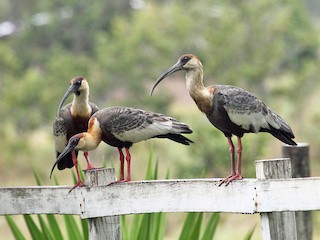
Where does the Buff-necked Ibis live?
Theristicus caudatus
Spotted a bird? Identify it instantly with the Birdby app
Open the appThe Buff-necked Ibis lives in specific habitats and regions. Knowing where, and when, to look improves your chances of a successful sighting.
Biomes
Grasslands, savannas, wetlands, agricultural fields, open woodlands, marshes, and riverbanks.
Geographic range
South America, from northern Colombia and Venezuela south through Brazil, Bolivia, Paraguay, Uruguay, and northern Argentina. Also found in parts of Guyana, Suriname, and French Guiana.
Preferred environments
Prefers open, wet areas such as flooded fields, pastures, marshes, and the edges of ponds and rivers. They adapt well to human-modified landscapes, including rice paddies and cattle ranches.
Elevation range
Primarily lowlands, up to approximately 1,000 meters (3,300 feet) above sea level, occasionally higher in some Andean valleys.
Where to look
Wetlands and Marshes
Look along the edges of freshwater marshes, swamps, and slow-moving rivers.
Agricultural Fields
Commonly found in flooded rice paddies, irrigated fields, and pastures, especially where cattle are present.
Open Grasslands
Can be seen foraging in open grasslands and savannas, particularly after rain or in areas with standing water.
Riverbanks and Lake Shores
Often found probing for food along muddy banks of rivers and lakes.
Field tips
- Look for foraging groups. Buff-necked Ibises often forage in small groups, making them easier to spot than solitary birds. Look for them probing the ground with their bills.
- Listen for calls. Their loud, distinctive calls are often the first indication of their presence, especially when they are flying overhead or disturbed.
- Scan open areas. Focus your search on open, wet habitats. They are less likely to be found in dense forests.
- Check near livestock. They frequently associate with cattle, feeding on insects stirred up by the animals. Look for them in pastures with grazing livestock.
- Observe flight patterns. When in flight, their extended neck and legs, combined with their dark body and buff neck, are good identification clues.
Migration
Mostly resident throughout its range, but some populations may undertake local or regional movements in response to rainfall patterns and food availability, particularly in drier regions.
Explore the Buff-necked Ibis
Identify birds anywhere
Free on iOS, Android, and Web. Photo & sound identification, full species database, and your personal life list.