
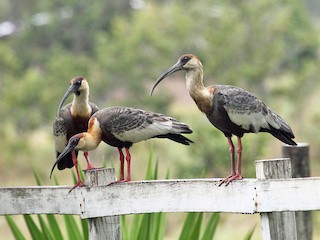
How to identify the Buff-necked Ibis
Theristicus caudatus
Spotted a bird? Identify it instantly with the Birdby app
Open the appTo correctly identify the Buff-necked Ibis (Theristicus caudatus), check each of these features. Birds can be tricky: habit, habitat, and call often confirm a sighting that a single photo cannot.
Size at a glance
- Length
- 71-79 cm (28-31 in)
- Wingspan
- 120-130 cm (47-51 in)
- Weight
- 1.2-1.7 kg (2.6-3.7 lbs)
Physical features to check
- 1
Plumage
Overall feather coloration and pattern.
Adults have a distinctive buff-colored neck and head, contrasting with a dark, iridescent green-black body. The back and wings are dark, often appearing glossy green or purple in good light. A broad white band separates the buff neck from the dark breast. The underparts are dark. The flight feathers are blackish. There is a prominent crest of shaggy feathers on the nape.
- 2
Beak shape
Shape and color of the bill: a key field mark.
Long, slender, and strongly decurved (downward-curving) bill, dark grey to blackish.
- 3
Eye color
Iris color and any distinctive eye markings.
Reddish-brown to dark brown.
- 4
Leg color
Leg and foot color.
Dull reddish-orange to dark greyish-red.
- 5
Distinguishing features
Standout features that separate this species.
The combination of the buff neck, dark body, and long decurved bill is unique among ibises in its range. The shaggy crest on the nape is also a good field mark.
- 6
Juvenile appearance
How young birds differ from adults.
Juveniles resemble adults but have duller plumage, with less distinct buff coloration on the neck and head, and less iridescence on the body. Their crest is also less developed.
- 7
Seasonal changes
Plumage variation between breeding and non-breeding seasons.
No significant seasonal plumage changes. Breeding plumage is essentially the same as non-breeding plumage, though colors may appear more vibrant during the breeding season due to better feather condition.
- 8
Sexual dimorphism
How males and females differ.
Males and females are monomorphic in plumage, though males may be slightly larger on average.
Key field marks
- Buff Neck and Head. Look for the prominent, warm buff coloration on the entire neck and head, which is a key distinguishing feature from other ibises.
- Dark Body and White Band. Observe the dark, iridescent green-black body plumage, separated from the buff neck by a distinct broad white band across the upper breast.
- Decurved Bill. Note the long, slender, and strongly downward-curving dark bill, characteristic of ibises.
- Shaggy Crest. Look for the shaggy, somewhat disheveled crest of feathers on the nape, especially visible when the bird is alert.
- Vocalization. Listen for its loud, raucous, and far-carrying 'curi-curi-ca' calls, which are highly distinctive and often given in flight.
- Habitat. Scan open, wet areas such as flooded fields, pastures, and marsh edges, where they frequently forage.
Explore the Buff-necked Ibis
Identify birds anywhere
Free on iOS, Android, and Web. Photo & sound identification, full species database, and your personal life list.