
Spotted a bird? Identify it instantly with the Birdby app
Open the appAbout
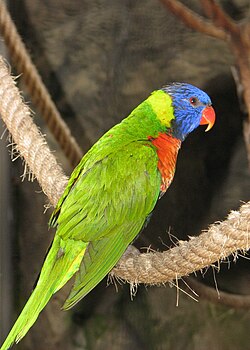
The Rainbow Lorikeet (Trichoglossus haematodus) is a medium-sized parrot characterized by its vibrant, multicoloured plumage. It is native to Australia, eastern Indonesia (Maluku Islands and Western New Guinea), Papua New Guinea, New Caledonia, Solomon Islands, and Vanuatu. Known for its playful and boisterous nature, it is a highly successful species thriving in a variety of habitats, often seen in large, noisy flocks. Their brush-tipped tongue is specially adapted for feeding on nectar and pollen.
Size & lifespan
- Length
- 25-30 cm (10-12 in)
- Wingspan
- 40-42 cm (16-17 in)
- Weight
- 75-157 g (2.6-5.5 oz)
- Lifespan
- 10-20 years in the wild, longer in captivity (up to 30 years)
- Diet
- Primarily nectar and pollen from a wide variety of flowers; also consumes soft fruits, berries, seeds, insects, and their larvae. They are generalist foragers and adapt their diet seasonably based on food availability.
Physical characteristics
- Plumage
- Adults have a deep blue (or purplish-blue) head and belly, greenish-yellow collar, green back, wings, and tail, and a red-orange breast with yellow streaking. The underwing coverts are bright red. Plumage varies across subspecies.
- Beak shape
- Orange-red, short, stout, and strongly curved; adapted for feeding on nectar and fruit.
- Eye color
- Red-orange with a grey orbital ring.
- Leg color
- Grey
- Distinguishing features
- The striking, multi-coloured plumage, particularly the blue head, red breast, and green body, with the prominent orange-red beak. Their fast, direct flight and screeching calls are also distinctive.
- Juvenile appearance
- Juveniles have duller plumage compared to adults. The head blue is less intense, the breast red is less vibrant and more mottled, and the beak is dusky brown with a yellow tip, gradually turning orange-red with age. Eyes are brownish.
- Seasonal changes
- No significant seasonal plumage changes.
- Sexual dimorphism
- Males and females are generally outwardly indistinguishable in plumage, though males may average slightly larger. Sexing usually requires genetic testing or endoscopic examination.
How to identify
- 1
Plumage Pattern
Look for the distinctive blue head, greenish-yellow nape/collar, bright red-orange breast with yellow streaking, green back and wings, and blue belly. This combination is unique.
- 2
Vocalizations
Their loud, high-pitched, shrill screeches and chattering calls are highly characteristic and often heard before the bird is seen, especially in flight or at feeding sites.
- 3
Flight Style
Fast, direct flight with rapid wing beats, often in flocks, accompanied by incessant calling.
- 4
Feeding Behavior
Observe them feeding on nectar and pollen from flowering trees and shrubs, often hanging acrobatically to reach blossoms. Their brush-tipped tongue may be visible.
- 5
Beak Color
Adults have a prominent bright orange-red beak, which contrasts with their colourful plumage.
Habitat & range
- Biomes
- Subtropical and tropical forests, woodlands, urban and suburban areas, coastal scrubs, heathlands, mangrove forests, and agricultural lands.
- Geographic range
- Northern, eastern, and south-eastern Australia (including Tasmania), eastern Indonesia (Maluku Islands and Western New Guinea), Papua New Guinea, New Caledonia, Solomon Islands, and Vanuatu.
- Elevation range
- Sea level up to approximately 2000 meters in some parts of their range, but generally concentrated in lower to mid-elevations.
- Preferred environments
- Areas with abundant flowering trees, particularly Eucalyptus and Melaleuca species, as well as exotic street trees and garden plants in urban environments. They are highly adaptable to human-altered landscapes.
Behavior
- Activity time
- Diurnal, most active during the early morning and late afternoon.
- Feeding habits
- Arboreal feeders, using their brush-tipped tongue to lap up nectar and pollen from flowers. They also consume soft fruits, berries, and occasionally seeds or insects. They are active and agile foragers, often hanging upside down to access flowers. They will readily feed at bird feeders offering suitable foods like commercial lorikeet mixes.
- Social behavior
- Highly gregarious, forming large, noisy flocks outside the breeding season, sometimes numbering in the hundreds or even thousands. They roost communally and feed in groups, often becoming aggressive towards other bird species at feeding sites.
- Flight pattern
- Fast, direct, and often low, with rapid wingbeats. Flights are typically accompanied by loud screeching calls. They often fly in tight, cohesive flocks.
- Migration pattern
- Generally resident, but exhibit nomadic movements in response to the availability of flowering food sources. These movements can cover significant distances.
- Territoriality
- Breeding pairs defend the immediate vicinity of their nest hollow. Non-breeding flocks are not territorial, but feeding groups may show aggression towards competitors.
Song & calls
- Song
- Though not having a 'song' in the traditional sense, their vocalizations are a continuous series of high-pitched, sharp, and shrill screeches, chattering, and harsh squawks. They are very loud and distinctive.
- Call
- Main calls include repeated, piercing 'screek-screek-screek' or 'tsee-eet' in flight, and a range of chattering, gurgling, and squealing notes while feeding or perched. Alarm calls are sharper and more urgent.
- When they vocalize
- Most vocal during flight, particularly at dawn and dusk when commuting to and from roosting sites, and continuously while feeding or interacting socially.
Breeding & reproduction
- Breeding season
- Typically August to January in southern Australia, but varies geographically and locally depending on food availability; can be double-brooded.
- Nesting habits
- Nests are usually in unlined tree hollows, often high up in mature eucalypts, but also in palm trunks or artificial structures. Both sexes inspect hollows, but the female does most of the nest preparation.
- Clutch size
- Usually 2-3 eggs, occasionally 1 or 4.
- Egg description
- Glossy white, oval to round.
- Incubation period
- Approximately 23-26 days, primarily by the female.
- Fledging period
- Chicks fledge around 7-8 weeks after hatching. Both parents feed the young.
- Parental care
- Both parents participate in feeding the nestlings. After fledging, juveniles remain with their parents for several weeks, learning foraging skills, before joining larger flocks.
Where to find
Urban Parks and Gardens
Widely present in cities and towns, especially where flowering native and exotic trees (e.g., eucalypts, bottlebrushes, jacarandas) are abundant. Look for them feeding in flowering plants or drinking at bird baths.
Eucalypt Woodlands and Forests
Their natural forested habitats, particularly those with a diverse range of flowering trees. Listen for their calls in the canopy.
Coastal Areas
Found in coastal scrubs and mangrove areas, often moving to inland flowering trees, depending on seasonal resources.
Field tips
- Listen First. Rainbow Lorikeets are very noisy. Their constant screeching is often the first indication of their presence, especially when a flock is approaching or feeding nearby.
- Look for Flowering Trees. Concentrate your search on trees and shrubs that are currently in flower, as these birds are primarily nectar and pollen feeders.
- Dawn and Dusk Activity. They are particularly active and vocal at dawn and dusk when flying between roosting sites and foraging grounds.
- Observe Flocks. They are highly social. If you see one, look for more. They often move and feed in groups.
- Patience at Bird Baths. In urban areas, they are frequent visitors to bird baths, especially on warm days.
Similar species
Scaly-breasted Lorikeet
Trichoglossus chlorolepidotus
The Scaly-breasted Lorikeet has an entirely green head and back, with prominent yellow scalloping on its green breast and flanks, lacking the Rainbow Lorikeet's blue head and red breast. Its underwing coverts are yellow, not red.
Coconut Lorikeet
Trichoglossus haematodus (sensu stricto)
Historically, 'Rainbow Lorikeet' encompassed numerous subspecies. Recent taxonomic revisions elevate many to full species. The Coconut Lorikeet (T. haematodus sensu stricto) specifically refers to the populations found in New Guinea and surrounding islands, often having a darker blue head and more extensive yellow collar, but overall patterning is very similar, requiring careful observation of geographical range and subtle plumage nuances.
Red-collared Lorikeet
Trichoglossus rubritorquis
Found in northern Australia, it has a more distinct red-orange nuchal (nape) collar and a less blue crown, with the blue confined more to the face and chin. The breast is also red-orange, but the demarcation between colours can be slightly different.
Quick facts
- Distinctive Feeder:
- Brush-tipped tongue for nectar and pollen feeding.
- Social Behavior:
- Highly gregarious, forms large, noisy flocks.
- Urban Adaptability:
- Thrives in human-modified landscapes.
- Conservation Status:
- Least Concern
- Native Range:
- Australia, New Guinea, and surrounding islands
Fun facts
- Rainbow Lorikeets are one of the most vividly coloured parrot species in the world, making them an iconic bird of the Australian continent.
- Their brush-tipped tongue is a remarkable adaptation, covered in papillae that can be extended to collect nectar and pollen like a sponge.
- They are known for their feisty and aggressive behaviour towards other bird species, especially at food sources, often dominating feeders.
- Introduced populations of Rainbow Lorikeets have established themselves in places like Perth, Western Australia, where they are considered an invasive species due to competition with native birds.
- Despite their bright colours which might seem to make them conspicuous, their plumage provides surprisingly good camouflage among the vibrant flowers and foliage of their native habitats.
Scientific classification
- Kingdom
- Animalia
- Phylum
- Chordata
- Class
- Aves
- Order
- Psittaciformes
- Family
- Psittaculidae
- Genus
- Trichoglossus
- Species
- Trichoglossus haematodus
Explore the Rainbow Lorikeet
Identify birds anywhere
Free on iOS, Android, and Web. Photo & sound identification, full species database, and your personal life list.