
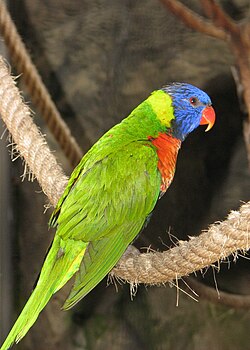
Where does the Rainbow Lorikeet live?
Trichoglossus haematodus
Spotted a bird? Identify it instantly with the Birdby app
Open the appThe Rainbow Lorikeet lives in specific habitats and regions. Knowing where, and when, to look improves your chances of a successful sighting.
Biomes
Subtropical and tropical forests, woodlands, urban and suburban areas, coastal scrubs, heathlands, mangrove forests, and agricultural lands.
Geographic range
Northern, eastern, and south-eastern Australia (including Tasmania), eastern Indonesia (Maluku Islands and Western New Guinea), Papua New Guinea, New Caledonia, Solomon Islands, and Vanuatu.
Preferred environments
Areas with abundant flowering trees, particularly Eucalyptus and Melaleuca species, as well as exotic street trees and garden plants in urban environments. They are highly adaptable to human-altered landscapes.
Elevation range
Sea level up to approximately 2000 meters in some parts of their range, but generally concentrated in lower to mid-elevations.
Where to look
Urban Parks and Gardens
Widely present in cities and towns, especially where flowering native and exotic trees (e.g., eucalypts, bottlebrushes, jacarandas) are abundant. Look for them feeding in flowering plants or drinking at bird baths.
Eucalypt Woodlands and Forests
Their natural forested habitats, particularly those with a diverse range of flowering trees. Listen for their calls in the canopy.
Coastal Areas
Found in coastal scrubs and mangrove areas, often moving to inland flowering trees, depending on seasonal resources.
Field tips
- Listen First. Rainbow Lorikeets are very noisy. Their constant screeching is often the first indication of their presence, especially when a flock is approaching or feeding nearby.
- Look for Flowering Trees. Concentrate your search on trees and shrubs that are currently in flower, as these birds are primarily nectar and pollen feeders.
- Dawn and Dusk Activity. They are particularly active and vocal at dawn and dusk when flying between roosting sites and foraging grounds.
- Observe Flocks. They are highly social. If you see one, look for more. They often move and feed in groups.
- Patience at Bird Baths. In urban areas, they are frequent visitors to bird baths, especially on warm days.
Migration
Generally resident, but exhibit nomadic movements in response to the availability of flowering food sources. These movements can cover significant distances.
Explore the Rainbow Lorikeet
Identify birds anywhere
Free on iOS, Android, and Web. Photo & sound identification, full species database, and your personal life list.