
How to identify the Rainbow Lorikeet
Trichoglossus haematodus
Spotted a bird? Identify it instantly with the Birdby app
Open the appTo correctly identify the Rainbow Lorikeet (Trichoglossus haematodus), check each of these features. Birds can be tricky: habit, habitat, and call often confirm a sighting that a single photo cannot.
Size at a glance
- Length
- 25-30 cm (10-12 in)
- Wingspan
- 40-42 cm (16-17 in)
- Weight
- 75-157 g (2.6-5.5 oz)
Physical features to check
- 1
Plumage
Overall feather coloration and pattern.
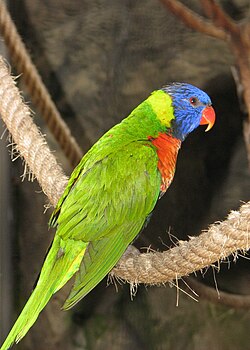
Adults have a deep blue (or purplish-blue) head and belly, greenish-yellow collar, green back, wings, and tail, and a red-orange breast with yellow streaking. The underwing coverts are bright red. Plumage varies across subspecies.
- 2
Beak shape
Shape and color of the bill: a key field mark.
Orange-red, short, stout, and strongly curved; adapted for feeding on nectar and fruit.
- 3
Eye color
Iris color and any distinctive eye markings.
Red-orange with a grey orbital ring.
- 4
Leg color
Leg and foot color.
Grey
- 5
Distinguishing features
Standout features that separate this species.
The striking, multi-coloured plumage, particularly the blue head, red breast, and green body, with the prominent orange-red beak. Their fast, direct flight and screeching calls are also distinctive.
- 6
Juvenile appearance
How young birds differ from adults.
Juveniles have duller plumage compared to adults. The head blue is less intense, the breast red is less vibrant and more mottled, and the beak is dusky brown with a yellow tip, gradually turning orange-red with age. Eyes are brownish.
- 7
Seasonal changes
Plumage variation between breeding and non-breeding seasons.
No significant seasonal plumage changes.
- 8
Sexual dimorphism
How males and females differ.
Males and females are generally outwardly indistinguishable in plumage, though males may average slightly larger. Sexing usually requires genetic testing or endoscopic examination.
Key field marks
- Plumage Pattern. Look for the distinctive blue head, greenish-yellow nape/collar, bright red-orange breast with yellow streaking, green back and wings, and blue belly. This combination is unique.
- Vocalizations. Their loud, high-pitched, shrill screeches and chattering calls are highly characteristic and often heard before the bird is seen, especially in flight or at feeding sites.
- Flight Style. Fast, direct flight with rapid wing beats, often in flocks, accompanied by incessant calling.
- Feeding Behavior. Observe them feeding on nectar and pollen from flowering trees and shrubs, often hanging acrobatically to reach blossoms. Their brush-tipped tongue may be visible.
- Beak Color. Adults have a prominent bright orange-red beak, which contrasts with their colourful plumage.
Explore the Rainbow Lorikeet
Identify birds anywhere
Free on iOS, Android, and Web. Photo & sound identification, full species database, and your personal life list.