
Spotted a bird? Identify it instantly with the Birdby app
Open the appAbout
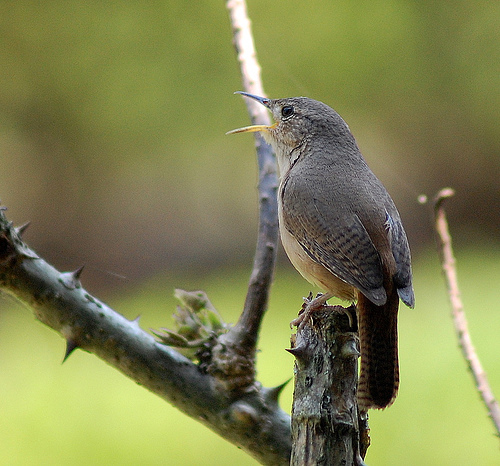
The House Wren is a small, active songbird known for its plain brown plumage, upright tail, and bubbling, effervescent song. It is one of the most widespread wren species in the Americas, adapting well to human-modified landscapes.
Size & lifespan
- Length
- 11-13 cm (4.3-5.1 in)
- Wingspan
- 15 cm (5.9 in)
- Weight
- 10-12 g (0.35-0.42 oz)
- Lifespan
- Typically 2-7 years in the wild, with a maximum recorded age of 9 years.
- Diet
- Insectivore
Physical characteristics
- Plumage
- Overall dull brown, finely barred with darker brown on the wings, tail, and flanks. The back is a slightly richer brown, and the underparts are paler, grayish-brown. There is a faint, pale supercilium (eyebrow stripe) that is often indistinct.
- Beak shape
- Slender, slightly decurved, and pointed. Dark horn-colored to blackish.
- Eye color
- Dark brown.
- Leg color
- Pinkish-brown to dark brown.
- Distinguishing features
- Small size, plain brown plumage without strong markings, short, often cocked tail, and a constantly active, twitching demeanor. The barring on the wings and tail is subtle but present.
- Juvenile appearance
- Juveniles resemble adults but may have a slightly scaly appearance on the head and back due to pale feather edgings, and their plumage can appear a bit looser or fluffier.
- Seasonal changes
- No significant seasonal plumage changes. Plumage remains consistent year-round.
- Sexual dimorphism
- Males and females are virtually identical in plumage and size.
How to identify
- 1
Size and Shape
Look for a small, compact bird with a relatively short, often cocked tail. It has a rather plump body and a small head.
- 2
Plumage
Observe the overall plain, dull brown coloration. Note the subtle darker barring on the wings, tail, and flanks. Lack of strong facial markings or bold patterns is key.
- 3
Behavior
Watch for its active, restless movements, constantly twitching its tail up and down or side to side as it forages or perches. It often appears to be 'nervous' or 'fidgety'.
- 4
Song
Listen for the distinctive, rapid, bubbling, and gurgling song. It's a jumbled cascade of notes that often ends in a descending trill. This is one of the most reliable identification features.
- 5
Habitat
Consider the habitat. House Wrens are common in suburban areas, gardens, parks, and open woodlands, often near human dwellings or structures.
Habitat & range
- Biomes
- Forest edges, open woodlands, suburban gardens, parks, agricultural areas, riparian zones.
- Geographic range
- Breeds across much of North America, from southern Canada through the United States and Mexico, and south through Central and South America. Northern populations migrate south for winter.
- Elevation range
- Sea level up to 3,000 meters (9,800 feet) in some parts of its range, though typically found at lower to mid-elevations.
- Preferred environments
- Prefers areas with scattered trees, shrubs, and open understory, often near human habitation. Readily uses birdhouses and natural cavities for nesting.
Behavior
- Activity time
- Diurnal.
- Feeding habits
- Forages actively among foliage, branches, and on the ground, gleaning insects and spiders. It moves quickly, often flicking its tail and wings. Diet consists almost entirely of insects and spiders, including caterpillars, beetles, grasshoppers, and crickets.
- Social behavior
- Generally solitary or found in pairs during the breeding season. Not typically seen in flocks.
- Flight pattern
- Short, rapid, and direct flights, often low to the ground or between shrubs. Wings beat quickly.
- Migration pattern
- Northern populations are migratory, moving south to the southern United States, Mexico, and Central America for the winter. Southern populations are resident year-round.
- Territoriality
- Highly territorial during the breeding season. Males are particularly aggressive, often filling multiple cavities with sticks to deter competitors and potential predators, even destroying eggs of other cavity-nesting birds.
Song & calls
- Song
- A distinctive, effervescent, gurgling, and bubbling song, often described as a 'torrent of musical notes.' It starts with a few introductory notes, then accelerates into a rapid, jumbled series of trills and warbles, often ending with a descending flourish. Males sing frequently and enthusiastically, especially during courtship and territory defense.
- Call
- Common calls include a sharp 'churrr' or 'churr-it' call, often given when agitated or as an alarm. Also a dry, scolding 'teck' or 'chick' note.
- When they vocalize
- Males sing most frequently from dawn to mid-morning during the breeding season (spring and early summer). Calls are given year-round, especially when disturbed.
Breeding & reproduction
- Breeding season
- Typically April to August in North America, varying by latitude.
- Nesting habits
- Nests in cavities, both natural (tree hollows, old woodpecker holes) and artificial (birdhouses, mailboxes, old boots, tin cans). The male initiates nest building by filling the cavity with sticks, sometimes to the brim. The female then adds finer materials like grass, rootlets, hair, and feathers to create a cup-shaped nest within the stick base.
- Clutch size
- Typically 4-8 eggs, with 6 being common.
- Egg description
- Small, oval, white to creamy-white, heavily speckled with reddish-brown or cinnamon spots, often concentrated at the larger end. Eggs measure approximately 1.6 x 1.3 cm (0.6 x 0.5 in).
- Incubation period
- 12-15 days, primarily by the female.
- Fledging period
- 12-18 days after hatching. Young leave the nest fully feathered and capable of short flights.
- Parental care
- Both parents feed the nestlings and fledglings. The male may continue to feed the first brood while the female begins a second clutch.
Where to find
Suburban Gardens and Parks
Often found in backyards, parks, and urban green spaces, especially where birdhouses are present or there are dense shrubs and small trees.
Open Woodlands and Forest Edges
Look along the edges of deciduous or mixed forests, in areas with some undergrowth and scattered trees.
Agricultural Areas
Can be found in orchards, vineyards, and other agricultural landscapes with suitable nesting sites and insect prey.
Field tips
- Listen for the Song. The House Wren's bubbling song is very distinctive and often the first indication of its presence. Learn to recognize it, especially during spring and early summer mornings.
- Check Birdhouses and Cavities. House Wrens readily use birdhouses. If you have one, or see one in a park, watch for activity around it. They also nest in natural tree cavities.
- Look for Movement. These birds are constantly moving. Scan shrubs and low branches for small, active brown birds with twitching tails.
- Be Patient. While active, their small size and cryptic coloration can make them blend in. Patience and careful observation will often reveal them.
Similar species
Winter Wren
Troglodytes hiemalis
Winter Wrens are smaller, darker, and have a much shorter tail that is often held straight up. They have a more finely barred pattern on their flanks and a more distinct pale supercilium. Their song is also more intricate and sustained, without the bubbling quality of the House Wren.
Carolina Wren
Thryothorus ludovicianus
Carolina Wrens are larger, richer rufous-brown, and have a very prominent white supercilium. Their song is a loud, clear, repetitive 'teakettle-teakettle-teakettle' or 'cheer-cheer-cheer' that is distinctly different from the House Wren's bubbling song.
Bewick's Wren
Thryomanes bewickii
Bewick's Wrens are similar in size but have a longer tail with white outer tail feathers (visible in flight or when fanned), and a more prominent white supercilium. Their song is a series of buzzy notes and trills, often ending with a distinctive 'bzzzt' sound, different from the House Wren's.
Quick facts
- Scientific Name:
- Troglodytes aedon
- Family:
- Troglodytidae (Wrens)
- Diet:
- Insects and Spiders
- Nesting:
- Cavity Nester (natural and artificial)
- Song:
- Bubbling, gurgling, effervescent
- Conservation Status:
- Least Concern
Fun facts
- The scientific name 'Troglodytes aedon' means 'cave-dweller singer,' referring to its habit of nesting in cavities and its melodious song.
- Male House Wrens are known for their aggressive territorial behavior, sometimes filling multiple cavities with sticks to prevent other birds from nesting nearby, even destroying eggs of other species like chickadees and bluebirds.
- They are one of the most widespread songbirds in the Americas, adapting well to human-altered environments.
- A single male House Wren can sing hundreds of times per hour during the breeding season.
- Despite their small size, they are fierce defenders of their nests and territories.
Scientific classification
- Kingdom
- Animalia
- Phylum
- Chordata
- Class
- Aves
- Order
- Passeriformes
- Family
- Troglodytidae
- Genus
- Troglodytes
- Species
- T. aedon
Explore the House Wren
Identify birds anywhere
Free on iOS, Android, and Web. Photo & sound identification, full species database, and your personal life list.