
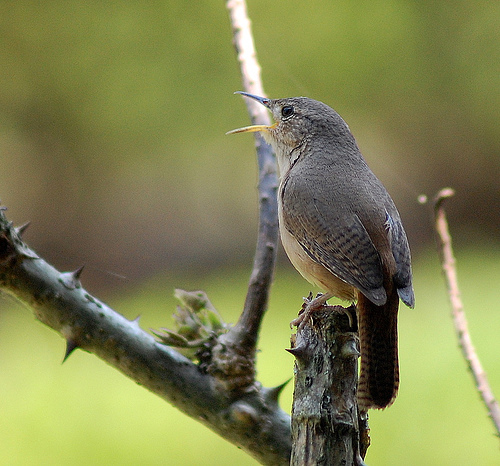
Where does the House Wren live?
Troglodytes aedon
Spotted a bird? Identify it instantly with the Birdby app
Open the appThe House Wren lives in specific habitats and regions. Knowing where, and when, to look improves your chances of a successful sighting.
Biomes
Forest edges, open woodlands, suburban gardens, parks, agricultural areas, riparian zones.
Geographic range
Breeds across much of North America, from southern Canada through the United States and Mexico, and south through Central and South America. Northern populations migrate south for winter.
Preferred environments
Prefers areas with scattered trees, shrubs, and open understory, often near human habitation. Readily uses birdhouses and natural cavities for nesting.
Elevation range
Sea level up to 3,000 meters (9,800 feet) in some parts of its range, though typically found at lower to mid-elevations.
Where to look
Suburban Gardens and Parks
Often found in backyards, parks, and urban green spaces, especially where birdhouses are present or there are dense shrubs and small trees.
Open Woodlands and Forest Edges
Look along the edges of deciduous or mixed forests, in areas with some undergrowth and scattered trees.
Agricultural Areas
Can be found in orchards, vineyards, and other agricultural landscapes with suitable nesting sites and insect prey.
Field tips
- Listen for the Song. The House Wren's bubbling song is very distinctive and often the first indication of its presence. Learn to recognize it, especially during spring and early summer mornings.
- Check Birdhouses and Cavities. House Wrens readily use birdhouses. If you have one, or see one in a park, watch for activity around it. They also nest in natural tree cavities.
- Look for Movement. These birds are constantly moving. Scan shrubs and low branches for small, active brown birds with twitching tails.
- Be Patient. While active, their small size and cryptic coloration can make them blend in. Patience and careful observation will often reveal them.
Migration
Northern populations are migratory, moving south to the southern United States, Mexico, and Central America for the winter. Southern populations are resident year-round.
Explore the House Wren
Identify birds anywhere
Free on iOS, Android, and Web. Photo & sound identification, full species database, and your personal life list.