
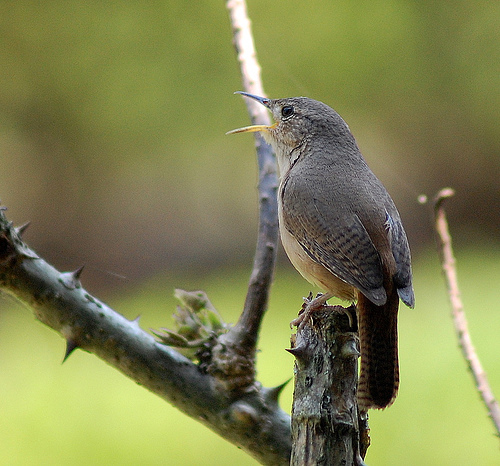
How to identify the House Wren
Troglodytes aedon
Spotted a bird? Identify it instantly with the Birdby app
Open the appTo correctly identify the House Wren (Troglodytes aedon), check each of these features. Birds can be tricky: habit, habitat, and call often confirm a sighting that a single photo cannot.
Size at a glance
- Length
- 11-13 cm (4.3-5.1 in)
- Wingspan
- 15 cm (5.9 in)
- Weight
- 10-12 g (0.35-0.42 oz)
Physical features to check
- 1
Plumage
Overall feather coloration and pattern.
Overall dull brown, finely barred with darker brown on the wings, tail, and flanks. The back is a slightly richer brown, and the underparts are paler, grayish-brown. There is a faint, pale supercilium (eyebrow stripe) that is often indistinct.
- 2
Beak shape
Shape and color of the bill: a key field mark.
Slender, slightly decurved, and pointed. Dark horn-colored to blackish.
- 3
Eye color
Iris color and any distinctive eye markings.
Dark brown.
- 4
Leg color
Leg and foot color.
Pinkish-brown to dark brown.
- 5
Distinguishing features
Standout features that separate this species.
Small size, plain brown plumage without strong markings, short, often cocked tail, and a constantly active, twitching demeanor. The barring on the wings and tail is subtle but present.
- 6
Juvenile appearance
How young birds differ from adults.
Juveniles resemble adults but may have a slightly scaly appearance on the head and back due to pale feather edgings, and their plumage can appear a bit looser or fluffier.
- 7
Seasonal changes
Plumage variation between breeding and non-breeding seasons.
No significant seasonal plumage changes. Plumage remains consistent year-round.
- 8
Sexual dimorphism
How males and females differ.
Males and females are virtually identical in plumage and size.
Key field marks
- Size and Shape. Look for a small, compact bird with a relatively short, often cocked tail. It has a rather plump body and a small head.
- Plumage. Observe the overall plain, dull brown coloration. Note the subtle darker barring on the wings, tail, and flanks. Lack of strong facial markings or bold patterns is key.
- Behavior. Watch for its active, restless movements, constantly twitching its tail up and down or side to side as it forages or perches. It often appears to be 'nervous' or 'fidgety'.
- Song. Listen for the distinctive, rapid, bubbling, and gurgling song. It's a jumbled cascade of notes that often ends in a descending trill. This is one of the most reliable identification features.
- Habitat. Consider the habitat. House Wrens are common in suburban areas, gardens, parks, and open woodlands, often near human dwellings or structures.
Explore the House Wren
Identify birds anywhere
Free on iOS, Android, and Web. Photo & sound identification, full species database, and your personal life list.