
Spotted a bird? Identify it instantly with the Birdby app
Open the appAbout
The Eurasian Wren is a very small, plump, and short-tailed passerine bird, renowned for its disproportionately loud and complex song. It is one of the most widespread bird species globally, found across a vast range in the Northern Hemisphere. Its cryptic brown plumage allows it to blend seamlessly into its preferred dense undergrowth habitats.
Size & lifespan
- Length
- 9-10.5 cm
- Wingspan
- 13-17 cm
- Weight
- 6-12 g
- Lifespan
- 2-5 years (up to 7 years recorded)
- Diet
- Insectivore
Physical characteristics
- Plumage
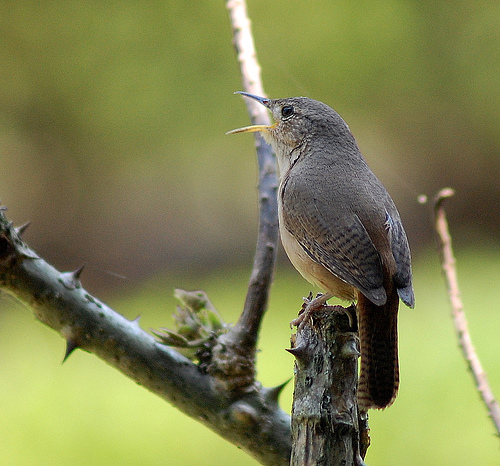
- Upperparts are rufous-brown, finely barred with darker brown on the back, rump, and tail. Underparts are paler, buffish-brown, also finely barred on the flanks and undertail coverts. A prominent pale supercilium (eyebrow stripe) is present, contrasting with a darker eye-stripe. The short tail is often held cocked upwards.
- Beak shape
- Slender, pointed, and slightly decurved, dark brown to blackish.
- Eye color
- Dark brown.
- Leg color
- Pale brown to pinkish-brown.
- Distinguishing features
- Its small size, plump body, short cocked tail, and constant active movement in dense vegetation are highly distinctive. The pale supercilium is a key field mark.
- Juvenile appearance
- Juveniles resemble adults but may have slightly less distinct barring and a duller overall appearance. The plumage is generally softer and less defined.
- Seasonal changes
- No significant seasonal plumage changes. Plumage may appear slightly fresher after the autumn molt.
- Sexual dimorphism
- None; males and females are identical in plumage and size.
How to identify
- 1
Size and Shape
Look for a very small, plump bird with a short, often cocked-up tail. Its body is rounded, giving it a 'ball of feathers' appearance.
- 2
Plumage
Observe the rufous-brown upperparts with fine dark barring, especially on the wings, rump, and tail. The underparts are paler buffish-brown, also barred on the flanks. Note the distinct pale supercilium (eyebrow).
- 3
Behavior
Watch for its characteristic active, restless movements, constantly flitting through dense undergrowth, often with its tail held vertically. It rarely stays still for long.
- 4
Song
Listen for its remarkably loud, complex, and rapid song, which is disproportionately powerful for its size. It's a series of trills, whistles, and churring notes, often ending with an emphatic trill.
- 5
Habitat
Check dense, tangled vegetation, hedgerows, woodland undergrowth, and gardens. They prefer areas with plenty of cover.
Habitat & range
- Biomes
- Forests, woodlands, scrublands, hedgerows, gardens, parks, riparian zones, moorland with dense cover.
- Geographic range
- Widespread across Europe, North Africa, Asia (from Siberia to Japan), and North America (where it is often considered a separate species, Winter Wren, T. hiemalis, or Pacific Wren, T. pacificus, depending on taxonomy).
- Elevation range
- Sea level up to 3,000 meters in some mountainous regions.
- Preferred environments
- Prefers areas with dense undergrowth, tangled vegetation, fallen logs, and thickets, providing cover for foraging and nesting. Often found near water sources.
Behavior
- Activity time
- Diurnal, most active during early morning and late afternoon.
- Feeding habits
- Primarily insectivorous, foraging actively among dense vegetation, on the ground, and in crevices. Diet includes insects (beetles, caterpillars, flies), spiders, and other small invertebrates. Occasionally consumes small berries in winter.
- Social behavior
- Generally solitary or found in pairs during the breeding season. Can form small communal roosts in winter for warmth, sometimes involving many individuals.
- Flight pattern
- Short, rapid, and direct flights, often low to the ground, characterized by quick wing beats. Rarely flies long distances in the open.
- Migration pattern
- Mostly resident throughout much of its range, particularly in milder climates. Northern and eastern populations are partially migratory, moving south or to lower elevations for winter. Some individuals undertake short-distance movements.
- Territoriality
- Males are highly territorial during the breeding season, defending their territory with vigorous song. They are polygynous, often building multiple 'cock nests' to attract females.
Song & calls
- Song
- A remarkably loud, complex, and rapid series of trills, whistles, and churring notes, often delivered with surprising power for such a small bird. It includes high-pitched, ringing phrases and can be sustained for several seconds. Often ends with a distinctive, emphatic trill.
- Call
- Common calls include a sharp, explosive 'tic-tic-tic' or 'churr' alarm call, and a softer 'tseep' contact call.
- When they vocalize
- Sings year-round, but most frequently and intensely during the breeding season (spring and early summer). Males sing to attract mates and defend territory. Also vocalizes during winter, especially on sunny days.
Breeding & reproduction
- Breeding season
- April to July, with two broods common.
- Nesting habits
- Nests are typically dome-shaped structures with a side entrance, built by the male. Constructed from moss, leaves, grass, and spider silk, lined with feathers. Nests are usually well-hidden in dense vegetation, tree roots, rock crevices, or old buildings.
- Clutch size
- 5-8 eggs
- Egg description
- 5-8 (occasionally 3-12) small, smooth, glossy white eggs, often with fine reddish-brown speckles, particularly at the broader end. Dimensions average 16 x 12 mm.
- Incubation period
- 14-16 days, primarily by the female.
- Fledging period
- 15-19 days after hatching.
- Parental care
- Female incubates and broods the young. Both parents feed the nestlings, though the male may also be attending to other nests with different females.
Where to find
Woodlands and Forests
Look in the undergrowth, fallen logs, and dense thickets of deciduous and coniferous forests.
Gardens and Parks
Often found in well-vegetated gardens, parks, and allotments, especially those with hedges, shrubs, and ivy.
Riparian Zones
Along riverbanks, streams, and ditches with dense waterside vegetation.
Moorland and Heathland
In areas with dense heather or gorse cover.
Field tips
- Listen for the song. The Wren's song is its most distinctive feature and often the first indication of its presence. Learn to recognize its loud, complex trills.
- Look low. Wrens spend most of their time foraging in dense, low-lying vegetation. Scan the base of hedges, thickets, and fallen branches.
- Be patient and still. They are shy and quick-moving. Find a good spot near dense cover and remain still; they will often emerge to forage.
- Check for movement. Look for rapid, jerky movements within the foliage, often accompanied by the characteristic cocked tail.
Similar species
Winter Wren
Troglodytes hiemalis
Historically considered conspecific with Eurasian Wren. Now often treated as a separate species in eastern North America. Very similar in appearance, but typically has a slightly shorter tail, paler underparts, and a slightly different song structure (less harsh, more musical). Field identification is extremely challenging without direct comparison or vocalizations.
Pacific Wren
Troglodytes pacificus
Also historically considered conspecific. Found in western North America. Similar to Eurasian Wren but generally darker, more rufous, and with a more complex, longer song. Again, very difficult to distinguish visually from Eurasian Wren without direct comparison.
Dunnock
Prunella modularis
While superficially similar in size and habitat preference, the Dunnock is larger (13-14.5 cm), has a longer, thinner tail, and lacks the strong barring of the Wren. Its plumage is duller, greyish-brown, and it has a distinctive grey head and breast. Its movements are more sedate, often shuffling rather than flitting.
Quick facts
- Smallest European Bird (by weight):
- Often considered the smallest bird in Europe by weight, though the Goldcrest is slightly smaller by length.
- Loudest Song for its Size:
- Produces an astonishingly loud and complex song for its tiny stature.
- Polygynous Breeding:
- Males often mate with multiple females and build several 'cock nests'.
- Communal Roosting:
- Known to roost communally in large numbers during cold winter nights for warmth.
- Widespread Distribution:
- One of the most widely distributed passerines in the Northern Hemisphere.
Fun facts
- In some European folklore, the Wren is known as the 'King of Birds' due to a fable where it outsmarted an eagle by hiding on its back and flying higher.
- Despite its small size, the Wren is remarkably hardy and can survive harsh winters, often by huddling together in communal roosts.
- A single male Wren can build up to 6-12 'cock nests' within his territory to attract females, who then choose one to line and lay eggs in.
- The scientific name 'Troglodytes' means 'cave-dweller', referring to its habit of creeping into holes and crevices.
Scientific classification
- Kingdom
- Animalia
- Phylum
- Chordata
- Class
- Aves
- Order
- Passeriformes
- Family
- Troglodytidae
- Genus
- Troglodytes
- Species
- Troglodytes troglodytes
Explore the Eurasian Wren
Identify birds anywhere
Free on iOS, Android, and Web. Photo & sound identification, full species database, and your personal life list.