
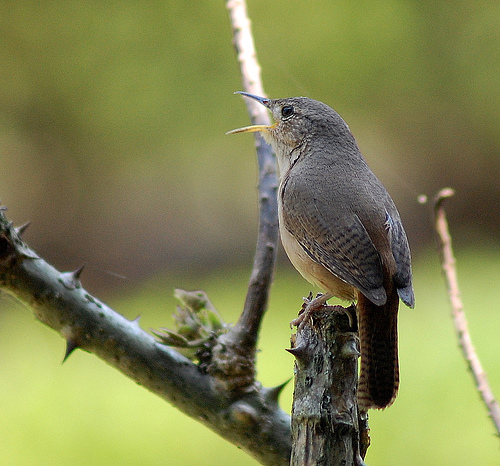
How to identify the Eurasian Wren
Troglodytes troglodytes
Spotted a bird? Identify it instantly with the Birdby app
Open the appTo correctly identify the Eurasian Wren (Troglodytes troglodytes), check each of these features. Birds can be tricky: habit, habitat, and call often confirm a sighting that a single photo cannot.
Size at a glance
- Length
- 9-10.5 cm
- Wingspan
- 13-17 cm
- Weight
- 6-12 g
Physical features to check
- 1
Plumage
Overall feather coloration and pattern.
Upperparts are rufous-brown, finely barred with darker brown on the back, rump, and tail. Underparts are paler, buffish-brown, also finely barred on the flanks and undertail coverts. A prominent pale supercilium (eyebrow stripe) is present, contrasting with a darker eye-stripe. The short tail is often held cocked upwards.
- 2
Beak shape
Shape and color of the bill: a key field mark.
Slender, pointed, and slightly decurved, dark brown to blackish.
- 3
Eye color
Iris color and any distinctive eye markings.
Dark brown.
- 4
Leg color
Leg and foot color.
Pale brown to pinkish-brown.
- 5
Distinguishing features
Standout features that separate this species.
Its small size, plump body, short cocked tail, and constant active movement in dense vegetation are highly distinctive. The pale supercilium is a key field mark.
- 6
Juvenile appearance
How young birds differ from adults.
Juveniles resemble adults but may have slightly less distinct barring and a duller overall appearance. The plumage is generally softer and less defined.
- 7
Seasonal changes
Plumage variation between breeding and non-breeding seasons.
No significant seasonal plumage changes. Plumage may appear slightly fresher after the autumn molt.
- 8
Sexual dimorphism
How males and females differ.
None; males and females are identical in plumage and size.
Key field marks
- Size and Shape. Look for a very small, plump bird with a short, often cocked-up tail. Its body is rounded, giving it a 'ball of feathers' appearance.
- Plumage. Observe the rufous-brown upperparts with fine dark barring, especially on the wings, rump, and tail. The underparts are paler buffish-brown, also barred on the flanks. Note the distinct pale supercilium (eyebrow).
- Behavior. Watch for its characteristic active, restless movements, constantly flitting through dense undergrowth, often with its tail held vertically. It rarely stays still for long.
- Song. Listen for its remarkably loud, complex, and rapid song, which is disproportionately powerful for its size. It's a series of trills, whistles, and churring notes, often ending with an emphatic trill.
- Habitat. Check dense, tangled vegetation, hedgerows, woodland undergrowth, and gardens. They prefer areas with plenty of cover.
Explore the Eurasian Wren
Identify birds anywhere
Free on iOS, Android, and Web. Photo & sound identification, full species database, and your personal life list.