
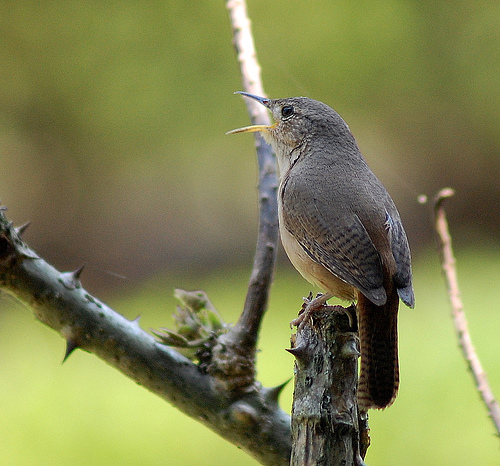
Where does the Eurasian Wren live?
Troglodytes troglodytes
Spotted a bird? Identify it instantly with the Birdby app
Open the appThe Eurasian Wren lives in specific habitats and regions. Knowing where, and when, to look improves your chances of a successful sighting.
Biomes
Forests, woodlands, scrublands, hedgerows, gardens, parks, riparian zones, moorland with dense cover.
Geographic range
Widespread across Europe, North Africa, Asia (from Siberia to Japan), and North America (where it is often considered a separate species, Winter Wren, T. hiemalis, or Pacific Wren, T. pacificus, depending on taxonomy).
Preferred environments
Prefers areas with dense undergrowth, tangled vegetation, fallen logs, and thickets, providing cover for foraging and nesting. Often found near water sources.
Elevation range
Sea level up to 3,000 meters in some mountainous regions.
Where to look
Woodlands and Forests
Look in the undergrowth, fallen logs, and dense thickets of deciduous and coniferous forests.
Gardens and Parks
Often found in well-vegetated gardens, parks, and allotments, especially those with hedges, shrubs, and ivy.
Riparian Zones
Along riverbanks, streams, and ditches with dense waterside vegetation.
Moorland and Heathland
In areas with dense heather or gorse cover.
Field tips
- Listen for the song. The Wren's song is its most distinctive feature and often the first indication of its presence. Learn to recognize its loud, complex trills.
- Look low. Wrens spend most of their time foraging in dense, low-lying vegetation. Scan the base of hedges, thickets, and fallen branches.
- Be patient and still. They are shy and quick-moving. Find a good spot near dense cover and remain still; they will often emerge to forage.
- Check for movement. Look for rapid, jerky movements within the foliage, often accompanied by the characteristic cocked tail.
Migration
Mostly resident throughout much of its range, particularly in milder climates. Northern and eastern populations are partially migratory, moving south or to lower elevations for winter. Some individuals undertake short-distance movements.
Explore the Eurasian Wren
Identify birds anywhere
Free on iOS, Android, and Web. Photo & sound identification, full species database, and your personal life list.