
Spotted a bird? Identify it instantly with the Birdby app
Open the appAbout
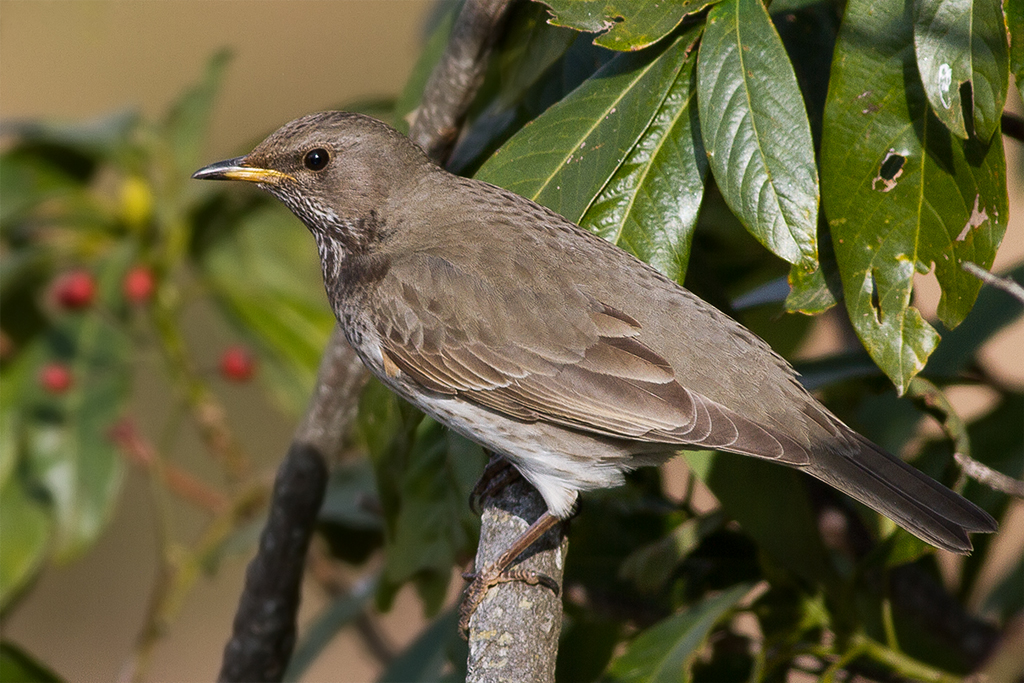
The Black-throated Thrush is a medium-sized migratory thrush known for the distinctive dark throat and upper breast of the male. It is a Palearctic species, breeding in the taiga and mixed forests of Siberia and migrating south to winter in parts of central and south Asia. Its presence in Europe is typically as a vagrant. This species is often seen foraging on the ground for invertebrates and fruits.
Size & lifespan
- Length
- 23-27 cm
- Wingspan
- 37-43 cm
- Weight
- 63-105 g
- Lifespan
- Up to 5-8 years in the wild
- Diet
- Primarily invertebrates (insects, earthworms, snails) during the breeding season; supplemented with berries and fruits, especially during migration and in winter.
Physical characteristics
- Plumage
- Adult male: Head, throat, and upper breast are solid black, sharply demarcated from the white belly. Upperparts are dark grey-brown. Undertail coverts are white. Adult female: Has a much paler, streaked grey-brown throat and breast, often with a hint of dark mottling or streaking, but never solid black. Upperparts are similar to the male but often slightly paler. Immature/Juvenile: Resembles the female, but with buff streaking on the upperparts and more pronounced dark spots or streaks on the throat and breast, often with rufous tones on the flanks.
- Beak shape
- Medium-length, slender, straight bill; dark horn-colored, often with a paler base to the lower mandible.
- Eye color
- Dark brown.
- Leg color
- Dark brown to blackish.
- Distinguishing features
- The male's striking black throat and breast contrasting with white belly. The female's streaky grey-brown throat, distinct from other thrushes.
- Juvenile appearance
- Juveniles are paler and browner overall than adults, with buff-white streaking on the back and head. The throat and breast are buffish with heavy dark brown spotting and streaking, often with rufous wash on flanks. This streaking gradually fades as they mature into first-winter plumage, which resembles a duller female.
- Seasonal changes
- Plumage does not change significantly between breeding and non-breeding seasons for adults, apart from wear and tear. First-winter males begin to show more black on the throat in their first autumn/winter but typically do not achieve the full black throat of an adult male until their second year.
- Sexual dimorphism
- Strong sexual dimorphism in plumage, particularly in the throat and breast coloration. Males possess a solid black throat, while females have a streaked grey-brown throat.
How to identify
- 1
Throat and Breast Color
Male: Solid, velvety black throat extending to the upper breast, sharply contrasting with a clean white belly. Female: Paler, streaky grey-brown throat and upper breast, lighter than the male, but still distinct from other thrushes.
- 2
Upperparts
Uniform dark grey-brown back, wings, and tail in both sexes, without strong markings or patterns.
- 3
Undertail Coverts
Always white in both sexes, which is a useful field mark.
- 4
Behavior
Often seen foraging on the ground, sometimes in open areas. Can be quite skittish in breeding areas but more approachable in winter. Often in flocks during migration and winter.
- 5
Song/Calls
Listen for the distinctive clear, fluty, melancholy song (breeding) or the soft 'churr' and high 'tseep' calls.
Habitat & range
- Biomes
- Taiga, boreal forests, mixed woodlands, steppe-forests, subalpine zones.
- Geographic range
- Breeds from western Siberia across to central Asia (e.g., Altai Mountains, Tien Shan). Winters in parts of Central Asia, the Indian subcontinent, and the Middle East, with vagrants reaching Europe and North Africa.
- Elevation range
- Breeds at elevations from sea level up to 2500m in mountainous regions. Winters at lower elevations, often in foothills and plains.
- Preferred environments
- Breeding: Coniferous and mixed forests, particularly those with a dense undergrowth. Often near clearings or forest edges. Wintering: Open woodlands, orchards, gardens, cultivation, and semi-arid scrub with scattered trees.
Behavior
- Activity time
- Primarily diurnal, most active during the early morning and late afternoon.
- Feeding habits
- Forages mainly on the ground, often in open areas or under trees, searching for invertebrates by flicking leaf litter and probing the soil with its bill. Also climbs into trees and bushes to feed on berries and fruits. Can be quite tame in wintering areas when undisturbed.
- Social behavior
- Territorial during the breeding season, though sometimes nests in loose colonies. Outside the breeding season, especially during migration and winter, they can form large flocks, sometimes mixing with other thrush species.
- Flight pattern
- Strong, direct, and slightly undulating flight typical of thrushes. Often flies low between cover.
- Migration pattern
- Long-distance migratory. Breeds in northern latitudes and moves south to warmer climates for the winter. Migrates primarily at night. European records are predominantly of vagrants during autumn migration.
- Territoriality
- Males establish and defend breeding territories through song and displays. In winter, feeding territories are less defined, and they are more sociable.
Song & calls
- Song
- The song is a series of clear, fluty, melancholy phrases, often consisting of two to four whistled notes, delivered slowly and deliberately. It can be quite varied and typically sounds softer and less varied than the song of a Song Thrush.
- Call
- Common calls include a soft, rolling 'churr' or 'tsrr' and a thin, high-pitched 'tseep' or 'seee' often given in flight or as an alarm call. When alarmed, a sharp 'chak-chak-chak' can also be heard.
- When they vocalize
- Sings primarily during the breeding season, from spring through early summer. Calls are given year-round, particularly alarm calls when disturbed or contact calls during migration.
Breeding & reproduction
- Breeding season
- Typically May to July.
- Nesting habits
- Monogamous. The nest is a bulky, cup-shaped structure made of grass, moss, twigs, and leaves, lined with mud and fine grass. It is usually placed in a bush or tree, often close to the trunk or on a sturdy branch, typically 1-5 meters above the ground.
- Clutch size
- Usually 3-6 eggs.
- Egg description
- 3-6 eggs, usually 4-5. Pale blue or greenish-blue, often sparsely speckled with reddish-brown spots, particularly at the broader end.
- Incubation period
- 11-13 days, primarily by the female.
- Fledging period
- 12-16 days after hatching. Young are fed by both parents.
- Parental care
- Both parents participate in feeding the young. After fledging, the young are still dependent on parents for several days to weeks before becoming fully independent. Usually one brood per year, sometimes two.
Where to find
Breeding Grounds
Look in coniferous forests, mixed woodlands, and taiga environments across Siberia and Central Asia. Forest edges and areas with dense undergrowth are preferred.
Wintering Grounds
Search open woodlands, agricultural areas with scattered trees, orchards, gardens, and scrubland in Central Asia, India, and the Middle East.
Vagrant Locations
In Europe, look in any suitable thrush habitat (fields, parks, gardens, woodlands) especially during autumn migration periods (October-November) when individuals may have overshot their typical wintering range.
Field tips
- Scan Open Ground and Shrubs. They frequently forage on the ground, often venturing out from cover. In winter, check berry-laden shrubs and trees.
- Listen for Vocalizations. Their song is distinctive, and their calls can help pinpoint their presence, particularly the 'churr' contact call.
- Observe Flocks. During migration and winter, they often form mixed flocks with other thrushes. Carefully examine each individual in a flock for the diagnostic throat pattern.
- Check for Vagrants. In regions outside its normal range (e.g., Europe), birdwatchers should be vigilant during autumn migration for unusual thrush sightings, especially after easterly winds.
Similar species
Red-throated Thrush
Turdus ruficollis
The Red-throated Thrush male has a rufous-chestnut throat and upper breast, contrasting with the Black-throated Thrush's black. Females of Red-throated Thrush show a rufous wash on the underparts with streaking, unlike the grey-brown throat of the Black-throated.
Fieldfare
Turdus pilaris
Fieldfares have a grey head and rump, spotted breast, and rufous-brown back. Black-throated Thrush lacks the grey head and rump and has a solid black (male) or streaky grey (female) throat/breast without heavy spotting.
Dark-throated Thrush (former subspecies)
Turdus atrogularis / Turdus eunomus (partially, as a split)
Historically, Black-throated Thrush (T. atrogularis) and Red-throated Thrush (T. ruficollis) were often treated as conspecific 'Dark-throated Thrush' or 'Red-throated Thrush' depending on the publication. However, they are now widely recognized as distinct species. Brown-headed Thrushes (Turdus ruficollis atrogularis) was an old term for what is now Black-throated Thrush. It's crucial not to confuse with Dusky Thrush (Turdus eunomus) which breeds further east and has a much browner, scaly patterning on breast and flanks, and prominent supercilium; although some sources still use 'Dark-throated Thrush' for T. atrogularis, it's best to stick to 'Black-throated Thrush' to avoid confusion with T. eunomus.
Quick facts
- Status:
- Least Concern
- Diet Type:
- Omnivorous (Insects, Worms, Fruits)
- Nesting Type:
- Cup-shaped nest in trees/bushes
- Migration Type:
- Long-distance migrant
- Habitat Preference:
- Forests, Woodlands, Gardens, Scrubland
Fun facts
- The Black-throated Thrush is one of the more commonly recorded Asiatic thrush vagrants in Europe, making it a highly anticipated find for many European birdwatchers.
- Its specific scientific name 'atrogularis' comes from Latin 'ater' meaning black and 'gula' meaning throat, directly describing its most prominent feature.
- This species can be quite confiding in certain wintering areas, allowing for close observation, especially when food is readily available.
Scientific classification
- Kingdom
- Animalia
- Phylum
- Chordata
- Class
- Aves
- Order
- Passeriformes
- Family
- Turdidae
- Genus
- Turdus
- Species
- Turdus atrogularis
Explore the Black-throated Thrush
Identify birds anywhere
Free on iOS, Android, and Web. Photo & sound identification, full species database, and your personal life list.