
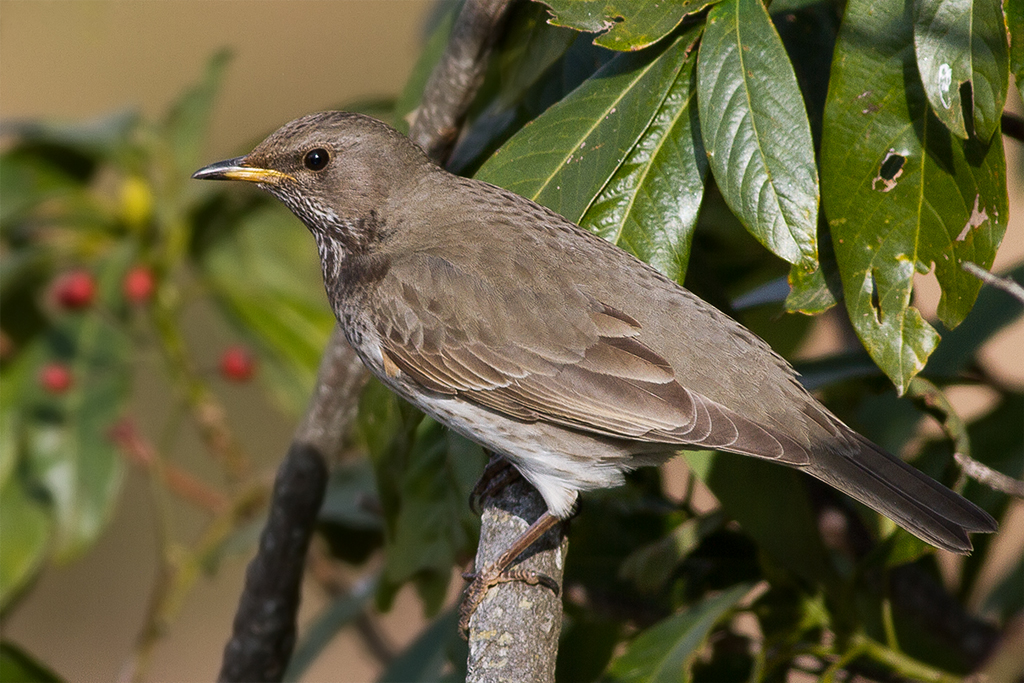
How to identify the Black-throated Thrush
Turdus atrogularis
Spotted a bird? Identify it instantly with the Birdby app
Open the appTo correctly identify the Black-throated Thrush (Turdus atrogularis), check each of these features. Birds can be tricky: habit, habitat, and call often confirm a sighting that a single photo cannot.
Size at a glance
- Length
- 23-27 cm
- Wingspan
- 37-43 cm
- Weight
- 63-105 g
Physical features to check
- 1
Plumage
Overall feather coloration and pattern.
Adult male: Head, throat, and upper breast are solid black, sharply demarcated from the white belly. Upperparts are dark grey-brown. Undertail coverts are white. Adult female: Has a much paler, streaked grey-brown throat and breast, often with a hint of dark mottling or streaking, but never solid black. Upperparts are similar to the male but often slightly paler. Immature/Juvenile: Resembles the female, but with buff streaking on the upperparts and more pronounced dark spots or streaks on the throat and breast, often with rufous tones on the flanks.
- 2
Beak shape
Shape and color of the bill: a key field mark.
Medium-length, slender, straight bill; dark horn-colored, often with a paler base to the lower mandible.
- 3
Eye color
Iris color and any distinctive eye markings.
Dark brown.
- 4
Leg color
Leg and foot color.
Dark brown to blackish.
- 5
Distinguishing features
Standout features that separate this species.
The male's striking black throat and breast contrasting with white belly. The female's streaky grey-brown throat, distinct from other thrushes.
- 6
Juvenile appearance
How young birds differ from adults.
Juveniles are paler and browner overall than adults, with buff-white streaking on the back and head. The throat and breast are buffish with heavy dark brown spotting and streaking, often with rufous wash on flanks. This streaking gradually fades as they mature into first-winter plumage, which resembles a duller female.
- 7
Seasonal changes
Plumage variation between breeding and non-breeding seasons.
Plumage does not change significantly between breeding and non-breeding seasons for adults, apart from wear and tear. First-winter males begin to show more black on the throat in their first autumn/winter but typically do not achieve the full black throat of an adult male until their second year.
- 8
Sexual dimorphism
How males and females differ.
Strong sexual dimorphism in plumage, particularly in the throat and breast coloration. Males possess a solid black throat, while females have a streaked grey-brown throat.
Key field marks
- Throat and Breast Color. Male: Solid, velvety black throat extending to the upper breast, sharply contrasting with a clean white belly. Female: Paler, streaky grey-brown throat and upper breast, lighter than the male, but still distinct from other thrushes.
- Upperparts. Uniform dark grey-brown back, wings, and tail in both sexes, without strong markings or patterns.
- Undertail Coverts. Always white in both sexes, which is a useful field mark.
- Behavior. Often seen foraging on the ground, sometimes in open areas. Can be quite skittish in breeding areas but more approachable in winter. Often in flocks during migration and winter.
- Song/Calls. Listen for the distinctive clear, fluty, melancholy song (breeding) or the soft 'churr' and high 'tseep' calls.
Explore the Black-throated Thrush
Identify birds anywhere
Free on iOS, Android, and Web. Photo & sound identification, full species database, and your personal life list.