
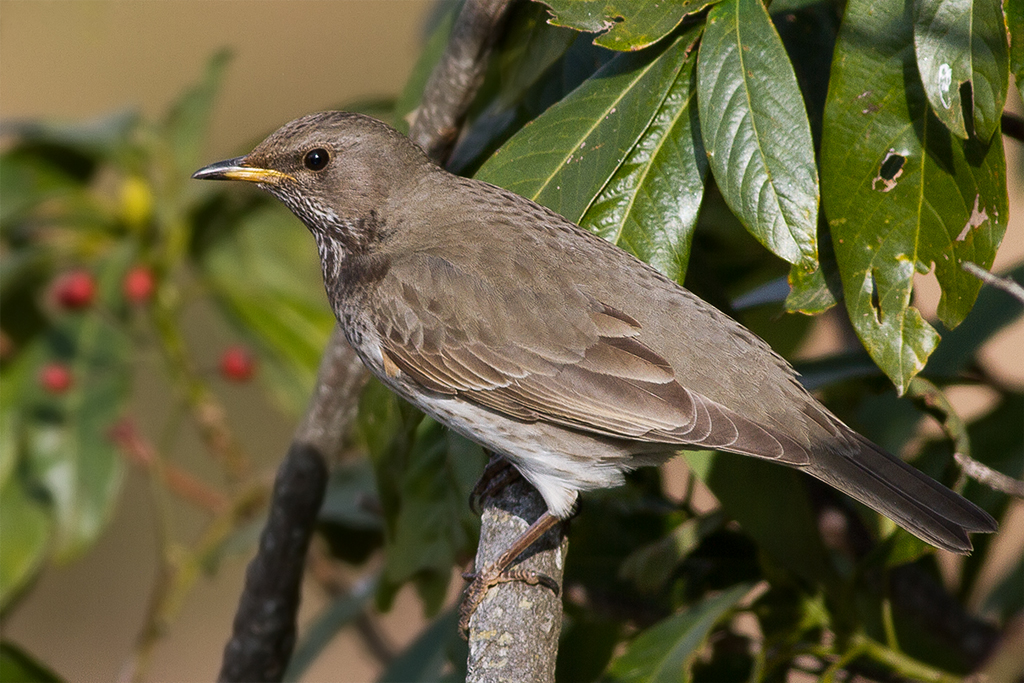
Where does the Black-throated Thrush live?
Turdus atrogularis
Spotted a bird? Identify it instantly with the Birdby app
Open the appThe Black-throated Thrush lives in specific habitats and regions. Knowing where, and when, to look improves your chances of a successful sighting.
Biomes
Taiga, boreal forests, mixed woodlands, steppe-forests, subalpine zones.
Geographic range
Breeds from western Siberia across to central Asia (e.g., Altai Mountains, Tien Shan). Winters in parts of Central Asia, the Indian subcontinent, and the Middle East, with vagrants reaching Europe and North Africa.
Preferred environments
Breeding: Coniferous and mixed forests, particularly those with a dense undergrowth. Often near clearings or forest edges. Wintering: Open woodlands, orchards, gardens, cultivation, and semi-arid scrub with scattered trees.
Elevation range
Breeds at elevations from sea level up to 2500m in mountainous regions. Winters at lower elevations, often in foothills and plains.
Where to look
Breeding Grounds
Look in coniferous forests, mixed woodlands, and taiga environments across Siberia and Central Asia. Forest edges and areas with dense undergrowth are preferred.
Wintering Grounds
Search open woodlands, agricultural areas with scattered trees, orchards, gardens, and scrubland in Central Asia, India, and the Middle East.
Vagrant Locations
In Europe, look in any suitable thrush habitat (fields, parks, gardens, woodlands) especially during autumn migration periods (October-November) when individuals may have overshot their typical wintering range.
Field tips
- Scan Open Ground and Shrubs. They frequently forage on the ground, often venturing out from cover. In winter, check berry-laden shrubs and trees.
- Listen for Vocalizations. Their song is distinctive, and their calls can help pinpoint their presence, particularly the 'churr' contact call.
- Observe Flocks. During migration and winter, they often form mixed flocks with other thrushes. Carefully examine each individual in a flock for the diagnostic throat pattern.
- Check for Vagrants. In regions outside its normal range (e.g., Europe), birdwatchers should be vigilant during autumn migration for unusual thrush sightings, especially after easterly winds.
Migration
Long-distance migratory. Breeds in northern latitudes and moves south to warmer climates for the winter. Migrates primarily at night. European records are predominantly of vagrants during autumn migration.
Explore the Black-throated Thrush
Identify birds anywhere
Free on iOS, Android, and Web. Photo & sound identification, full species database, and your personal life list.