
Spotted a bird? Identify it instantly with the Birdby app
Open the appAbout
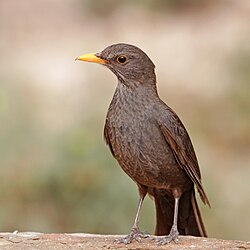
The Common Blackbird is a widespread and familiar thrush species, known for the striking black plumage and bright orange-yellow bill and eye-ring of the male. Females are typically duller brown. It is a highly adaptable bird, thriving in a variety of habitats from woodlands to urban gardens across much of Eurasia and parts of North Africa, and introduced to Australia and New Zealand. Its melodious song is a characteristic sound of spring and early summer.
Size & lifespan
- Length
- 23.5-29 cm
- Wingspan
- 34-38 cm
- Weight
- 80-125 g
- Lifespan
- 2-5 years (up to 20 years recorded in captivity)
- Diet
- Omnivore
Physical characteristics
- Plumage
- Adult males are entirely glossy black. Adult females are dark brown, often with a paler throat and sometimes faint mottling on the breast. Juveniles are mottled brown with rufous tones, especially on the underparts, and often have pale streaks.
- Beak shape
- Slender, pointed bill. Adult males have a bright orange-yellow bill, sometimes with a darker tip. Females and juveniles have a duller, brownish-yellow to dark brown bill.
- Eye color
- Dark brown. Adult males have a prominent bright orange-yellow eye-ring.
- Leg color
- Dark brown to blackish-brown.
- Distinguishing features
- The combination of all-black plumage, bright orange-yellow bill, and eye-ring in the male is unmistakable. Females are distinguished by their dark brown plumage, often with a paler throat, and lack the male's bright eye-ring and bill color.
- Juvenile appearance
- Juveniles are mottled brown with rufous tones, especially on the underparts, and often have pale streaks. Their bill is dark brown, and they lack the adult male's bright eye-ring.
- Seasonal changes
- No significant seasonal plumage changes in adults. Bill color of males can be slightly duller outside the breeding season, but the bright orange-yellow is generally maintained.
- Sexual dimorphism
- Pronounced. Males are glossy black with bright orange-yellow bill and eye-ring. Females are dark brown with a duller bill and no prominent eye-ring.
How to identify
- 1
Male Plumage
Look for a completely glossy black bird with a bright orange-yellow bill and a prominent orange-yellow eye-ring. This combination is unique among common European birds.
- 2
Female Plumage
Identify females by their dark brown plumage, often with a paler throat and sometimes faint mottling on the breast. Their bill is duller (brownish-yellow to dark brown) and they lack the male's bright eye-ring.
- 3
Juvenile Plumage
Young birds are mottled brown with rufous tones and pale streaks, especially on the underparts. Their bill is dark. They often appear scruffier than adults.
- 4
Behavior
Observe its foraging style: hopping on the ground, pausing, tilting its head to listen for worms, and then suddenly plunging its bill into the soil. Its upright posture when alert is also characteristic.
- 5
Song
Listen for its distinctive, rich, fluty, and melancholic song, often delivered from a high perch. It's a series of varied, unhurried phrases.
Habitat & range
- Biomes
- Temperate forests, woodlands, scrublands, parks, gardens, urban areas, agricultural land.
- Geographic range
- Widespread across Europe, Asia (east to China), and North Africa. Introduced to Australia and New Zealand.
- Elevation range
- Sea level up to 2,500 meters, occasionally higher.
- Preferred environments
- Prefers areas with dense undergrowth for nesting and foraging, often near human habitation. Gardens, parks, hedgerows, and woodland edges are ideal.
Behavior
- Activity time
- Diurnal, most active at dawn and dusk.
- Feeding habits
- Forages primarily on the ground, hopping and pausing to listen for prey. Diet includes earthworms, insects, larvae, snails, slugs, berries, and fallen fruit. Often seen flicking leaf litter to uncover invertebrates.
- Social behavior
- Generally solitary or in pairs during the breeding season. May form loose flocks in winter, especially at abundant food sources or communal roosts.
- Flight pattern
- Strong, direct flight, often low to the ground. Undulating flight over longer distances. When alarmed, may fly rapidly into dense cover.
- Migration pattern
- Northern and eastern populations are migratory, moving south and west for winter. Western and southern European populations are largely resident, though some individuals may undertake short-distance movements.
- Territoriality
- Males are highly territorial during the breeding season, defending their nesting and foraging areas with song and aggressive displays.
Song & calls
- Song
- A rich, fluty, melodic song, often described as a series of varied, clear, and unhurried phrases with a melancholic quality. Often includes mimicry of other birds or sounds. Typically sung from a high perch.
- Call
- Common calls include a sharp, insistent 'chook-chook-chook' alarm call, a softer 'tseee' contact call, and a harsh, rattling 'churr' when agitated or mobbing predators.
- When they vocalize
- Sings most frequently from early spring through mid-summer, often starting before dawn and continuing until dusk. Alarm calls are given year-round when a threat is perceived.
Breeding & reproduction
- Breeding season
- Typically March to July, with multiple broods (2-3, sometimes 4) common.
- Nesting habits
- Nests are cup-shaped, built by the female from grass, moss, leaves, and mud, lined with fine grass. Usually placed in dense bushes, hedges, or low trees, often close to human activity.
- Clutch size
- 3-5 eggs
- Egg description
- 3-5 eggs, typically greenish-blue with reddish-brown speckles, especially at the broader end. Approximately 29 x 21 mm.
- Incubation period
- 12-14 days, primarily by the female.
- Fledging period
- 12-15 days after hatching. Young are fed by both parents.
- Parental care
- Both parents feed the nestlings and fledglings. Males may continue to feed the first brood while the female starts a second clutch.
Where to find
Gardens and Parks
Common Blackbirds are highly adapted to human environments and are frequently found in suburban and urban gardens, parks, and cemeteries.
Woodlands and Forests
They inhabit deciduous and mixed woodlands, particularly at the edges and in areas with dense undergrowth.
Hedgerows and Farmland
Agricultural areas with hedgerows, orchards, and scattered trees provide suitable habitat.
Field tips
- Listen for their song. Their distinctive, melodious song is often the first indication of their presence, especially at dawn and dusk during spring and summer.
- Look on the ground. They are primarily ground feeders. Watch for them hopping and pausing on lawns, leaf litter, or bare soil, searching for invertebrates.
- Check dense vegetation. They often nest and roost in dense bushes, hedges, and low trees. Look for movement within these areas.
- Observe feeding stations. In winter, they may visit bird feeders for fruit, seeds, or mealworms, especially if ground-level feeding trays are provided.
Similar species
Ring Ouzel
Turdus torquatus
Males are similar in overall black plumage but have a distinctive white crescent-shaped gorget on the breast. Females are browner with a less distinct gorget. Ring Ouzels are typically found in upland, rocky habitats, unlike the more widespread Common Blackbird.
Eurasian Starling
Sturnus vulgaris
Starlings are smaller, have a shorter tail, and their plumage is iridescent black with white speckles (especially in winter). Their flight is more direct and rapid, and their bill is yellow in summer but dark in winter. Blackbirds are larger, uniformly black (males), and have a longer tail.
American Robin
Turdus migratorius
While also a thrush, the American Robin has a distinctive brick-red breast and grey back, clearly differentiating it from the all-black male Common Blackbird. Females and juveniles of both species are brown, but the robin's rufous breast is still a key identifier.
Quick facts
- Scientific Name:
- Turdus merula
- Family:
- Turdidae (Thrushes)
- Diet:
- Omnivorous (insects, worms, berries, fruit)
- Habitat:
- Woodlands, gardens, parks, urban areas
- Conservation Status:
- Least Concern (IUCN)
- Distinctive Feature (Male):
- Glossy black plumage, orange-yellow bill and eye-ring
- Song:
- Rich, fluty, melancholic melody
Fun facts
- The Common Blackbird was voted the 'National Bird of Sweden' in 1962.
- Males are known to incorporate mimicry of other bird calls or even artificial sounds into their complex songs.
- Despite its name, the Common Blackbird is not closely related to the New World blackbirds (family Icteridae).
- Urban blackbirds often start singing earlier in the morning and finish later in the evening than their rural counterparts, possibly due to artificial light and noise.
- In some cultures, the blackbird is associated with magic and mystery due to its dark plumage and melodious song.
Scientific classification
- Kingdom
- Animalia
- Phylum
- Chordata
- Class
- Aves
- Order
- Passeriformes
- Family
- Turdidae
- Genus
- Turdus
- Species
- Turdus merula
Explore the Common Blackbird
Identify birds anywhere
Free on iOS, Android, and Web. Photo & sound identification, full species database, and your personal life list.