
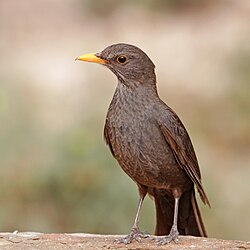
How to identify the Common Blackbird
Turdus merula
Spotted a bird? Identify it instantly with the Birdby app
Open the appTo correctly identify the Common Blackbird (Turdus merula), check each of these features. Birds can be tricky: habit, habitat, and call often confirm a sighting that a single photo cannot.
Size at a glance
- Length
- 23.5-29 cm
- Wingspan
- 34-38 cm
- Weight
- 80-125 g
Physical features to check
- 1
Plumage
Overall feather coloration and pattern.
Adult males are entirely glossy black. Adult females are dark brown, often with a paler throat and sometimes faint mottling on the breast. Juveniles are mottled brown with rufous tones, especially on the underparts, and often have pale streaks.
- 2
Beak shape
Shape and color of the bill: a key field mark.
Slender, pointed bill. Adult males have a bright orange-yellow bill, sometimes with a darker tip. Females and juveniles have a duller, brownish-yellow to dark brown bill.
- 3
Eye color
Iris color and any distinctive eye markings.
Dark brown. Adult males have a prominent bright orange-yellow eye-ring.
- 4
Leg color
Leg and foot color.
Dark brown to blackish-brown.
- 5
Distinguishing features
Standout features that separate this species.
The combination of all-black plumage, bright orange-yellow bill, and eye-ring in the male is unmistakable. Females are distinguished by their dark brown plumage, often with a paler throat, and lack the male's bright eye-ring and bill color.
- 6
Juvenile appearance
How young birds differ from adults.
Juveniles are mottled brown with rufous tones, especially on the underparts, and often have pale streaks. Their bill is dark brown, and they lack the adult male's bright eye-ring.
- 7
Seasonal changes
Plumage variation between breeding and non-breeding seasons.
No significant seasonal plumage changes in adults. Bill color of males can be slightly duller outside the breeding season, but the bright orange-yellow is generally maintained.
- 8
Sexual dimorphism
How males and females differ.
Pronounced. Males are glossy black with bright orange-yellow bill and eye-ring. Females are dark brown with a duller bill and no prominent eye-ring.
Key field marks
- Male Plumage. Look for a completely glossy black bird with a bright orange-yellow bill and a prominent orange-yellow eye-ring. This combination is unique among common European birds.
- Female Plumage. Identify females by their dark brown plumage, often with a paler throat and sometimes faint mottling on the breast. Their bill is duller (brownish-yellow to dark brown) and they lack the male's bright eye-ring.
- Juvenile Plumage. Young birds are mottled brown with rufous tones and pale streaks, especially on the underparts. Their bill is dark. They often appear scruffier than adults.
- Behavior. Observe its foraging style: hopping on the ground, pausing, tilting its head to listen for worms, and then suddenly plunging its bill into the soil. Its upright posture when alert is also characteristic.
- Song. Listen for its distinctive, rich, fluty, and melancholic song, often delivered from a high perch. It's a series of varied, unhurried phrases.
Explore the Common Blackbird
Identify birds anywhere
Free on iOS, Android, and Web. Photo & sound identification, full species database, and your personal life list.