
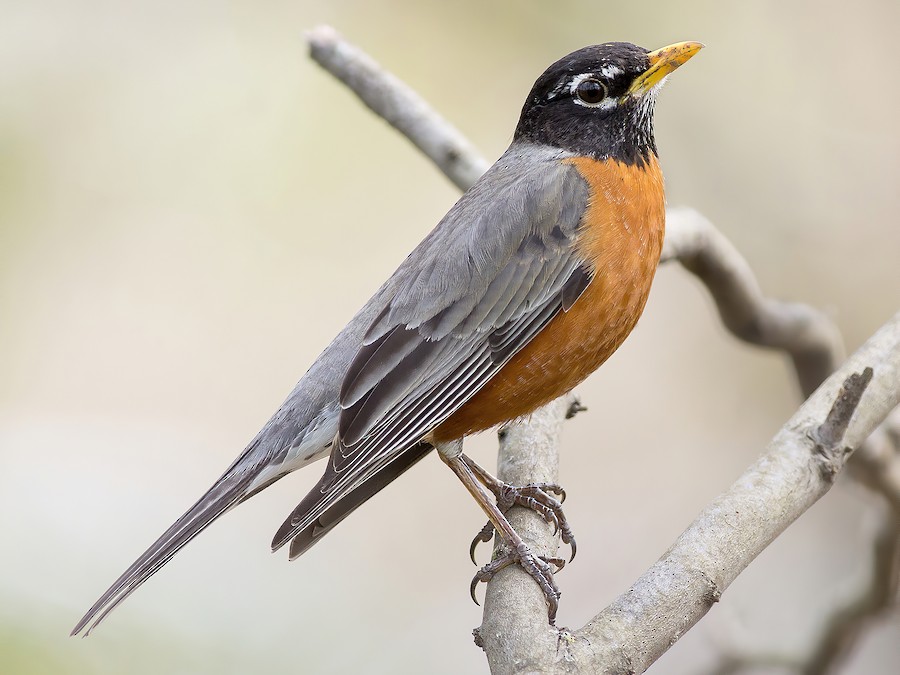
How to identify the American Robin
Turdus migratorius
Spotted a bird? Identify it instantly with the Birdby app
Open the appTo correctly identify the American Robin (Turdus migratorius), check each of these features. Birds can be tricky: habit, habitat, and call often confirm a sighting that a single photo cannot.
Size at a glance
- Length
- 20-28 cm (8-11 in)
- Wingspan
- 31-41 cm (12-16 in)
- Weight
- 72-94 g (2.5-3.3 oz)
Physical features to check
- 1
Plumage
Overall feather coloration and pattern.
Adults have a dark gray to black head, back, and wings, with a prominent brick-red to rufous-orange breast and belly. The lower belly and undertail coverts are white. There is a broken white eye-ring and white streaking on the throat. The bill is yellow with a dark tip, especially in males during breeding season.
- 2
Beak shape
Shape and color of the bill: a key field mark.
Medium-sized, straight, and pointed; yellow with a dark tip, becoming entirely yellow in breeding males.
- 3
Eye color
Iris color and any distinctive eye markings.
Dark brown
- 4
Leg color
Leg and foot color.
Dark gray to black
- 5
Distinguishing features
Standout features that separate this species.
Brick-red breast, dark head and back, white lower belly, and a distinctive white eye-ring. Its upright posture and hopping gait on lawns are also characteristic.
- 6
Juvenile appearance
How young birds differ from adults.
Juveniles have a spotted breast (dark spots on a pale background) and pale streaking on the back and wings, which gradually fades as they mature into their first basic plumage. They also have a less distinct eye-ring.
- 7
Seasonal changes
Plumage variation between breeding and non-breeding seasons.
Plumage remains largely consistent year-round, though colors may appear slightly duller due to feather wear by late summer. Breeding males exhibit the most vibrant coloration.
- 8
Sexual dimorphism
How males and females differ.
Males are typically slightly larger and have more vibrant, darker plumage, particularly a darker head and a richer, more intense red breast. Females are duller overall, with a paler head and a less vivid orange-red breast.
Key field marks
- Plumage Coloration. Look for the dark gray/black head and back contrasting with the bright brick-red breast and white lower belly. The white eye-ring is a key field mark.
- Behavior and Posture. Observe its characteristic stop-and-go foraging on lawns, often cocking its head to listen for earthworms. It typically stands upright.
- Song and Calls. Listen for its distinctive, cheerful, caroling song, especially at dawn. Its sharp 'peek' alarm call is also very recognizable.
- Bill Color. Note the yellow bill with a dark tip, which can become entirely yellow in breeding males.
Explore the American Robin
Identify birds anywhere
Free on iOS, Android, and Web. Photo & sound identification, full species database, and your personal life list.