
Spotted a bird? Identify it instantly with the Birdby app
Open the appAbout
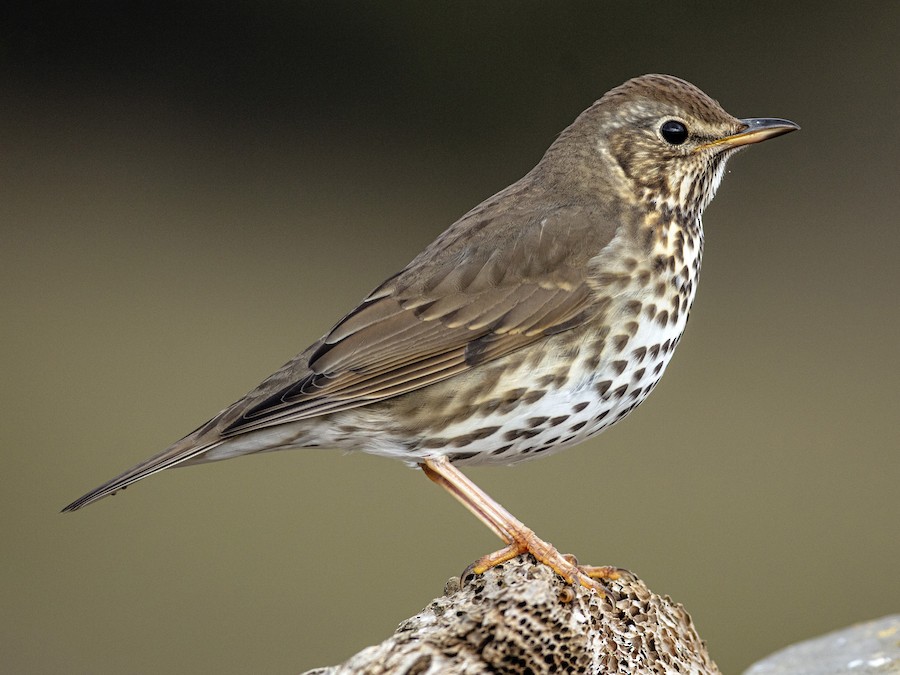
The Song Thrush is a medium-sized passerine bird, well-known for its beautiful and repetitive song. It is a common and widespread species across much of Eurasia, inhabiting woodlands, gardens, and parks. Its diet primarily consists of invertebrates, especially snails, which it famously breaks open on 'anvil' stones.
Size & lifespan
- Length
- 20-23 cm
- Wingspan
- 33-36 cm
- Weight
- 50-107 g
- Lifespan
- 2-3 years (up to 10 years recorded)
- Diet
- Omnivore (primarily invertebrates, especially snails, earthworms, insects; also berries and fruits)
Physical characteristics
- Plumage
- Upperparts are uniformly warm brown, often with a rufous tinge. Underparts are pale cream or buff, heavily spotted with dark brown or black, forming distinct arrow-shaped or triangular markings. The flanks are often tinged with buff or orange-brown.
- Beak shape
- Medium-length, slender, pointed bill; dark brown to blackish on the upper mandible, paler yellowish-horn at the base of the lower mandible.
- Eye color
- Dark brown.
- Leg color
- Pinkish-brown to yellowish-brown.
- Distinguishing features
- Distinctive dark spotting on the breast and flanks, often forming neat rows. A pale buffy supercilium (eyebrow stripe) is sometimes faintly visible. The underwing coverts are rufous-orange, visible in flight.
- Juvenile appearance
- Similar to adults but often with paler, more streaky upperparts, and the spots on the underparts may be less sharply defined, sometimes appearing more smudged. Young birds may also show faint pale streaks on the back and head.
- Seasonal changes
- No significant seasonal plumage changes. Plumage may appear slightly duller or more worn outside of the breeding season due to feather abrasion.
- Sexual dimorphism
- None; males and females are identical in plumage.
How to identify
- 1
Plumage
Look for the warm brown upperparts and the heavily spotted, pale underparts. The spots are typically arrow-shaped or triangular and extend down the flanks.
- 2
Underwing
In flight, observe the rufous-orange underwing coverts, a key distinguishing feature from Mistle Thrush.
- 3
Song
Listen for the distinctive, repetitive song with phrases repeated 2-4 times. This is often the easiest way to identify a Song Thrush, even when hidden in foliage.
- 4
Behavior
Watch for its ground-foraging behavior, including its characteristic hopping and pausing, and the use of 'anvil' stones to break snail shells.
- 5
Size and Shape
Note its medium size and typical thrush shape, slightly smaller and more slender than a Mistle Thrush.
Habitat & range
- Biomes
- Temperate forests, woodlands, scrub, gardens, parks, hedgerows, orchards.
- Geographic range
- Widespread across Europe, North Africa, and Asia, from Ireland and Portugal east to Siberia. Introduced to Australia and New Zealand.
- Elevation range
- Sea level up to 2,200 meters in some parts of its range, but typically found at lower to mid-elevations.
- Preferred environments
- Prefers areas with dense undergrowth for nesting and foraging, often near damp ground where invertebrates are abundant. Gardens and parks with mature trees and shrubs are ideal.
Behavior
- Activity time
- Diurnal, most active during early morning and late afternoon.
- Feeding habits
- Forages on the ground, often hopping and pausing to listen for prey. Famous for its habit of using a 'thrush anvil' – a stone or hard surface – to break open snail shells. Also gleans insects from foliage and eats berries from bushes.
- Social behavior
- Generally solitary or found in pairs during the breeding season. Can form loose flocks outside the breeding season, especially during migration or in areas with abundant food resources.
- Flight pattern
- Strong, undulating flight over longer distances, but often flies low and direct between cover. When disturbed, it may fly rapidly into dense vegetation.
- Migration pattern
- Northern and eastern populations are migratory, moving to southern Europe, North Africa, and the Middle East for winter. Western and southern populations are largely resident or undertake short-distance movements. Migrates at night.
- Territoriality
- Males are highly territorial during the breeding season, defending their nesting and foraging areas with song and aggressive displays.
Song & calls
- Song
- A rich, varied, and melodious song, characterized by repeated phrases (typically 2-4 times) of clear, fluty, and often complex notes. It incorporates mimicry of other birds and sounds. Often described as 'did he do it, did he do it, did he do it, he did it, he did it'.
- Call
- Common calls include a sharp, explosive 'tsip' or 'chup' when alarmed, and a thin, high-pitched 'seep' contact call, especially during migration. A harsh 'chook-chook' alarm call is also used.
- When they vocalize
- Sings most frequently from late winter through summer, often from a prominent perch (e.g., treetop, chimney). Sings throughout the day, but particularly at dawn and dusk.
Breeding & reproduction
- Breeding season
- March to August, with peak activity from April to June. Can raise 2-3 broods per year.
- Nesting habits
- The nest is a neat, cup-shaped structure built by the female, typically in a bush, hedge, or tree fork, usually 1-5 meters above the ground. It is constructed from grass, moss, and twigs, lined internally with mud or rotten wood pulp, creating a smooth, hard cup.
- Clutch size
- 3-6 eggs
- Egg description
- 3-6 (typically 4-5) eggs per clutch. Eggs are smooth, glossy, bright blue, often with sparse black or dark brown spots, particularly at the broader end.
- Incubation period
- 11-15 days, primarily by the female.
- Fledging period
- 12-15 days after hatching. Young are fed by both parents.
- Parental care
- Both parents feed the nestlings and fledglings. The female primarily incubates, while the male often brings food to her on the nest.
Where to find
Gardens and Parks
Common in suburban and urban green spaces with mature trees, shrubs, and open ground for foraging.
Woodlands and Forests
Found in deciduous and mixed woodlands, especially those with a good understory.
Hedgerows and Orchards
These linear habitats provide excellent nesting and foraging opportunities.
Field tips
- Listen for the song. The Song Thrush's distinctive, repetitive song is often the first indication of its presence, especially at dawn and dusk.
- Look for 'anvil' stones. Check for stones or hard surfaces with broken snail shells nearby, indicating a thrush feeding area.
- Scan the ground. They frequently forage on the ground, so observe open areas under trees and shrubs.
- Be patient. While often conspicuous when singing, they can be shy when foraging. Remain still and observe quietly.
Similar species
Mistle Thrush
Turdus viscivorus
The Mistle Thrush is larger, paler, and greyer overall, with rounder, bolder spots on the breast and flanks that are less arrow-shaped. It has prominent white underwing coverts (not rufous-orange) and a more upright posture. Its song is also fluty but less varied and more melancholic, often described as 'flute-like' but without the repetition of phrases.
Redwing
Turdus iliacus
The Redwing is smaller than the Song Thrush, with a prominent creamy supercilium and distinctive rufous-orange flanks and underwing coverts. Its breast spotting is finer and less extensive. Its song is simpler, often a short, fluty whistle, and its call is a distinctive 'tseep'.
Common Blackbird
Turdus merula
Adult male Blackbirds are entirely black with an orange bill and eye-ring. Females are dark brown with a duller bill and some streaking on the throat. Blackbirds lack the extensive spotting of the Song Thrush. Their song is rich and fluty but lacks the repetitive phrases of the Song Thrush.
Quick facts
- Diet:
- Invertebrates (especially snails), berries
- Habitat:
- Woodlands, gardens, parks
- Song:
- Repetitive, melodious phrases
- Nesting:
- Cup-shaped nest lined with mud
- Conservation Status:
- Least Concern
Fun facts
- Song Thrushes are famous for their 'thrush anvils', using a specific stone or hard object to smash open snail shells to extract the soft body.
- Their song is one of the most complex and varied among European birds, often incorporating mimicry of other species.
- The Song Thrush was introduced to Australia and New Zealand in the 19th century, where it has established breeding populations.
- Despite its 'Least Concern' status globally, some regional populations, particularly in Western Europe, have experienced significant declines.
Scientific classification
- Kingdom
- Animalia
- Phylum
- Chordata
- Class
- Aves
- Order
- Passeriformes
- Family
- Turdidae
- Genus
- Turdus
- Species
- Turdus philomelos
Explore the Song Thrush
Identify birds anywhere
Free on iOS, Android, and Web. Photo & sound identification, full species database, and your personal life list.