
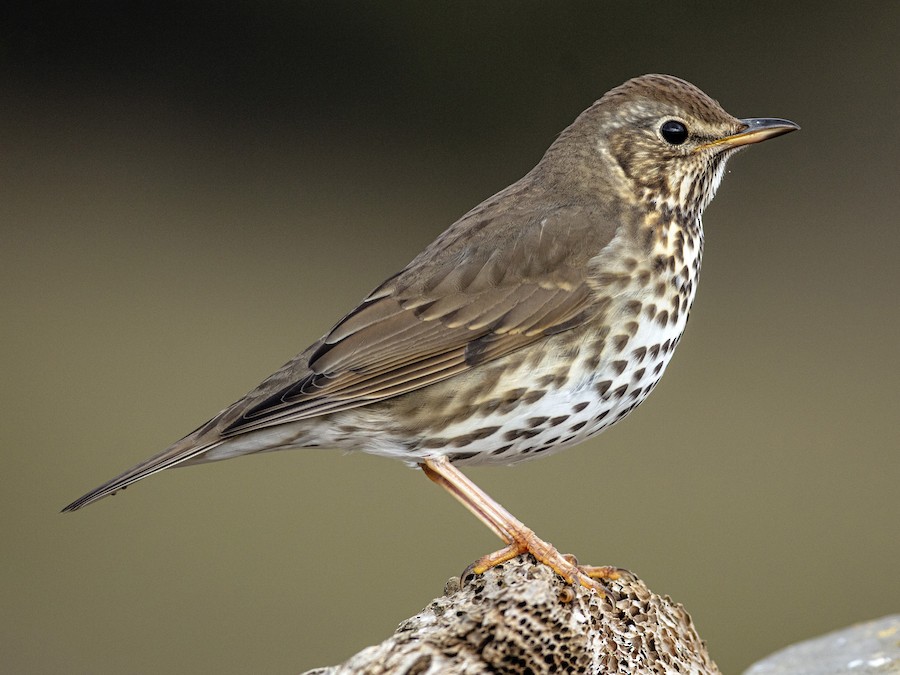
How to identify the Song Thrush
Turdus philomelos
Spotted a bird? Identify it instantly with the Birdby app
Open the appTo correctly identify the Song Thrush (Turdus philomelos), check each of these features. Birds can be tricky: habit, habitat, and call often confirm a sighting that a single photo cannot.
Size at a glance
- Length
- 20-23 cm
- Wingspan
- 33-36 cm
- Weight
- 50-107 g
Physical features to check
- 1
Plumage
Overall feather coloration and pattern.
Upperparts are uniformly warm brown, often with a rufous tinge. Underparts are pale cream or buff, heavily spotted with dark brown or black, forming distinct arrow-shaped or triangular markings. The flanks are often tinged with buff or orange-brown.
- 2
Beak shape
Shape and color of the bill: a key field mark.
Medium-length, slender, pointed bill; dark brown to blackish on the upper mandible, paler yellowish-horn at the base of the lower mandible.
- 3
Eye color
Iris color and any distinctive eye markings.
Dark brown.
- 4
Leg color
Leg and foot color.
Pinkish-brown to yellowish-brown.
- 5
Distinguishing features
Standout features that separate this species.
Distinctive dark spotting on the breast and flanks, often forming neat rows. A pale buffy supercilium (eyebrow stripe) is sometimes faintly visible. The underwing coverts are rufous-orange, visible in flight.
- 6
Juvenile appearance
How young birds differ from adults.
Similar to adults but often with paler, more streaky upperparts, and the spots on the underparts may be less sharply defined, sometimes appearing more smudged. Young birds may also show faint pale streaks on the back and head.
- 7
Seasonal changes
Plumage variation between breeding and non-breeding seasons.
No significant seasonal plumage changes. Plumage may appear slightly duller or more worn outside of the breeding season due to feather abrasion.
- 8
Sexual dimorphism
How males and females differ.
None; males and females are identical in plumage.
Key field marks
- Plumage. Look for the warm brown upperparts and the heavily spotted, pale underparts. The spots are typically arrow-shaped or triangular and extend down the flanks.
- Underwing. In flight, observe the rufous-orange underwing coverts, a key distinguishing feature from Mistle Thrush.
- Song. Listen for the distinctive, repetitive song with phrases repeated 2-4 times. This is often the easiest way to identify a Song Thrush, even when hidden in foliage.
- Behavior. Watch for its ground-foraging behavior, including its characteristic hopping and pausing, and the use of 'anvil' stones to break snail shells.
- Size and Shape. Note its medium size and typical thrush shape, slightly smaller and more slender than a Mistle Thrush.
Explore the Song Thrush
Identify birds anywhere
Free on iOS, Android, and Web. Photo & sound identification, full species database, and your personal life list.