
Spotted a bird? Identify it instantly with the Birdby app
Open the appAbout
The Common Murre is a large seabird belonging to the auk family (Alcidae). It is a highly specialized pursuit-diver, exhibiting a sleek, dark-and-white plumage adapted for marine life. Their upright posture on land gives them a penguin-like appearance. They form large, dense colonies on coastal cliffs during the breeding season.
Size & lifespan
- Length
- 40-48 cm (16-19 in)
- Wingspan
- 61-73 cm (24-29 in)
- Weight
- 850-1200 g (1.9-2.6 lbs)
- Lifespan
- Up to 30 years in the wild, though typically 15-20 years.
- Diet
- Primarily small to medium-sized fish (e.g., sandlance, capelin, herring, cod fry) caught by pursuit-diving. Also consumes marine invertebrates like squid and crustaceans, particularly during non-breeding seasons or when fish are scarce.
Physical characteristics
- Plumage
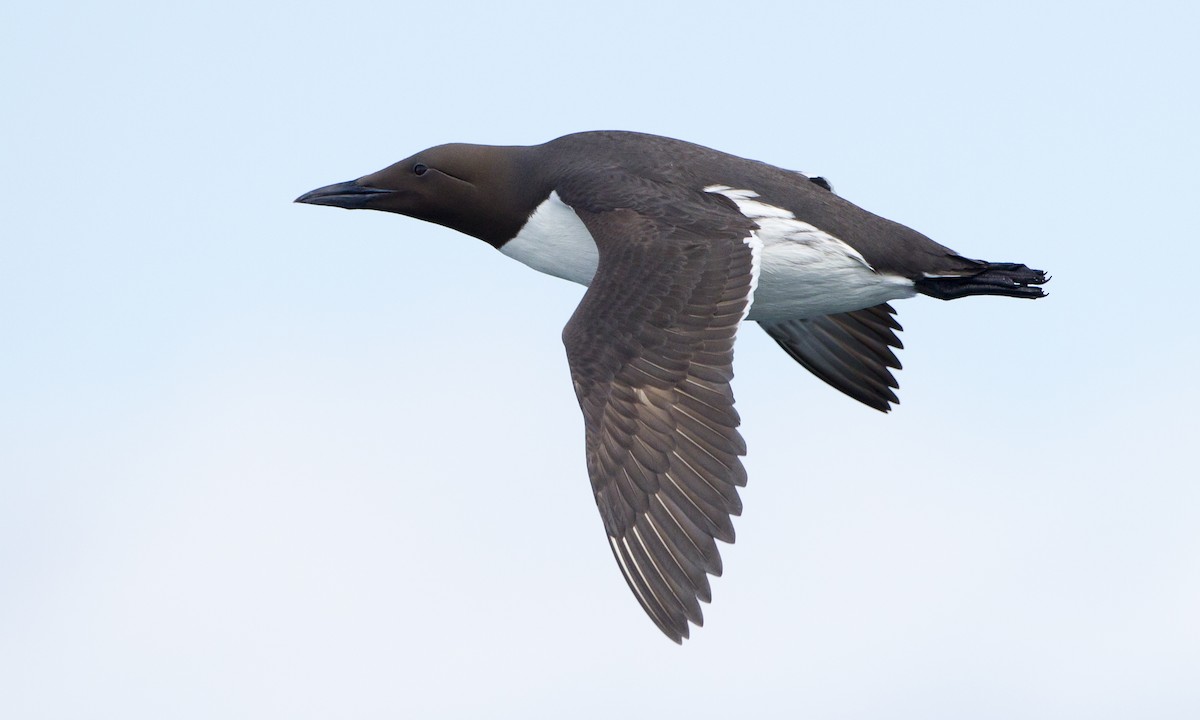
- Adult breeding plumage is characterized by a dark chocolate-brown (almost black) head, neck, back, and upperwings, contrasting sharply with a pure white belly and flanks. A distinct white stripe extends from the rear of the eye in birds of the 'bridled' form (U. a. aalge, U. a. albionis, U. a. hyperborea subspecies). Non-breeding plumage is similar but the chin and throat become white, and a dark line extends back from the eye, often referred to as the 'gular stripe'.
- Beak shape
- A slender, pointed, dagger-like bill, dark horn-colored. Specialized for grasping small fish.
- Eye color
- Dark brown, often appearing black. In the bridled morph, a thin white line encircles the eye and extends as a variable 'bridle' mark behind it.
- Leg color
- Dark gray to black, webbed feet positioned far back on the body, ideal for swimming and diving.
- Distinguishing features
- Upright posture on land suggesting a small penguin. In flight, wings are small and rapidly beating. Dark brown upperparts, white underparts, and slender pointed bill are key. Bridled form (with white eye-ring and post-ocular stripe) is a distinctive but geographically variable trait.
- Juvenile appearance
- Juveniles resemble non-breeding adults but are generally smaller, often with a slightly shorter and more pointed bill, and a less defined dark throat stripe initially. Their upperparts are usually duller brown. Fledglings are smaller versions of flightless adults, often with downy remnants.
- Seasonal changes
- The most notable change is in head and neck coloration. In breeding plumage, the head and neck are dark brown. In non-breeding plumage (winter), the throat and cheeks become white, creating a distinct white 'bib' and a dark line running through the eye and across the cheek. The rest of the body plumage remains largely consistent.
- Sexual dimorphism
- Minimal; males and females are visually identical in plumage and size. Field identification of sexes is not possible.
How to identify
- 1
Plumage Coloration
Look for the sharp contrast between the dark chocolate-brown (breeding) or blackish-brown (non-breeding) upperparts and pure white underparts. Note the extent of dark on the head and neck in breeding plumage versus the white 'bib' and dark eye-stripe in non-breeding plumage.
- 2
Bill Shape
Observe the slender, pointed, dagger-like bill. This helps distinguish it from the thicker-billed murre and the heavy, compressed bill of a Razorbill.
- 3
Posture
On land, they stand very upright, giving them a typical penguin-like stance.
- 4
Flight
Fast, direct flight with rapid wing beats. They fly low over the water.
- 5
Bridled Morph (where present)
In some populations (e.g., North Atlantic), look for a fine white ring around the eye that extends as a thin white line behind the eye. This 'bridle' is diagnostic for individuals that possess it, but many Common Murres lack it.
Habitat & range
- Biomes
- Temperate and subarctic marine environments. Found in coastal waters, offshore pelagic zones, and along rocky coastlines.
- Geographic range
- Circumpolar in the Northern Hemisphere. Found across the North Atlantic (from eastern Canada to Greenland, Iceland, Scandinavia, and the UK) and North Pacific (from Alaska down to California and across to Japan and Korea).
- Elevation range
- Sea level. Breeds on cliffs overlooking the ocean.
- Preferred environments
- Steep, rocky coastal cliffs for breeding, often on narrow ledges or flat tops. Forages in productive cold ocean waters, typically within 100 km of the coast, but can be found further offshore. Requires abundant supplies of small pelagic fish.
Behavior
- Activity time
- Diurnal, active during daylight hours for foraging and colonial interactions.
- Feeding habits
- Highly adept pursuit-divers. They propel themselves underwater using their powerful wings, capable of diving to depths exceeding 100 meters (330 feet), with average dives lasting 1-2 minutes. They typically swallow prey whole underwater. Forages individually or in small groups, sometimes associating with other seabirds.
- Social behavior
- Highly colonial breeders, forming immense, dense colonies on cliffs (called 'loomeries'). They are gregarious at sea, often found in rafts. During breeding, they display complex social interactions, including mutual preening and 'billing' (mutual rubbing of bills).
- Flight pattern
- Direct, strong, and rapid flight, characterized by very fast wingbeats due to their small wing area relative to body size. They fly low over the water, often in long lines. Take-off can be difficult from water, requiring a running start.
- Migration pattern
- Partial migrant. Northern populations are generally migratory, moving south to ice-free waters (e.g., from Arctic breeding grounds to more southerly coasts). More southerly populations are often dispersive, staying closer to breeding areas or moving short distances offshore. Juveniles tend to disperse further than adults.
- Territoriality
- Highly territorial on their small breeding ledges. They defend a small individual space fiercely from conspecifics, using threat displays and pecking. However, the colony as a whole is a collective defense mechanism against predators.
Song & calls
- Song
- Common Murres do not have a complex song. Vocalizations are mostly guttural, croaking, and grunting calls, especially at the colony.
- Call
- Main calls are low, guttural 'arrr', 'aahhhrrr', or 'grrr' notes, often repeated rapidly. These are used in colonial contexts for advertising presence, aggression, and recognition between mates and parent-chick. Fledglings emit a high-pitched 'peep' or whistle to solicit food.
- When they vocalize
- Most vocal during the breeding season when on their cliff colonies. Less vocal at sea, though occasionally emit grunts or growls.
Breeding & reproduction
- Breeding season
- Typically May to July, varying geographically. Arrival at colonies usually begins in late winter/early spring.
- Nesting habits
- Nests in dense, large colonies on steep, inaccessible sea cliffs, often on bare rock ledges or broad, flat areas. No true nest is constructed; the single egg is laid directly on the bare rock. The egg is conical (pyriform) to prevent it from rolling off the ledge.
- Clutch size
- One egg.
- Egg description
- A single, large, pyriform (pear-shaped) egg. Highly variable in color and pattern, ranging from white, pale blue, green, or buff, with dark spots, streaks, or blotches. This variability may help parents recognize their own egg in dense colonies.
- Incubation period
- Approximately 28-34 days, shared by both parents.
- Fledging period
- Chicks leave the breeding ledge at a very young age, around 18-25 days old, before they can fly. They 'jump' from the cliff, accompanied by the male parent, and swim out to sea. The male continues to care for and feed the chick at sea for several weeks (up to 2 months) until it gains independence.
- Parental care
- Both parents incubate the egg and brood the young chick. After the chick leaves the cliff, the male provides ongoing parental care and feeding at sea while the female often returns to foraging or begins her pre-molt period.
Where to find
Breeding Colonies
During the breeding season (spring/summer), locate their dense colonies on inaccessible sea cliffs or rocky islands. These 'loomeries' are often visible from observation points on land via binoculars or scopes, or from boats offshore.
Coastal Waters
At sea, they can be found floating in rafts on the water, often in large numbers, particularly near rich feeding grounds. Look for them diving for food. During winter, they often disperse to shelf waters.
Offshore Pelagic Zones
Can be observed far offshore from headlands or during pelagic birding trips, especially during migration or wintering periods.
Field tips
- Scan the Sea. Use binoculars or a spotting scope to scan the surface of the ocean for rafts of birds. They often sit low in the water.
- Visit Cliff Colonies. During breeding season, visit designated seabird observation sites at cliff colonies. The sheer numbers make them easy to see, hear, and study behaviorally.
- Observe Behavior. Note their pursuit-diving behavior. Watching them disappear underwater and resurface with fish can be a good identification cue.
- Distinguish from Similar Auks. Pay close attention to bill shape, head/throat pattern (especially in winter), and the presence or absence of the bridled mark and any white wing-stripe, to differentiate from Thick-billed Murres and Razorbills.
Similar species
Thick-billed Murre
Uria lomvia
Thick-billed Murre has a noticeably thicker, shorter bill with a prominent white stripe along the gape (the commissural stripe), which is absent in Common Murre. Its breeding plumage is blacker, not dark brown, and the extent of dark plumage on the face is less, giving a 'hooded' appearance. The white on the flanks extends higher in Thick-billed Murre. In winter, Thick-billed Murre has an all-white throat and neck without the distinct dark gular stripe of the Common Murre.
Razorbill
Alca torda
Razorbills are noticeably chunkier with a much heavier, deep, laterally compressed bill that has a distinctive white vertical stripe. They also have a white stripe from the bill to the eye in breeding plumage. Their upperparts are much blacker than the Common Murre's dark brown. In flight, Razorbills often show a thin white trailing edge to their secondary feathers, which is absent in Common Murres.
Pallas's Murre
Uria aalge inornata
Pallas's Murre is a subspecies of Common Murre, not a distinct species. It refers to the Pacific Common Murre, which appears similar to Atlantic Common Murres but tends to be slightly larger and often lacks the 'bridled' morph present in some Atlantic populations.
Quick facts
- Diet:
- Fish (sandlance, capelin), squid, crustaceans
- Clutch Size:
- 1 egg
- Habitat:
- Oceanic, rocky coasts, sea cliffs
- Special Adaptation:
- Pyriform (pear-shaped) egg to prevent rolling off cliffs
- Diving Depth:
- Up to 100 meters (330 feet)
Fun facts
- Common Murres are often referred to as 'Atlantic Puffin's cousins' due to their taxonomic relationship within the Alcidae family, though they are much more sleek and less colorful than puffins.
- The 'bridled' form, with a white eye-ring and stripe, is genetically inherited as a dominant trait. Its frequency varies geographically, being common in some areas (e.g., Iceland, Faroes) and rare or absent in others (e.g., North Pacific).
- When murre chicks leave the cliff at a very young age, they 'parachute' down, using their stubby wings to slow their descent, often landing in the water or at the base of the cliff where their father awaits them.
- Common Murres have dense bones, which helps them reduce buoyancy and enhances their diving capabilities to pursue fish more effectively.
Scientific classification
- Kingdom
- Animalia
- Phylum
- Chordata
- Class
- Aves
- Order
- Charadriiformes
- Family
- Alcidae
- Genus
- Uria
- Species
- Uria aalge
Explore the Common Murre
Identify birds anywhere
Free on iOS, Android, and Web. Photo & sound identification, full species database, and your personal life list.