
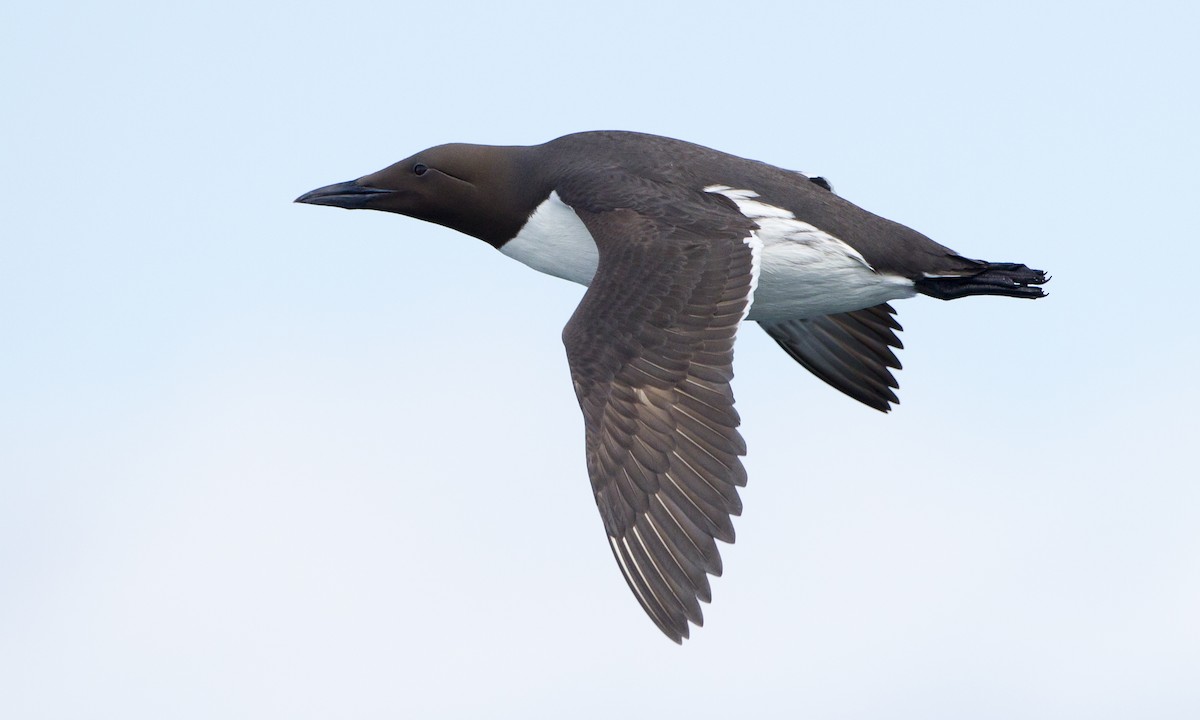
Where does the Common Murre live?
Uria aalge
Spotted a bird? Identify it instantly with the Birdby app
Open the appThe Common Murre lives in specific habitats and regions. Knowing where, and when, to look improves your chances of a successful sighting.
Biomes
Temperate and subarctic marine environments. Found in coastal waters, offshore pelagic zones, and along rocky coastlines.
Geographic range
Circumpolar in the Northern Hemisphere. Found across the North Atlantic (from eastern Canada to Greenland, Iceland, Scandinavia, and the UK) and North Pacific (from Alaska down to California and across to Japan and Korea).
Preferred environments
Steep, rocky coastal cliffs for breeding, often on narrow ledges or flat tops. Forages in productive cold ocean waters, typically within 100 km of the coast, but can be found further offshore. Requires abundant supplies of small pelagic fish.
Elevation range
Sea level. Breeds on cliffs overlooking the ocean.
Where to look
Breeding Colonies
During the breeding season (spring/summer), locate their dense colonies on inaccessible sea cliffs or rocky islands. These 'loomeries' are often visible from observation points on land via binoculars or scopes, or from boats offshore.
Coastal Waters
At sea, they can be found floating in rafts on the water, often in large numbers, particularly near rich feeding grounds. Look for them diving for food. During winter, they often disperse to shelf waters.
Offshore Pelagic Zones
Can be observed far offshore from headlands or during pelagic birding trips, especially during migration or wintering periods.
Field tips
- Scan the Sea. Use binoculars or a spotting scope to scan the surface of the ocean for rafts of birds. They often sit low in the water.
- Visit Cliff Colonies. During breeding season, visit designated seabird observation sites at cliff colonies. The sheer numbers make them easy to see, hear, and study behaviorally.
- Observe Behavior. Note their pursuit-diving behavior. Watching them disappear underwater and resurface with fish can be a good identification cue.
- Distinguish from Similar Auks. Pay close attention to bill shape, head/throat pattern (especially in winter), and the presence or absence of the bridled mark and any white wing-stripe, to differentiate from Thick-billed Murres and Razorbills.
Migration
Partial migrant. Northern populations are generally migratory, moving south to ice-free waters (e.g., from Arctic breeding grounds to more southerly coasts). More southerly populations are often dispersive, staying closer to breeding areas or moving short distances offshore. Juveniles tend to disperse further than adults.
Explore the Common Murre
Identify birds anywhere
Free on iOS, Android, and Web. Photo & sound identification, full species database, and your personal life list.