
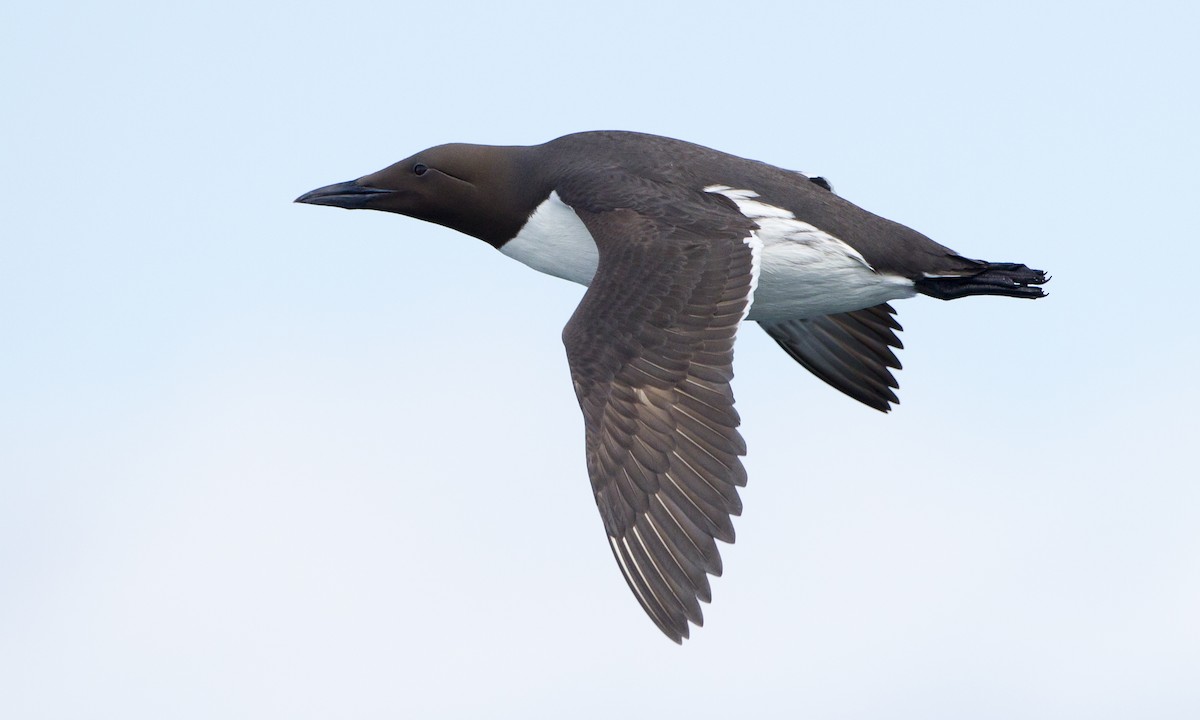
How to identify the Common Murre
Uria aalge
Spotted a bird? Identify it instantly with the Birdby app
Open the appTo correctly identify the Common Murre (Uria aalge), check each of these features. Birds can be tricky: habit, habitat, and call often confirm a sighting that a single photo cannot.
Size at a glance
- Length
- 40-48 cm (16-19 in)
- Wingspan
- 61-73 cm (24-29 in)
- Weight
- 850-1200 g (1.9-2.6 lbs)
Physical features to check
- 1
Plumage
Overall feather coloration and pattern.
Adult breeding plumage is characterized by a dark chocolate-brown (almost black) head, neck, back, and upperwings, contrasting sharply with a pure white belly and flanks. A distinct white stripe extends from the rear of the eye in birds of the 'bridled' form (U. a. aalge, U. a. albionis, U. a. hyperborea subspecies). Non-breeding plumage is similar but the chin and throat become white, and a dark line extends back from the eye, often referred to as the 'gular stripe'.
- 2
Beak shape
Shape and color of the bill: a key field mark.
A slender, pointed, dagger-like bill, dark horn-colored. Specialized for grasping small fish.
- 3
Eye color
Iris color and any distinctive eye markings.
Dark brown, often appearing black. In the bridled morph, a thin white line encircles the eye and extends as a variable 'bridle' mark behind it.
- 4
Leg color
Leg and foot color.
Dark gray to black, webbed feet positioned far back on the body, ideal for swimming and diving.
- 5
Distinguishing features
Standout features that separate this species.
Upright posture on land suggesting a small penguin. In flight, wings are small and rapidly beating. Dark brown upperparts, white underparts, and slender pointed bill are key. Bridled form (with white eye-ring and post-ocular stripe) is a distinctive but geographically variable trait.
- 6
Juvenile appearance
How young birds differ from adults.
Juveniles resemble non-breeding adults but are generally smaller, often with a slightly shorter and more pointed bill, and a less defined dark throat stripe initially. Their upperparts are usually duller brown. Fledglings are smaller versions of flightless adults, often with downy remnants.
- 7
Seasonal changes
Plumage variation between breeding and non-breeding seasons.
The most notable change is in head and neck coloration. In breeding plumage, the head and neck are dark brown. In non-breeding plumage (winter), the throat and cheeks become white, creating a distinct white 'bib' and a dark line running through the eye and across the cheek. The rest of the body plumage remains largely consistent.
- 8
Sexual dimorphism
How males and females differ.
Minimal; males and females are visually identical in plumage and size. Field identification of sexes is not possible.
Key field marks
- Plumage Coloration. Look for the sharp contrast between the dark chocolate-brown (breeding) or blackish-brown (non-breeding) upperparts and pure white underparts. Note the extent of dark on the head and neck in breeding plumage versus the white 'bib' and dark eye-stripe in non-breeding plumage.
- Bill Shape. Observe the slender, pointed, dagger-like bill. This helps distinguish it from the thicker-billed murre and the heavy, compressed bill of a Razorbill.
- Posture. On land, they stand very upright, giving them a typical penguin-like stance.
- Flight. Fast, direct flight with rapid wing beats. They fly low over the water.
- Bridled Morph (where present). In some populations (e.g., North Atlantic), look for a fine white ring around the eye that extends as a thin white line behind the eye. This 'bridle' is diagnostic for individuals that possess it, but many Common Murres lack it.
Explore the Common Murre
Identify birds anywhere
Free on iOS, Android, and Web. Photo & sound identification, full species database, and your personal life list.