
Spotted a bird? Identify it instantly with the Birdby app
Open the appAbout
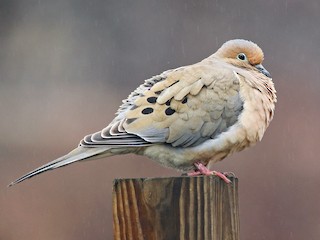
The Mourning Dove is a medium-sized, slender pigeon with a small head and a long, tapered tail. It is one of the most widespread and abundant bird species in North America, known for its distinctive mournful cooing call and swift, direct flight.
Size & lifespan
- Length
- 22-36 cm (8.7-14.2 in)
- Wingspan
- 37-45 cm (14.6-17.7 in)
- Weight
- 96-170 g (3.4-6.0 oz)
- Lifespan
- Typically 1.5 years in the wild, but can live up to 19 years in exceptional cases.
- Diet
- Granivore (primarily seeds)
Physical characteristics
- Plumage
- Overall grayish-brown to buffy-tan, with a paler, often pinkish wash on the breast and belly. The back and wings are a slightly darker gray-brown, often with small black spots on the wing coverts. The primary flight feathers are dark. The long, graduated tail has white tips on the outer feathers, visible in flight and when fanned.
- Beak shape
- Small, slender, and dark gray to black.
- Eye color
- Dark brown, surrounded by a patch of pale blue skin.
- Leg color
- Dull reddish-pink.
- Distinguishing features
- Small head, slender body, long pointed tail with white outer tail feathers, and a distinctive black spot on the lower side of the neck (often more prominent in males).
- Juvenile appearance
- Juveniles are similar to adults but have a scaly appearance due to pale feather edgings, especially on the wing coverts and breast. They lack the iridescent neck patch and the black neck spot is absent or very faint.
- Seasonal changes
- No significant seasonal plumage changes. Plumage remains consistent year-round, though wear and tear can make feathers appear duller before molting.
- Sexual dimorphism
- Males tend to be slightly larger and have a more pronounced iridescent pinkish-purple sheen on the neck and breast, and a brighter blue-gray crown. Females are generally duller, with less iridescence and a more uniform brownish-gray head. The black spot on the neck is often more distinct in males.
How to identify
- 1
Shape and Size
Look for a slender, medium-sized dove with a small head and a long, pointed tail.
- 2
Plumage Color
Observe the overall grayish-brown to buffy-tan body, with a pinkish wash on the breast and belly. Note the small black spots on the wings.
- 3
Tail
The long, pointed tail with white tips on the outer feathers is a key field mark, especially visible in flight.
- 4
Neck Spot
Look for a small black spot on the lower side of the neck, though it can be faint or absent in females and juveniles.
- 5
Flight
Listen for the distinctive whistling sound made by their wings during takeoff and landing. Observe their swift, direct flight.
- 6
Vocalization
Learn their characteristic mournful 'coo-OO-oo-oo-oo' call, which is often the first indication of their presence.
Habitat & range
- Biomes
- Forest edges, open woodlands, grasslands, agricultural fields, suburban areas, urban parks, deserts, and savannas.
- Geographic range
- Widespread across North America, extending from southern Canada through the United States and Mexico, into Central America and the Caribbean. Also found in parts of the Greater Antilles.
- Elevation range
- Sea level up to approximately 3,000 meters (10,000 feet) in mountainous regions.
- Preferred environments
- Prefers open country with scattered trees and shrubs for nesting and roosting, and open ground for foraging. Highly adaptable to human-modified landscapes.
Behavior
- Activity time
- Diurnal, most active during the day, especially in the morning and late afternoon.
- Feeding habits
- Primarily ground feeders, consuming almost exclusively seeds (99% of their diet). They forage by walking on the ground, pecking up seeds. They can store seeds in their crop and digest them later. They also consume grit to aid digestion. Rarely eats insects or fruits. They are attracted to bird feeders, especially those offering millet, corn, and sunflower seeds.
- Social behavior
- Often seen in pairs during the breeding season, but forms large flocks outside of breeding, especially during migration and in winter. They are generally peaceful birds.
- Flight pattern
- Strong, swift, and direct flight with rapid wingbeats. Produces a distinctive whistling sound with its wings upon takeoff and landing, particularly noticeable when startled.
- Migration pattern
- Northern populations are migratory, moving south for the winter. Southern populations are resident year-round. Migration occurs in flocks, typically during the day. They are one of the most hunted migratory game birds in North America.
- Territoriality
- Males establish small breeding territories, primarily defended through cooing displays and occasional chases. They are not highly territorial outside of the immediate nest site.
Song & calls
- Song
- The characteristic 'mournful' cooing call, often described as 'coo-OO-oo-oo-oo', with the second note being the loudest and longest. This is typically a male's advertising call, used to attract a mate and announce territory.
- Call
- In addition to the cooing, they produce a short, guttural 'ooh' or 'grunt' when startled or taking flight. The whistling sound made by their wings during takeoff is also a key auditory identification cue.
- When they vocalize
- Most vocal during the breeding season (spring and summer), particularly in the early morning and late afternoon. Calls can be heard year-round, especially in resident populations.
Breeding & reproduction
- Breeding season
- Can breed almost year-round in warmer climates, but typically from March to September in temperate regions. They are prolific breeders, often raising multiple broods (2-6) per year.
- Nesting habits
- Nests are flimsy, shallow platforms of twigs, often so sparse that the eggs can be seen from below. They are typically built in trees or shrubs, 1-10 meters (3-30 feet) above the ground, but can also be found on artificial structures like window ledges or gutters. Both parents participate in nest building.
- Clutch size
- Typically 2 eggs.
- Egg description
- Two pure white, elliptical eggs, approximately 2.5-3.2 cm (1.0-1.3 in) long.
- Incubation period
- 14-15 days, shared by both parents (male usually incubates during the day, female at night).
- Fledging period
- 11-15 days after hatching. Young are fed 'pigeon milk' (crop milk) by both parents.
- Parental care
- Both parents share incubation duties and feed the altricial young 'crop milk' for the first few days, gradually transitioning to regurgitated seeds. They continue to care for the fledglings for a short period after they leave the nest.
Where to find
Backyards and Gardens
Common visitors to bird feeders, especially those offering seeds on the ground or in platform feeders. They also forage on lawns and under trees.
Parks and Open Spaces
Found in urban and suburban parks, golf courses, and other open areas with scattered trees and shrubs.
Agricultural Fields
Frequently seen foraging in cultivated fields, especially after harvest, for spilled grains and weed seeds.
Forest Edges and Woodlands
Often found along the edges of forests, in open woodlands, and areas with a mix of trees and open ground.
Field tips
- Listen for their call. Their distinctive mournful cooing is often heard before they are seen, especially in the morning and late afternoon.
- Watch for ground feeders. Mourning Doves primarily feed on the ground, so scan open areas, lawns, and under bird feeders.
- Look for movement. Their head-bobbing walk and sudden takeoffs can draw attention. Listen for the wing whistle when they fly.
- Check power lines and fences. They often perch on wires, fences, and bare branches, especially in open areas.
- Provide water. Like all doves, they need to drink frequently and are attracted to bird baths.
Similar species
Eurasian Collared-Dove
Streptopelia decaocto
The Eurasian Collared-Dove is larger and stockier, with a distinctive black half-collar on the nape. Its tail is square-tipped, not pointed, and lacks the white outer tail feathers of the Mourning Dove. Its call is a three-note coo, 'coo-COO-coo', distinct from the Mourning Dove's mournful call.
White-winged Dove
Zenaida asiatica
The White-winged Dove is slightly larger and has prominent white patches on the wings, especially visible in flight. It also has a blue eye-ring and a shorter, more rounded tail. Its call is a distinctive 'hoo-hoo-hoo-hooo' or 'who-cooks-for-you'.
Common Ground-Dove
Columbina passerina
The Common Ground-Dove is much smaller, with a shorter tail and a scaly appearance on its breast. It shows rufous primary feathers in flight. Its call is a soft, repeated 'woo-oo'.
Quick facts
- Diet:
- Almost exclusively seeds
- Nesting:
- Flimsy twig nests in trees or shrubs
- Clutch Size:
- 2 eggs
- Broods per year:
- 2-6
- Flight Sound:
- Whistling wings on takeoff
- Conservation Status:
- Least Concern
Fun facts
- Mourning Doves are one of the most abundant bird species in North America, with an estimated population of over 350 million individuals.
- They are the most hunted game bird in North America, with tens of millions harvested annually.
- Mourning Doves produce 'crop milk' (also called pigeon milk), a nutritious, protein-rich substance secreted from the lining of their crop, to feed their young. Both parents produce this milk.
- Despite their flimsy nests, they are highly successful breeders, often raising multiple broods in a single season.
- Their scientific name, Zenaida macroura, honors Zénaïde Laetitia Julie Bonaparte, the wife of French ornithologist Charles Lucien Bonaparte, and 'macroura' means 'long-tailed'.
Scientific classification
- Kingdom
- Animalia
- Phylum
- Chordata
- Class
- Aves
- Order
- Columbiformes
- Family
- Columbidae
- Genus
- Zenaida
- Species
- Zenaida macroura
Explore the Mourning Dove
Identify birds anywhere
Free on iOS, Android, and Web. Photo & sound identification, full species database, and your personal life list.