
Spotted a bird? Identify it instantly with the Birdby app
Open the appAbout
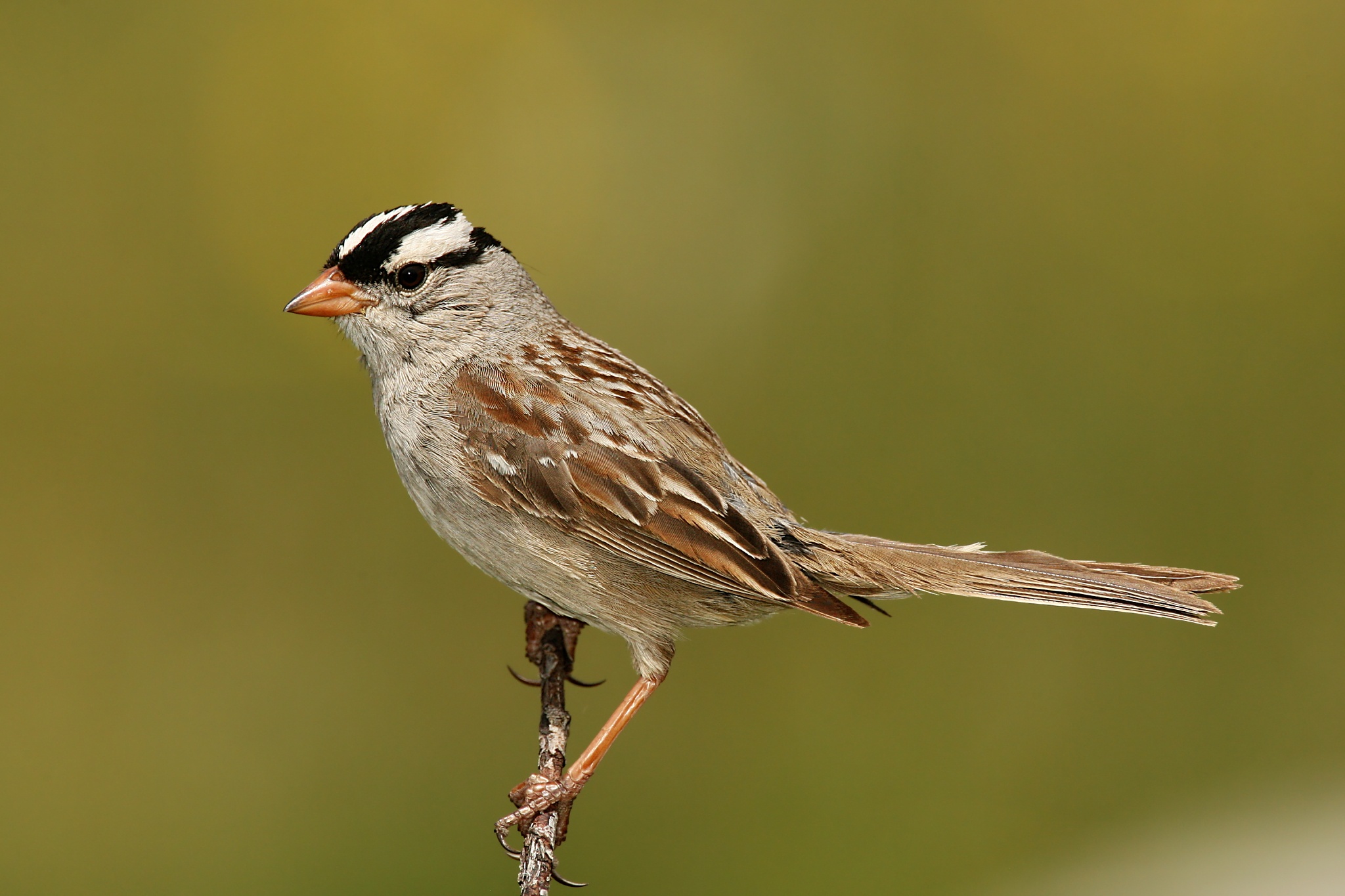
The White-crowned Sparrow is a common and distinctive New World sparrow known for its striking head pattern of black and white stripes. It is a migratory species, breeding in northern North America and wintering across much of the United States and parts of Mexico. They are often seen foraging on the ground in open areas and are well-known for their clear, whistling songs.
Size & lifespan
- Length
- 14-18 cm (5.5-7.1 inches)
- Wingspan
- 21-27 cm (8.3-10.6 inches)
- Weight
- 25-30 g (0.9-1.1 oz)
- Lifespan
- Up to 13 years in the wild, typically 2-5 years.
- Diet
- Primarily seeds, supplemented with insects (especially during breeding season), buds, and fruits. They are opportunistic foragers.
Physical characteristics
- Plumage
- Adults have a prominent black and white striped crown, a gray face, and a plain dingy grayish-white breast and belly. Their back is streaked brown, and their wings are brownish with two white wing bars. The bill is pinkish-orange or yellow. Juveniles have brown and buff stripes on their crown, a streaky breast, and a duller bill. There are subtle plumage variations among subspecies.
- Beak shape
- Conical, adapted for seed crushing.
- Eye color
- Dark brown.
- Leg color
- Dull brownish-pink.
- Distinguishing features
- The bold black and white striped crown is the most distinctive feature. The relatively long tail that is slightly notched is also characteristic.
- Juvenile appearance
- Juveniles (first summer and fall) have duller, brown and tan head stripes instead of black and white. Their underparts are buffier and often streaked, and their bills are typically dull orange to brownish, not bright pinkish-orange. They gradually acquire adult plumage by their first spring.
- Seasonal changes
- No significant seasonal plumage changes for adults. Juveniles undergo a gradual molt to adult-like plumage.
- Sexual dimorphism
- Males and females are visually identical in plumage.
How to identify
- 1
Head Pattern
Look for the sharp, alternating black and white stripes on the crown of adults. Juveniles have tan and brown stripes.
- 2
Bill Color
Adults have a pinkish-orange or yellow bill, which is a good field mark. Juveniles have duller, brownish-orange bills.
- 3
Plumage
Overall grayish underparts without streaking (in adults) and streaky brown back and wings with two white wing bars.
- 4
Foraging Behavior
Often seen foraging on the ground, scratching with a two-footed hop.
- 5
Song
Learn its clear, whistling song, which often includes a buzzy trill at the end. This is one of the easiest ways to identify them in spring and summer.
Habitat & range
- Biomes
- Tundra, taiga, boreal forest, temperate grassland, shrubland, open woodland, suburban parks, gardens, agricultural fields.
- Geographic range
- Breeds across Alaska, northern Canada, and mountainous regions of the western United United States. Winters throughout much of the United States, coastal British Columbia, and northern Mexico.
- Elevation range
- Sea level to over 3,000 meters (10,000 feet) in mountainous breeding areas.
- Preferred environments
- Breeding habitat includes open woodlands, scrubby areas, stunted forests, and willow thickets near the treeline. Wintering habitat includes open brushy fields, roadsides, suburban gardens, parks, and agricultural edges.
Behavior
- Activity time
- Diurnal, most active during early morning and late afternoon.
- Feeding habits
- Primarily ground feeders, often scratching with both feet simultaneously to uncover seeds and insects. They will also glean seeds from low vegetation and occasionally catch insects in flight. They often forage in flocks during migration and winter.
- Social behavior
- Highly social, particularly during migration and winter, forming large mixed-species flocks. Males are territorial during the breeding season.
- Flight pattern
- Strong, undulating flight over longer distances; short, direct flights between cover.
- Migration pattern
- Long-distance migrant. Most populations breed in the far north and migrate south for the winter. Some western populations are short-distance migrants or resident in mountainous areas. They migrate primarily at night.
- Territoriality
- Males establish and defend breeding territories through song and displays. Non-breeding individuals are not territorial.
Song & calls
- Song
- A distinctive, clear, whistling song often described as 'Oh sweet canada-canada' or 'Oh my sweet lord-lord-lord'. It typically starts with one to three clear, bowed whistles, followed by a series of buzzy or clear trills. There are regional dialects in their songs.
- Call
- A sharp, metallic 'chink' or 'tseep' alarm call. Also a soft contact call within flocks.
- When they vocalize
- Songs are primarily given during the breeding season, from spring through mid-summer. Calls are heard year-round, especially during foraging and alarm situations.
Breeding & reproduction
- Breeding season
- May to August, with peak activity in June and July.
- Nesting habits
- Nests are typically built on or very close to the ground, often tucked into a depression under a shrub or clump of grass. The female constructs a cup-shaped nest of grass, twigs, and moss, lined with fine grasses and hair.
- Clutch size
- 2-6 eggs, commonly 3-5.
- Egg description
- Typically 3-5 eggs, pale greenish-blue or grayish-white, heavily spotted and blotched with browns and purplish-grays, usually concentrated at the larger end.
- Incubation period
- 11-14 days, primarily by the female.
- Fledging period
- 8-10 days after hatching. Young are altricial.
- Parental care
- Both parents feed the nestlings and fledglings, though the female does most of the incubation. Young are dependent on parents for several weeks after fledging.
Where to find
Rural/Wild
During breeding season, check open forest edges, subalpine meadows, tundra, and willow thickets in northern and western North America. In winter, look in brushy fields, fencerows, and woodland edges.
Suburban
Common visitors to suburban backyards in winter across much of the U.S. and southern Canada, especially areas with feeders, shrubs, and brushy cover.
Parks and Gardens
During migration and winter, they frequent parks, gardens, and urban green spaces that offer suitable shrubby habitats and seeds.
Field tips
- Listen for their song. Their distinctive, clear, whistling song is a strong clue to their presence, especially during the breeding season and migration.
- Look on the ground. White-crowned Sparrows are primarily ground feeders. Watch for them scratching under bushes or in open patches of ground.
- Check bird feeders. In winter, they are frequent visitors to bird feeders, especially those offering milo, white proso millet, or black oil sunflower seeds.
- Observe foraging behavior. Notice their characteristic two-footed scratching. If you see movement in leaf litter, wait to see if it's a White-crowned Sparrow.
- Learn juvenile plumage. In late summer and fall, many individuals will be juveniles with brown and buff head stripes. Don't mistake them for a different species.
Similar species
Golden-crowned Sparrow
Zonotrichia atricapilla
Adult Golden-crowned Sparrows have a bright yellow patch on the crown, bordered by black, rather than the black and white stripes of the White-crowned Sparrow. Juveniles can be similar, but Golden-crowned juveniles have a dull golden wash on their crown.
White-throated Sparrow
Zonotrichia albicollis
White-throated Sparrows have a distinct white throat patch (not present in White-crowned), a yellow lore, and a darker bill. Their crown stripes are also black and white, but the overall head pattern is different, and they often show chestnut on their back.
Harris's Sparrow
Zonotrichia querula
Adult Harris's Sparrows have a black crown, black bib, and pink bill, making them quite distinct. Juveniles can be confusing but typically show more streaking on their underparts and a less defined head pattern than White-crowned juveniles.
Quick facts
- Diet:
- Seeds, insects, buds, fruits
- Habitat:
- Open woodlands, shrubby areas, tundra (breeding); open fields, gardens (wintering)
- Clutch Size:
- 2-6 eggs
- Migration:
- Long-distance migrant (most populations)
- Head Pattern:
- Black and white stripes (adults), brown and tan stripes (juveniles)
Fun facts
- White-crowned Sparrows are known to show strong regional dialects in their songs, which can vary significantly across their wide range. These dialects are learned from older males.
- These sparrows engage in a 'double-scratch' foraging technique, jumping forward and then backward with both feet to expose hidden food items.
- During migration, White-crowned Sparrows can cover thousands of miles, often flying at night and navigating using the Earth's magnetic field and celestial cues.
- Different subspecies of White-crowned Sparrows have distinct migratory patterns. For instance, the 'Gambel's Sparrow' subspecies (Z. l. gambelii) has a particularly long migration from Alaska to the southern U.S. and Mexico.
- Research on White-crowned Sparrows has played a significant role in understanding bird song learning and neurobiology due to their ability to learn and refine their songs from their environment.
Scientific classification
- Kingdom
- Animalia
- Phylum
- Chordata
- Class
- Aves
- Order
- Passeriformes
- Family
- Passerellidae
- Genus
- Zonotrichia
- Species
- Zonotrichia leucophrys
Explore the White-crowned Sparrow
Identify birds anywhere
Free on iOS, Android, and Web. Photo & sound identification, full species database, and your personal life list.