
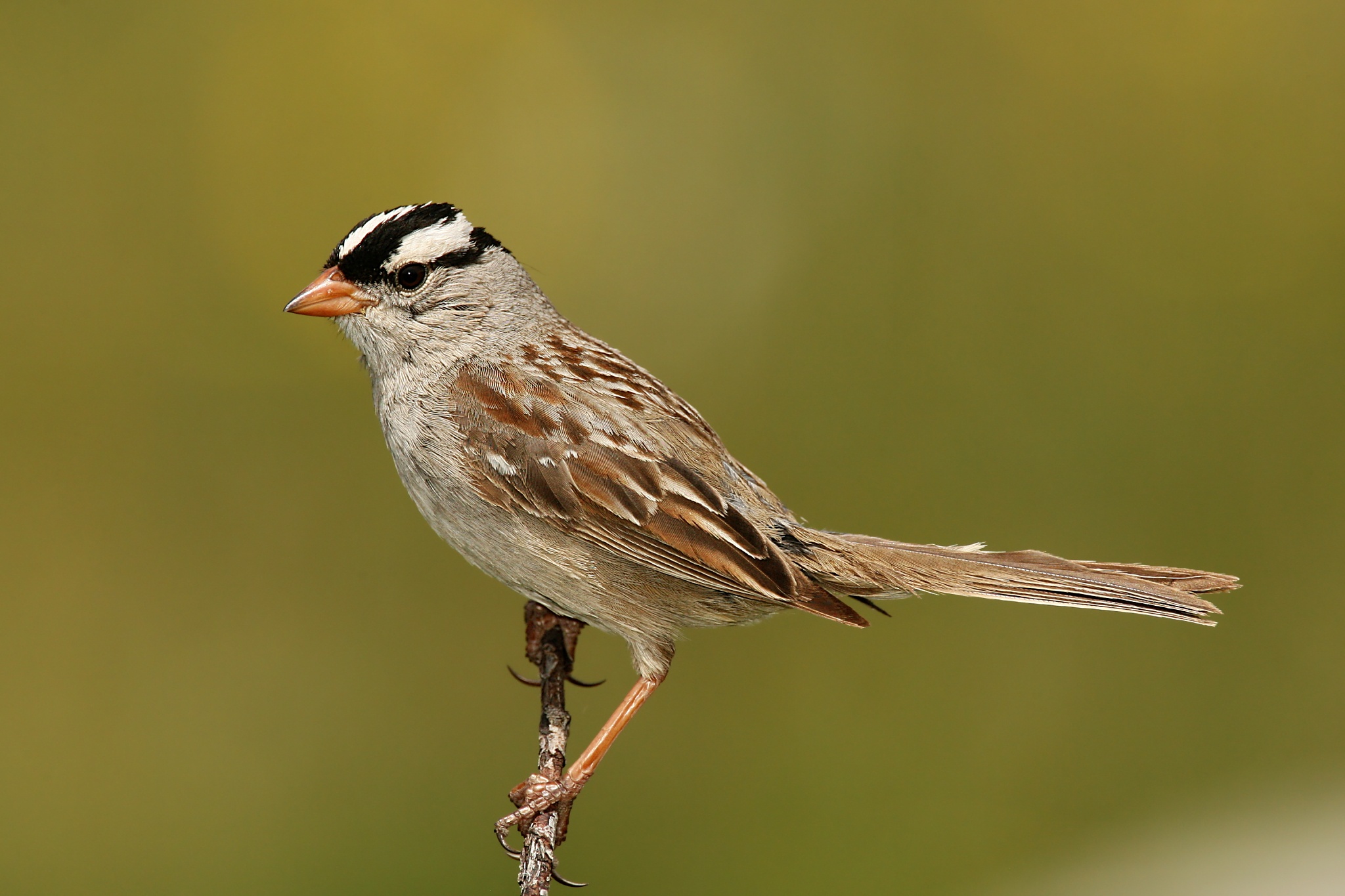
How to identify the White-crowned Sparrow
Zonotrichia leucophrys
Spotted a bird? Identify it instantly with the Birdby app
Open the appTo correctly identify the White-crowned Sparrow (Zonotrichia leucophrys), check each of these features. Birds can be tricky: habit, habitat, and call often confirm a sighting that a single photo cannot.
Size at a glance
- Length
- 14-18 cm (5.5-7.1 inches)
- Wingspan
- 21-27 cm (8.3-10.6 inches)
- Weight
- 25-30 g (0.9-1.1 oz)
Physical features to check
- 1
Plumage
Overall feather coloration and pattern.
Adults have a prominent black and white striped crown, a gray face, and a plain dingy grayish-white breast and belly. Their back is streaked brown, and their wings are brownish with two white wing bars. The bill is pinkish-orange or yellow. Juveniles have brown and buff stripes on their crown, a streaky breast, and a duller bill. There are subtle plumage variations among subspecies.
- 2
Beak shape
Shape and color of the bill: a key field mark.
Conical, adapted for seed crushing.
- 3
Eye color
Iris color and any distinctive eye markings.
Dark brown.
- 4
Leg color
Leg and foot color.
Dull brownish-pink.
- 5
Distinguishing features
Standout features that separate this species.
The bold black and white striped crown is the most distinctive feature. The relatively long tail that is slightly notched is also characteristic.
- 6
Juvenile appearance
How young birds differ from adults.
Juveniles (first summer and fall) have duller, brown and tan head stripes instead of black and white. Their underparts are buffier and often streaked, and their bills are typically dull orange to brownish, not bright pinkish-orange. They gradually acquire adult plumage by their first spring.
- 7
Seasonal changes
Plumage variation between breeding and non-breeding seasons.
No significant seasonal plumage changes for adults. Juveniles undergo a gradual molt to adult-like plumage.
- 8
Sexual dimorphism
How males and females differ.
Males and females are visually identical in plumage.
Key field marks
- Head Pattern. Look for the sharp, alternating black and white stripes on the crown of adults. Juveniles have tan and brown stripes.
- Bill Color. Adults have a pinkish-orange or yellow bill, which is a good field mark. Juveniles have duller, brownish-orange bills.
- Plumage. Overall grayish underparts without streaking (in adults) and streaky brown back and wings with two white wing bars.
- Foraging Behavior. Often seen foraging on the ground, scratching with a two-footed hop.
- Song. Learn its clear, whistling song, which often includes a buzzy trill at the end. This is one of the easiest ways to identify them in spring and summer.
Explore the White-crowned Sparrow
Identify birds anywhere
Free on iOS, Android, and Web. Photo & sound identification, full species database, and your personal life list.