
Melihat burung? Identifikasi seketika dengan aplikasi Birdby
Buka aplikasiTentang
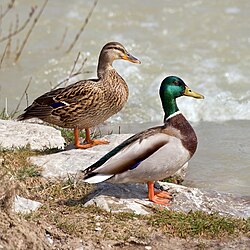
The Mallard is a dabbling duck that is the ancestor of most domestic duck breeds. It is highly adaptable and widely distributed across the Northern Hemisphere, inhabiting a variety of wetland environments. Males are distinctively colored, while females are mottled brown, providing camouflage during nesting.
Ukuran dan masa hidup
- Panjang
- 50-65 cm (20-26 in)
- Bentang sayap
- 81-98 cm (32-39 in)
- Berat
- 720-1580 g (1.6-3.5 lbs)
- Masa hidup
- 5-10 years in the wild, up to 20 years in captivity
- Makanan
- Omnivore
Ciri fisik
- Bulu
- Males (drakes) in breeding plumage have an iridescent green head and neck, a white neck ring, a chestnut breast, grey flanks, and a black rear with a white border. The back is grey-brown. Females (hens) are mottled brown with a dark brown eye-stripe and an orange-brown bill. Both sexes have a distinctive iridescent blue speculum (wing patch) bordered by white on the secondary flight feathers, visible in flight and at rest.
- Bentuk paruh
- Spatulate (flat and broad) bill. Males have a yellowish-orange bill with a black tip; females have a dull orange to brownish bill, often with dark mottling on the upper mandible.
- Warna mata
- Dark brown.
- Warna kaki
- Bright orange to reddish-orange in both sexes.
- Ciri pembeda
- The iridescent blue speculum bordered by white is a key field mark for both sexes. The curled black tail feathers (drake curl) are unique to breeding males.
- Penampilan muda
- Juveniles resemble adult females, but are often duller and may have less distinct markings. Young males gradually acquire their breeding plumage over their first year.
- Perubahan musiman
- Males undergo an eclipse plumage after breeding, typically from June to September. During this period, they resemble females, losing their vibrant green head and chestnut breast, becoming mottled brown. They retain the yellow bill and blue speculum, but the drake curl is lost. They regain their breeding plumage in late summer/early autumn.
- Dimorfisme seksual
- Pronounced. Males are much more brightly colored with a green head, white neck ring, and chestnut breast. Females are cryptically colored in mottled browns.
Cara identifikasi
- 1
Male Breeding Plumage
Look for the iridescent green head, white neck ring, chestnut breast, and grey flanks. The yellow bill and curled black tail feathers are also diagnostic.
- 2
Female Plumage
Observe the mottled brown body, dark eye-stripe, and dull orange bill (often with dark mottling). The blue speculum with white borders is crucial for identification.
- 3
Speculum
Both sexes display an iridescent blue speculum (wing patch) bordered by white on the trailing edge of the wing, visible in flight and when wings are folded.
- 4
Bill Color
Males have a bright yellow-orange bill with a black tip. Females have a duller orange to brownish bill, often with dark blotches.
- 5
Vocalization
Listen for the loud, classic 'quack' of the female. Males have a softer, rasping 'quack' or 'wheep'.
- 6
Behavior
Observe their dabbling feeding behavior, tipping head-down in shallow water. They are often found in mixed-species flocks with other dabbling ducks.
Habitat dan persebaran
- Bioma
- Wetlands, including freshwater and brackish marshes, ponds, lakes, rivers, estuaries, and coastal areas. Also found in urban parks and agricultural lands with water sources.
- Persebaran geografis
- Holarctic distribution, found across North America, Europe, Asia, and parts of North Africa. Introduced to Australia, New Zealand, and other regions.
- Rentang ketinggian
- Primarily lowlands, but can be found at higher elevations near suitable water bodies.
- Lingkungan yang disukai
- Shallow, calm waters with emergent vegetation for cover and foraging. Tolerant of human disturbance, often found in urban and suburban settings.
Perilaku
- Waktu aktivitas
- Diurnal, but can be active at night, especially during migration or when foraging in safe areas.
- Kebiasaan makan
- Dabbling duck, feeding by tipping forward to submerge its head and neck, sifting food from the water or mud with its bill. Diet includes seeds, aquatic vegetation, insects, larvae, worms, small crustaceans, and sometimes small fish. Also grazes on land.
- Perilaku sosial
- Highly social, often found in large flocks, especially outside the breeding season. During breeding, pairs are formed, but they may still associate with other ducks.
- Pola terbang
- Strong, direct flight with rapid wingbeats. Can take off almost vertically from water. Often flies in V-formations or irregular flocks during migration.
- Pola migrasi
- Northern populations are migratory, moving south for the winter. Southern populations are resident. Migration occurs in large flocks, typically at night.
- Teritorialitas
- Males can be territorial during the breeding season, defending their mate and nesting area, though less intensely than some other duck species.
Kicauan dan suara
- Kicauan
- Males have a softer, rasping 'quack' or 'rab-rab'. They also produce a low-pitched 'wheep' or 'raeb'.
- Panggilan
- Females produce the classic loud, descending 'quack-quack-quack-quack-quack' series, often described as the archetypal duck call. This call is used for alarm, contact, and advertising.
- Kapan bersuara
- Vocalize year-round, with increased calling during breeding season and when alarmed.
Reproduksi
- Musim kawin
- Varies geographically, typically March to July in temperate regions.
- Kebiasaan bersarang
- Nests are usually built on the ground, often hidden in dense vegetation near water. The female constructs a shallow depression lined with grass, leaves, and down feathers plucked from her breast.
- Jumlah telur
- Typically 8-13 eggs, but can range from 1 to 15.
- Deskripsi telur
- 8-13 eggs, typically pale green, buff, or grayish-white, unspotted. Average size is about 5.8 x 4.1 cm.
- Masa inkubasi
- 27-28 days, incubated solely by the female.
- Masa terbang
- Ducklings are precocial, leaving the nest within hours of hatching. They are able to fly at 50-60 days old.
- Perawatan orang tua
- Only the female cares for the ducklings, leading them to water and teaching them to forage. Males typically leave the female after she begins incubation.
Di mana ditemukan
Urban Parks and Ponds
Mallards are highly accustomed to humans and are frequently found in city parks, golf courses, and suburban ponds.
Lakes and Rivers
Look for them in slow-moving sections of rivers, along lake shores, and in coves with emergent vegetation.
Marshes and Wetlands
Natural wetland habitats, including freshwater and brackish marshes, are prime locations for Mallards.
Estuaries and Coastal Areas
During winter, they can be found in sheltered coastal waters and estuaries.
Tips lapangan
- Look for the 'classic duck'. The Mallard is often the most common duck species in many areas, so it's a good starting point for duck identification.
- Observe bill color and speculum. These are key features to distinguish Mallards from similar-looking species, especially females.
- Listen for calls. The female's loud 'quack' is unmistakable and often the first indication of a Mallard's presence.
- Check for eclipse plumage. Remember that males will look like females during their eclipse plumage period in summer, so rely on bill color and speculum.
- Scan mixed flocks. Mallards often associate with other dabbling ducks, providing opportunities to compare field marks.
Spesies serupa
American Black Duck
Anas rubripes
Mallards have a green head (male) or mottled brown head with a distinct eye-stripe (female), and an orange bill. American Black Ducks are uniformly dark brown with a paler head, a dark bill, and a purplish speculum (not blue) that is less distinctly bordered by white.
Mottled Duck
Anas fulvigula
Mottled Ducks are similar to female Mallards but are generally darker overall, lack the distinct eye-stripe, and have a more uniformly yellow-orange bill (females) or yellow bill (males) without dark mottling. Their speculum is blue-green, often without prominent white borders.
Mexican Duck
Anas diazi
Often considered a subspecies of Mallard (Anas platyrhynchos diazi). It resembles a female Mallard but is generally darker, with a less distinct eye-stripe and a more uniformly yellow bill. Its speculum is blue-green with less prominent white borders.
Fakta singkat
- Common Name:
- Mallard
- Scientific Name:
- Anas platyrhynchos
- Family:
- Anatidae
- Diet:
- Omnivore (seeds, aquatic plants, insects, small invertebrates)
- Habitat:
- Wetlands, ponds, lakes, rivers, urban parks
- Conservation Status:
- Least Concern
- Distinguishing Feature:
- Iridescent blue speculum with white borders
Fakta menarik
- The Mallard is the ancestor of almost all domestic duck breeds, including Pekin, Rouen, and Aylesbury ducks.
- Male Mallards have a distinctive curled feather (the 'drake curl') on their tail, which is absent in females and during eclipse plumage.
- Mallards are highly adaptable and can thrive in a wide range of environments, from pristine wilderness to bustling urban centers.
- Despite their commonality, Mallards exhibit complex social behaviors, including elaborate courtship displays.
- The female Mallard's 'quack' is one of the most universally recognized bird calls.
Klasifikasi ilmiah
- Kerajaan
- Animalia
- Filum
- Chordata
- Kelas
- Aves
- Ordo
- Anseriformes
- Famili
- Anatidae
- Genus
- Anas
- Spesies
- Anas platyrhynchos
Jelajahi Mallard
Identifikasi burung di mana saja
Gratis di iOS, Android, dan Web. Identifikasi foto & suara, database spesies lengkap, dan daftar pribadi Anda.