
Cara mengidentifikasi Mallard
Anas platyrhynchos
Melihat burung? Identifikasi seketika dengan aplikasi Birdby
Buka aplikasiUntuk mengidentifikasi Mallard (Anas platyrhynchos) dengan benar, periksa setiap fitur ini. Burung bisa sulit dikenali, karena perilaku, habitat, dan panggilan sering mengonfirmasi apa yang tidak bisa dilakukan satu foto.
Ukuran sekilas
- Panjang
- 50-65 cm (20-26 in)
- Bentang sayap
- 81-98 cm (32-39 in)
- Berat
- 720-1580 g (1.6-3.5 lbs)
Ciri fisik untuk diperiksa
- 1
Bulu
Warna dan pola bulu keseluruhan.
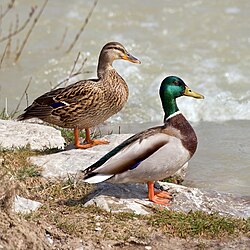
Males (drakes) in breeding plumage have an iridescent green head and neck, a white neck ring, a chestnut breast, grey flanks, and a black rear with a white border. The back is grey-brown. Females (hens) are mottled brown with a dark brown eye-stripe and an orange-brown bill. Both sexes have a distinctive iridescent blue speculum (wing patch) bordered by white on the secondary flight feathers, visible in flight and at rest.
- 2
Bentuk paruh
Bentuk dan warna paruh, tanda lapangan kunci.
Spatulate (flat and broad) bill. Males have a yellowish-orange bill with a black tip; females have a dull orange to brownish bill, often with dark mottling on the upper mandible.
- 3
Warna mata
Warna iris dan tanda khas di sekitar mata.
Dark brown.
- 4
Warna kaki
Warna kaki dan jari.
Bright orange to reddish-orange in both sexes.
- 5
Ciri pembeda
Ciri menonjol yang membedakan spesies ini.
The iridescent blue speculum bordered by white is a key field mark for both sexes. The curled black tail feathers (drake curl) are unique to breeding males.
- 6
Penampilan muda
Bagaimana yang muda berbeda dari yang dewasa.
Juveniles resemble adult females, but are often duller and may have less distinct markings. Young males gradually acquire their breeding plumage over their first year.
- 7
Perubahan musiman
Variasi bulu antara musim kawin dan tidak kawin.
Males undergo an eclipse plumage after breeding, typically from June to September. During this period, they resemble females, losing their vibrant green head and chestnut breast, becoming mottled brown. They retain the yellow bill and blue speculum, but the drake curl is lost. They regain their breeding plumage in late summer/early autumn.
- 8
Dimorfisme seksual
Perbedaan antara jantan dan betina.
Pronounced. Males are much more brightly colored with a green head, white neck ring, and chestnut breast. Females are cryptically colored in mottled browns.
Tanda lapangan kunci
- Male Breeding Plumage. Look for the iridescent green head, white neck ring, chestnut breast, and grey flanks. The yellow bill and curled black tail feathers are also diagnostic.
- Female Plumage. Observe the mottled brown body, dark eye-stripe, and dull orange bill (often with dark mottling). The blue speculum with white borders is crucial for identification.
- Speculum. Both sexes display an iridescent blue speculum (wing patch) bordered by white on the trailing edge of the wing, visible in flight and when wings are folded.
- Bill Color. Males have a bright yellow-orange bill with a black tip. Females have a duller orange to brownish bill, often with dark blotches.
- Vocalization. Listen for the loud, classic 'quack' of the female. Males have a softer, rasping 'quack' or 'wheep'.
- Behavior. Observe their dabbling feeding behavior, tipping head-down in shallow water. They are often found in mixed-species flocks with other dabbling ducks.
Jelajahi Mallard
Identifikasi burung di mana saja
Gratis di iOS, Android, dan Web. Identifikasi foto & suara, database spesies lengkap, dan daftar pribadi Anda.