
Visto un uccello? Identificalo all'istante con l'app Birdby
Apri l'appInformazioni
The Eurasian Sparrowhawk is a small, agile bird of prey found across a wide range of habitats in Eurasia and North Africa. It is a classic 'true hawk' with short, broad, rounded wings and a long tail, perfectly adapted for hunting small birds in dense cover. Known for its stealthy hunting technique and sexual dimorphism, with females being significantly larger than males.
Dimensioni e longevità
- Lunghezza
- 28-38 cm (male), 35-41 cm (female)
- Apertura alare
- 55-65 cm (male), 67-80 cm (female)
- Peso
- 110-196 g (male), 185-342 g (female)
- Longevità
- Typically 3-4 years in the wild, up to 10-15 years recorded
- Dieta
- Carnivore, primarily small to medium-sized birds, occasionally small mammals and insects
Caratteristiche fisiche
- Piumaggio
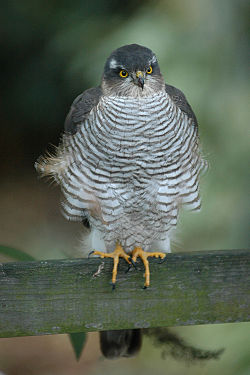
- Adult males have slate-grey upperparts, often with a bluish tinge, and finely barred rufous-orange underparts. Adult females have dark grey-brown upperparts and finely barred grey-brown underparts. Both sexes have a white supercilium (eyebrow stripe) and a dark eye stripe. Juveniles are browner above with coarser, often streaky, barring below.
- Forma del becco
- Short, strongly hooked, dark grey to black with a yellow cere.
- Colore degli occhi
- Adults have bright yellow to orange-yellow eyes; juveniles have pale yellow eyes.
- Colore delle zampe
- Long, slender yellow legs and feet with sharp black talons.
- Caratteristiche distintive
- Short, broad, rounded wings; long, square-tipped tail with 4-5 dark bands; rapid wing beats interspersed with glides; distinctive 'flap-flap-glide' flight pattern. Females are noticeably larger than males.
- Aspetto giovanile
- Juveniles are browner on the upperparts, often with rufous fringes to feathers. Underparts are more coarsely barred or streaked with dark brown on a creamy background. Eyes are paler yellow. The supercilium is less distinct.
- Cambiamenti stagionali
- No significant seasonal plumage changes. Plumage becomes slightly worn and faded by the end of the breeding season before molting.
- Dimorfismo sessuale
- Pronounced sexual dimorphism in size and plumage. Females are up to 25% larger and twice as heavy as males. Males have more rufous-orange barring on underparts and often a bluer back. Females are browner/greyer above and have grey-brown barring below.
Come identificare
- 1
Size and Shape
Look for a small, agile raptor with short, broad, rounded wings and a long, square-tipped tail. Females are noticeably larger than males.
- 2
Flight Pattern
Observe its characteristic 'flap-flap-glide' flight, often low and fast through vegetation. It rarely soars for extended periods.
- 3
Plumage (Adult Male)
Slate-grey back (often bluish), finely barred rufous-orange underparts, white supercilium, yellow-orange eyes.
- 4
Plumage (Adult Female)
Dark grey-brown back, finely barred grey-brown underparts, white supercilium, yellow eyes.
- 5
Plumage (Juvenile)
Browner upperparts, coarser dark brown barring/streaking on creamy underparts, paler yellow eyes.
- 6
Head and Eye
Distinctive white supercilium and bright yellow to orange eyes (paler in juveniles). Dark eye stripe.
- 7
Tail
Long tail with 4-5 dark bands, often held slightly fanned in flight.
Habitat e areale
- Biomi
- Forests, woodlands, plantations, parks, gardens, suburban areas, agricultural land with scattered trees.
- Areale geografico
- Widespread across Europe, Asia, and North Africa. From Ireland and Portugal in the west, across Eurasia to Japan in the east. Also found in parts of North Africa.
- Fascia altitudinale
- Sea level up to 2,000 meters, occasionally higher in mountainous regions.
- Ambienti preferiti
- Prefers areas with a mosaic of dense woodland for nesting and open areas or woodland edges for hunting. Increasingly found in urban and suburban environments where prey (garden birds) is abundant.
Comportamento
- Periodo di attività
- Diurnal, most active during daylight hours, particularly in the morning and late afternoon.
- Abitudini alimentari
- A highly specialized bird hunter. It ambushes prey from a concealed perch or makes low, fast flights through vegetation. It uses its agility to navigate dense cover, often pursuing birds into bushes or around obstacles. Prey is typically caught in flight or snatched from the ground/foliage. Plucks feathers from prey before consumption.
- Comportamento sociale
- Generally solitary outside the breeding season. During breeding, pairs are monogamous. Not colonial. Juveniles may disperse widely after fledging.
- Tipo di volo
- Characterized by a distinctive 'flap-flap-glide' flight. When hunting, it flies low and fast, often weaving through trees. Soaring is less common but occurs during migration or display flights. Agile and maneuverable.
- Migrazione
- Northern populations are migratory, moving south to warmer climes in winter (e.g., from Scandinavia to southern Europe/North Africa). Central and southern European populations are largely resident or undertake short-distance dispersal. Migration is often broad-front, but can be concentrated at bottlenecks.
- Territorialità
- Highly territorial during the breeding season, defending a nesting territory from other sparrowhawks. Males perform aerial displays to attract mates and establish territory.
Canto e richiami
- Canto
- Not known for a complex song. Vocalizations are typically calls.
- Richiamo
- Common calls include a rapid 'kek-kek-kek-kek' or 'ki-ki-ki-ki' when alarmed or agitated, especially near the nest. During courtship, males may give a softer 'gii-gii-gii'. Females have a deeper, harsher version of the alarm call.
- Quando vocalizza
- Most vocal during the breeding season, particularly during courtship, nest building, and when defending the nest or young. Less vocal outside the breeding season.
Riproduzione
- Stagione riproduttiva
- April to July, with peak egg-laying in late April to May.
- Abitudini di nidificazione
- Nests are typically built in trees (conifers or broadleaf), often close to the trunk or in a fork. The nest is a relatively small, flat platform of sticks, lined with bark flakes or fresh conifer needles. Often reuses old nests of other birds (e.g., crows, pigeons) or its own from previous years, adding new material.
- Dimensione della covata
- 4-5 eggs
- Descrizione dell'uovo
- Typically 4-5 eggs (range 3-7), pale bluish-white, often sparsely marked with reddish-brown spots or blotches.
- Periodo di incubazione
- 33-35 days, primarily by the female, while the male provides food.
- Periodo di involo
- 24-30 days after hatching. Young remain dependent on parents for several weeks after fledging.
- Cure parentali
- Female incubates and broods the young; male provides all food for the female and young during incubation and early nestling period. Both parents hunt for the young as they grow older.
Dove trovarlo
Woodlands and Forests
Primary habitat for nesting and hunting. Look along edges and clearings.
Parks and Gardens
Increasingly common in suburban and urban areas, especially where there are mature trees and abundant small birds.
Agricultural Land with Hedgerows
Hunts along hedgerows and tree lines in open countryside.
Migration Hotspots
During migration, they can be seen at coastal watchpoints or mountain passes.
Consigli sul campo
- Look for 'bird alarm calls'. Small birds often give alarm calls when a sparrowhawk is present, indicating its presence even if unseen.
- Scan woodland edges and clearings. They often perch concealed within trees, waiting to ambush prey. Look for them darting out from cover.
- Watch bird feeders. Sparrowhawks are known to hunt around bird feeders, taking advantage of concentrated prey.
- Observe flight patterns. Their low, fast, agile flight with rapid wing beats and glides is a key identification feature.
- Listen for calls. During the breeding season, their 'kek-kek-kek' alarm call can reveal their presence.
Specie simili
Goshawk
Accipiter gentilis
Goshawks are significantly larger and bulkier than Eurasian Sparrowhawks. They have a more prominent supercilium, a heavier build, and a relatively shorter tail for their size. Their flight is more powerful and less 'flappy'. Juveniles are also browner and more heavily streaked than juvenile sparrowhawks.
Kestrel
Falco tinnunculus
Kestrels are falcons, not true hawks. They have pointed wings and a different flight style, often hovering. While similar in size to a female sparrowhawk, their plumage (rufous back, spotted underparts) and head shape are distinct. Sparrowhawks have rounded wings and a long tail, and do not hover.
Collared Sparrowhawk
Accipiter cirrocephalus
Found in Australasia, not Eurasia. Very similar in appearance and ecology to the Eurasian Sparrowhawk, but generally smaller and with a more rounded head profile. Identification requires careful attention to subtle morphological differences and geographic location.
Fatti rapidi
- Primary Prey:
- Small birds
- Hunting Style:
- Ambush predator, agile pursuit
- Sexual Dimorphism:
- Females significantly larger than males
- Flight:
- Flap-flap-glide, low and fast
- Conservation Status:
- Least Concern (IUCN Red List)
Curiosità
- The Eurasian Sparrowhawk is one of the most common birds of prey in Europe.
- Its agility allows it to hunt effectively in dense woodland, a skill few other raptors possess to the same degree.
- The species suffered significant declines in the mid-20th century due to organochlorine pesticides, but populations have largely recovered since these chemicals were banned.
- Female sparrowhawks are so much larger than males that they often hunt different sizes of prey, reducing competition between the sexes.
- They are known to 'stoop' (dive) at high speed, sometimes reaching over 100 km/h, when pursuing prey.
Classificazione scientifica
- Regno
- Animalia
- Phylum
- Chordata
- Classe
- Aves
- Ordine
- Accipitriformes
- Famiglia
- Accipitridae
- Genere
- Accipiter
- Specie
- Accipiter nisus
Esplora Eurasian Sparrowhawk
Identifica uccelli ovunque
Gratis su iOS, Android e Web. Identificazione per foto e suono, database completo e la tua lista personale.