
Come identificare Eurasian Sparrowhawk
Accipiter nisus
Visto un uccello? Identificalo all'istante con l'app Birdby
Apri l'appPer identificare correttamente Eurasian Sparrowhawk (Accipiter nisus), controlla ciascuna di queste caratteristiche. Gli uccelli possono essere complicati da riconoscere, perché comportamento, habitat e canto spesso confermano ciò che una sola foto non può.
Dimensioni a colpo d'occhio
- Lunghezza
- 28-38 cm (male), 35-41 cm (female)
- Apertura alare
- 55-65 cm (male), 67-80 cm (female)
- Peso
- 110-196 g (male), 185-342 g (female)
Caratteristiche fisiche da controllare
- 1
Piumaggio
Colorazione e disegno generale del piumaggio.
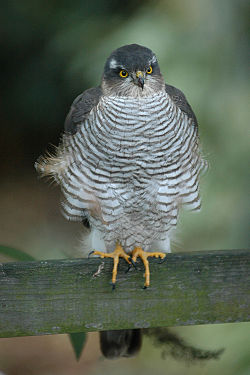
Adult males have slate-grey upperparts, often with a bluish tinge, and finely barred rufous-orange underparts. Adult females have dark grey-brown upperparts and finely barred grey-brown underparts. Both sexes have a white supercilium (eyebrow stripe) and a dark eye stripe. Juveniles are browner above with coarser, often streaky, barring below.
- 2
Forma del becco
Forma e colore del becco, un segno di campo chiave.
Short, strongly hooked, dark grey to black with a yellow cere.
- 3
Colore degli occhi
Colore dell'iride e segni distintivi sugli occhi.
Adults have bright yellow to orange-yellow eyes; juveniles have pale yellow eyes.
- 4
Colore delle zampe
Colore di zampe e piedi.
Long, slender yellow legs and feet with sharp black talons.
- 5
Caratteristiche distintive
Tratti distintivi che separano questa specie.
Short, broad, rounded wings; long, square-tipped tail with 4-5 dark bands; rapid wing beats interspersed with glides; distinctive 'flap-flap-glide' flight pattern. Females are noticeably larger than males.
- 6
Aspetto giovanile
Come i giovani si differenziano dagli adulti.
Juveniles are browner on the upperparts, often with rufous fringes to feathers. Underparts are more coarsely barred or streaked with dark brown on a creamy background. Eyes are paler yellow. The supercilium is less distinct.
- 7
Cambiamenti stagionali
Variazione del piumaggio tra stagione riproduttiva e non.
No significant seasonal plumage changes. Plumage becomes slightly worn and faded by the end of the breeding season before molting.
- 8
Dimorfismo sessuale
Differenze tra maschi e femmine.
Pronounced sexual dimorphism in size and plumage. Females are up to 25% larger and twice as heavy as males. Males have more rufous-orange barring on underparts and often a bluer back. Females are browner/greyer above and have grey-brown barring below.
Segni di campo chiave
- Size and Shape. Look for a small, agile raptor with short, broad, rounded wings and a long, square-tipped tail. Females are noticeably larger than males.
- Flight Pattern. Observe its characteristic 'flap-flap-glide' flight, often low and fast through vegetation. It rarely soars for extended periods.
- Plumage (Adult Male). Slate-grey back (often bluish), finely barred rufous-orange underparts, white supercilium, yellow-orange eyes.
- Plumage (Adult Female). Dark grey-brown back, finely barred grey-brown underparts, white supercilium, yellow eyes.
- Plumage (Juvenile). Browner upperparts, coarser dark brown barring/streaking on creamy underparts, paler yellow eyes.
- Head and Eye. Distinctive white supercilium and bright yellow to orange eyes (paler in juveniles). Dark eye stripe.
- Tail. Long tail with 4-5 dark bands, often held slightly fanned in flight.
Esplora Eurasian Sparrowhawk
Identifica uccelli ovunque
Gratis su iOS, Android e Web. Identificazione per foto e suono, database completo e la tua lista personale.