
Visto un uccello? Identificalo all'istante con l'app Birdby
Apri l'appInformazioni
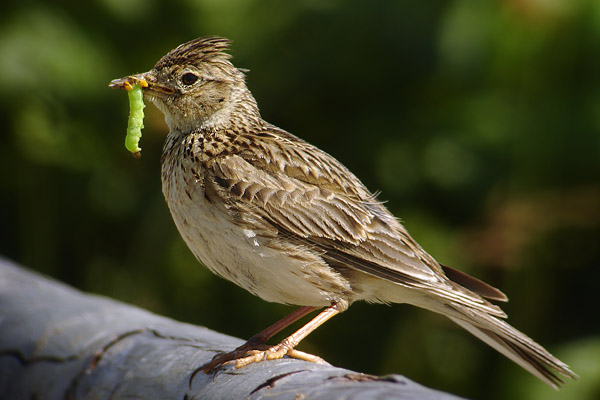
The Eurasian Skylark (Alauda arvensis) is a small passerine bird known for its distinctive and prolonged song-flight. It is a widespread species across Eurasia and parts of North Africa, typically inhabiting open grasslands, agricultural fields, and heathlands. Its cryptic plumage provides excellent camouflage against the ground.
Dimensioni e longevità
- Lunghezza
- 16-19 cm
- Apertura alare
- 30-36 cm
- Peso
- 25-45 g
- Longevità
- 2-5 years (up to 10 years recorded)
- Dieta
- Omnivore (primarily insects and seeds)
Caratteristiche fisiche
- Piumaggio
- Upperparts are streaky brown, buff, and black, providing excellent camouflage. Underparts are pale buffish-white with a heavily streaked breast. The outer tail feathers are white, visible in flight. A small, erectile crest is often visible on the crown.
- Forma del becco
- Relatively short, conical, and stout, dark horn-colored.
- Colore degli occhi
- Dark brown.
- Colore delle zampe
- Pale pinkish-brown to yellowish-brown.
- Caratteristiche distintive
- Small, erectile crest; streaky brown plumage; white outer tail feathers (especially noticeable in flight); long hind claw (hallux).
- Aspetto giovanile
- Juveniles are similar to adults but have a more spotted appearance on the upperparts due to pale feather tips, giving a somewhat scaly look. The breast streaking may be less defined.
- Cambiamenti stagionali
- No significant seasonal plumage changes. Plumage may appear slightly fresher after autumn moult and more worn by late breeding season.
- Dimorfismo sessuale
- Males and females are generally similar in plumage, though males tend to be slightly larger and have a more prominent crest. Field identification of sex is difficult.
Come identificare
- 1
Song-flight
Listen for the characteristic, prolonged, and complex song delivered high in the sky while the bird hovers or slowly ascends/descends. This is the most reliable identification feature.
- 2
Plumage
Look for streaky brown upperparts, a pale breast with heavy streaking, and a small, often visible crest on the crown. The overall impression is cryptic and camouflaged.
- 3
Tail
Observe the tail in flight; the white outer tail feathers are a key diagnostic feature, especially when the bird is flushed from the ground.
- 4
Hind Claw
If seen well on the ground, note the unusually long hind claw (hallux), an adaptation for walking on soft ground.
- 5
Habitat
Skylarks are almost exclusively found in open, treeless habitats like grasslands and agricultural fields. If you see a streaky brown bird in such an environment, it's likely a Skylark.
Habitat e areale
- Biomi
- Temperate grasslands, agricultural lands, heathlands, moorlands, coastal dunes, steppes.
- Areale geografico
- Widespread across Europe and Asia, extending into North Africa. Introduced to New Zealand, Australia, and Hawaii.
- Fascia altitudinale
- Sea level up to 2,000 meters, occasionally higher in mountainous regions.
- Ambienti preferiti
- Open, treeless areas with short to medium-height vegetation, often preferring cereal crops, fallow fields, and pastures. Avoids dense forests and urban areas.
Comportamento
- Periodo di attività
- Diurnal.
- Abitudini alimentari
- Forages on the ground, walking or running to pick up insects, spiders, and seeds. Diet varies seasonally, with insects dominating in summer and seeds in winter. May also consume small snails and plant shoots.
- Comportamento sociale
- Generally solitary or in pairs during the breeding season. Forms flocks, sometimes large, outside the breeding season, especially during migration and in winter feeding grounds.
- Tipo di volo
- Characterized by its iconic song-flight: a sustained, hovering ascent to great heights, often almost out of sight, followed by a gradual descent. In non-singing flight, it has an undulating pattern with rapid wingbeats.
- Migrazione
- Northern and eastern populations are migratory, moving south and west for winter. Southern and western populations are largely resident or undertake short-distance movements. Migratory flights occur during the day.
- Territorialità
- Males establish and defend breeding territories through song-flights and ground displays. Territories are typically small, centered around the nest site.
Canto e richiami
- Canto
- The most characteristic feature is its prolonged, complex, and melodious song, delivered during its iconic song-flight. It consists of a continuous, rapid outpouring of trills, whistles, and mimicry, lasting for several minutes, sometimes up to an hour. The song is delivered while ascending, hovering, and descending.
- Richiamo
- Common calls include a short, liquid 'prrrit' or 'chirrup' call, often given in flight or when flushed. Also a soft 'twee-twee' contact call.
- Quando vocalizza
- Primarily during the breeding season (spring and early summer), from dawn until dusk, especially in good weather. Calls are given year-round.
Riproduzione
- Stagione riproduttiva
- Typically April to July, but can start earlier in warmer regions and extend later with multiple broods.
- Abitudini di nidificazione
- Nests are built on the ground, usually in a shallow scrape, well-concealed within dense vegetation (e.g., tussocks of grass, cereal crops). The nest is a cup-shaped structure made of grass, leaves, and roots, often lined with finer materials like hair.
- Dimensione della covata
- 2-6 eggs, commonly 3-5.
- Descrizione dell'uovo
- 3-5 eggs, typically pale greyish-white or greenish-white, heavily speckled and blotched with dark brown, grey, or olive, often concentrated at the broader end. Eggs measure approximately 23 x 17 mm.
- Periodo di incubazione
- 11-12 days, primarily by the female.
- Periodo di involo
- 9-11 days. Young leave the nest before they can fly properly, hiding in vegetation, and are fed by both parents for several more days.
- Cure parentali
- Both parents feed the young. The female primarily incubates, while the male defends the territory and sings. Both contribute to feeding nestlings and fledglings.
Dove trovarlo
Agricultural Fields
Look in cereal crops (wheat, barley), fallow fields, and pastures. They prefer areas with some vegetation cover for nesting and foraging.
Grasslands and Meadows
Extensive open grasslands, both natural and managed, are prime habitats.
Heathlands and Moorlands
Open, treeless heath and moorland areas, particularly those with shorter vegetation.
Coastal Dunes
Can be found in open, grassy dune systems along coastlines.
Consigli sul campo
- Listen for the song. The best way to find a Skylark is to listen for its unmistakable song-flight. Once you hear it, scan the sky directly above for the tiny, hovering speck.
- Scan open fields. Walk slowly through suitable habitats, scanning the ground ahead. Skylarks are very well camouflaged and often only flush when approached closely.
- Look for movement. On the ground, look for subtle movements in the grass. They often run rather than hop.
- Observe flushed birds. If a bird flushes from your feet, note its flight pattern (undulating) and the white outer tail feathers as it flies away.
- Best time. Early morning and late afternoon during the breeding season are often the best times to hear their song-flights.
Specie simili
Woodlark
Lullula arborea
Woodlarks are smaller, have a shorter tail, a prominent pale supercilium (eyebrow stripe) that meets at the nape, and a different flight pattern (more undulating, less sustained hovering). Their song is also distinct, often described as fluty and melancholic, delivered in circles rather than high ascents.
Crested Lark
Galerida cristata
Crested Larks have a much larger, more pointed crest, a longer, more curved bill, and lack the white outer tail feathers of the Skylark. Their flight is less buoyant, and their song is less varied and often includes mimicry, but lacks the sustained, high-altitude delivery of the Skylark.
Oriental Skylark
Alauda gulgula
The Oriental Skylark is very similar but generally smaller and has a shorter bill. Its song is also similar but often described as less powerful and varied. Geographic range is key for distinction, as their ranges generally do not overlap significantly.
Fatti rapidi
- Iconic Song:
- Famous for its prolonged, high-altitude song-flight.
- Ground Nesters:
- Builds well-camouflaged nests directly on the ground.
- Diet:
- Feeds on insects in summer, seeds in winter.
- Camouflage:
- Streaky brown plumage provides excellent camouflage in open habitats.
- Long Hind Claw:
- Possesses a distinctive long hind claw, an adaptation for ground dwelling.
Curiosità
- The Eurasian Skylark's song can last for up to an hour without interruption, delivered from heights of up to 300 meters.
- Despite its widespread distribution, Skylark populations have declined in many parts of Europe due to agricultural intensification and habitat loss.
- The Skylark has been a source of inspiration for numerous poets and composers, including Percy Bysshe Shelley's 'To a Skylark' and Ralph Vaughan Williams' 'The Lark Ascending'.
- Skylarks can have multiple broods in a single breeding season, sometimes up to three or four, depending on food availability and climate.
- The long hind claw helps the Skylark distribute its weight over soft ground, preventing it from sinking.
Classificazione scientifica
- Regno
- Animalia
- Phylum
- Chordata
- Classe
- Aves
- Ordine
- Passeriformes
- Famiglia
- Alaudidae
- Genere
- Alauda
- Specie
- Alauda arvensis
Esplora Eurasian Skylark
Identifica uccelli ovunque
Gratis su iOS, Android e Web. Identificazione per foto e suono, database completo e la tua lista personale.