
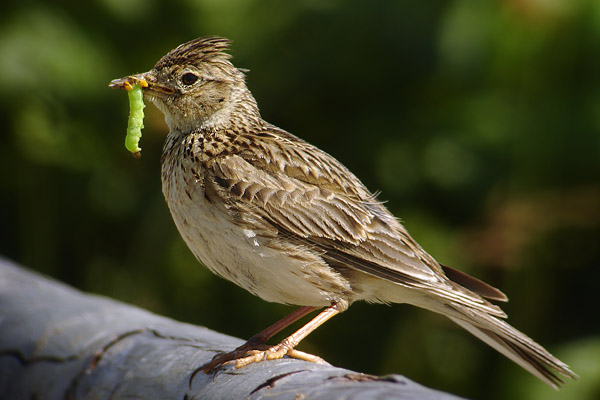
Come identificare Eurasian Skylark
Alauda arvensis
Visto un uccello? Identificalo all'istante con l'app Birdby
Apri l'appPer identificare correttamente Eurasian Skylark (Alauda arvensis), controlla ciascuna di queste caratteristiche. Gli uccelli possono essere complicati da riconoscere, perché comportamento, habitat e canto spesso confermano ciò che una sola foto non può.
Dimensioni a colpo d'occhio
- Lunghezza
- 16-19 cm
- Apertura alare
- 30-36 cm
- Peso
- 25-45 g
Caratteristiche fisiche da controllare
- 1
Piumaggio
Colorazione e disegno generale del piumaggio.
Upperparts are streaky brown, buff, and black, providing excellent camouflage. Underparts are pale buffish-white with a heavily streaked breast. The outer tail feathers are white, visible in flight. A small, erectile crest is often visible on the crown.
- 2
Forma del becco
Forma e colore del becco, un segno di campo chiave.
Relatively short, conical, and stout, dark horn-colored.
- 3
Colore degli occhi
Colore dell'iride e segni distintivi sugli occhi.
Dark brown.
- 4
Colore delle zampe
Colore di zampe e piedi.
Pale pinkish-brown to yellowish-brown.
- 5
Caratteristiche distintive
Tratti distintivi che separano questa specie.
Small, erectile crest; streaky brown plumage; white outer tail feathers (especially noticeable in flight); long hind claw (hallux).
- 6
Aspetto giovanile
Come i giovani si differenziano dagli adulti.
Juveniles are similar to adults but have a more spotted appearance on the upperparts due to pale feather tips, giving a somewhat scaly look. The breast streaking may be less defined.
- 7
Cambiamenti stagionali
Variazione del piumaggio tra stagione riproduttiva e non.
No significant seasonal plumage changes. Plumage may appear slightly fresher after autumn moult and more worn by late breeding season.
- 8
Dimorfismo sessuale
Differenze tra maschi e femmine.
Males and females are generally similar in plumage, though males tend to be slightly larger and have a more prominent crest. Field identification of sex is difficult.
Segni di campo chiave
- Song-flight. Listen for the characteristic, prolonged, and complex song delivered high in the sky while the bird hovers or slowly ascends/descends. This is the most reliable identification feature.
- Plumage. Look for streaky brown upperparts, a pale breast with heavy streaking, and a small, often visible crest on the crown. The overall impression is cryptic and camouflaged.
- Tail. Observe the tail in flight; the white outer tail feathers are a key diagnostic feature, especially when the bird is flushed from the ground.
- Hind Claw. If seen well on the ground, note the unusually long hind claw (hallux), an adaptation for walking on soft ground.
- Habitat. Skylarks are almost exclusively found in open, treeless habitats like grasslands and agricultural fields. If you see a streaky brown bird in such an environment, it's likely a Skylark.
Esplora Eurasian Skylark
Identifica uccelli ovunque
Gratis su iOS, Android e Web. Identificazione per foto e suono, database completo e la tua lista personale.