
Visto un uccello? Identificalo all'istante con l'app Birdby
Apri l'appInformazioni
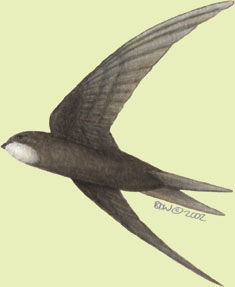
The Common Swift (Apus apus) is a highly aerial migratory bird, renowned for its exceptional flight capabilities. It spends almost its entire life in the air, feeding, drinking, mating, and even sleeping on the wing. Its scientific name 'Apus' is Greek for 'no feet', referring to its small, weak feet unsuited for walking, though they are perfectly adapted for clinging to vertical surfaces.
Dimensioni e longevità
- Lunghezza
- 16-17 cm
- Apertura alare
- 42-48 cm
- Peso
- 35-56 g
- Longevità
- Up to 21 years in the wild, typically 5-7 years
- Dieta
- Insectivore
Caratteristiche fisiche
- Piumaggio
- Sooty brown to blackish-brown overall, with a distinctive pale, whitish throat patch that is often difficult to see at a distance. The plumage is uniformly dark, lacking any lighter underparts or rump patch.
- Forma del becco
- Small, black, and triangular when closed, but capable of opening very wide to capture insects in flight.
- Colore degli occhi
- Dark brown to black
- Colore delle zampe
- Blackish-brown, very short and weak, with all four toes pointing forward (pamprodactyl) for clinging.
- Caratteristiche distintive
- Long, scythe-shaped wings, a short, forked tail (often appearing square or slightly notched in flight), and a uniformly dark plumage. Its flight is fast, powerful, and agile, characterized by rapid wing beats and long glides.
- Aspetto giovanile
- Juveniles resemble adults but often have a slightly paler, more prominent throat patch and a fresher, darker plumage with a faint scaly appearance due to pale feather edgings, particularly on the wings and tail. The tail fork may also appear slightly deeper.
- Cambiamenti stagionali
- No significant seasonal plumage changes. Plumage may appear slightly browner and more worn towards the end of the breeding season before the annual molt.
- Dimorfismo sessuale
- None; males and females are identical in plumage and size.
Come identificare
- 1
Overall Plumage
Look for a uniformly dark, sooty brown to blackish-brown bird. No white rump or pale belly. The pale throat patch is often hard to see unless close.
- 2
Wing Shape
Distinctive long, narrow, scythe-shaped wings. When gliding, the wings are held stiffly, often slightly bowed.
- 3
Tail Shape
Short, forked tail, which often appears square or slightly notched in flight, especially when spread. Not deeply forked like a swallow's.
- 4
Flight Style
Extremely fast, powerful, and agile flight with rapid wing beats and long, sweeping glides. Often seen in large, screaming flocks.
- 5
Vocalization
Listen for the characteristic high-pitched, piercing 'scree-scree-scree' calls, especially around buildings in summer evenings.
- 6
Behavior
Spends almost its entire life in the air. Only lands at its nest site. Never seen perched on wires or branches like swallows.
Habitat e areale
- Biomi
- Urban areas, towns, villages, open countryside, cliffs, and mountainous regions.
- Areale geografico
- Breeds across most of Europe and temperate Asia, from the Atlantic coast to Siberia and China. Winters in sub-Saharan Africa.
- Fascia altitudinale
- From sea level up to 3,000 meters in breeding areas, often higher during migration.
- Ambienti preferiti
- Primarily associated with human settlements where buildings provide nesting sites. Also uses natural cliffs and tree holes in less developed areas. Requires open airspace for foraging on aerial insects.
Comportamento
- Periodo di attività
- Diurnal, active from dawn to dusk, often flying high into the night during non-breeding periods.
- Abitudini alimentari
- Feeds exclusively on aerial insects and spiders, collectively known as 'aerial plankton'. It catches prey in its wide gape while flying, often in large flocks, especially before storms or during migration.
- Comportamento sociale
- Highly social, especially during the breeding season, forming large colonies in suitable nesting sites. Often seen foraging in large, swirling flocks. Roosts communally in the air during non-breeding periods.
- Tipo di volo
- Extremely fast, agile, and graceful. Characterized by powerful, stiff wing beats interspersed with long, sweeping glides. Can reach speeds of over 100 km/h. Spends virtually its entire life in the air, only landing to nest.
- Migrazione
- Long-distance migratory species. Arrives in breeding grounds in Europe and Asia from late April to early May and departs for wintering grounds in sub-Saharan Africa from late July to early September.
- Territorialità
- Colonial breeder, defending only the immediate nest site. Foraging areas are shared.
Canto e richiami
- Canto
- Does not have a complex song. Its vocalizations are primarily high-pitched, screaming calls.
- Richiamo
- A distinctive, high-pitched, piercing 'scree-scree-scree' or 'sree-sree-sree' call, often given in rapid succession, especially when flying in groups around nesting sites. These calls are often described as 'screaming' or 'whistling'.
- Quando vocalizza
- Most vocal during the breeding season, particularly in the mornings and evenings when flying around colonies. Also vocal during communal aerial displays.
Riproduzione
- Stagione riproduttiva
- May to August, with peak egg-laying in late May to early June.
- Abitudini di nidificazione
- Nests colonially in cavities, primarily in buildings (under eaves, in roof spaces, behind fascia boards), but also in natural cliff crevices or tree holes. The nest is a shallow cup made of airborne debris (feathers, plant material, paper) glued together with saliva.
- Dimensione della covata
- 2-3 eggs
- Descrizione dell'uovo
- Typically 2-3 (occasionally 1 or 4) pure white, elliptical eggs.
- Periodo di incubazione
- 19-20 days, incubated by both parents.
- Periodo di involo
- 37-56 days, highly variable depending on food availability. Young are fed by both parents.
- Cure parentali
- Both parents share incubation duties and feed the nestlings. Young are capable of surviving periods of food scarcity by entering a state of torpor.
Dove trovarlo
Urban and Suburban Areas
Look for them screaming around tall buildings, churches, and old houses, especially in the evenings during the breeding season.
Open Countryside
Often seen foraging over fields, wetlands, and forests, particularly when insect numbers are high.
Coastal Cliffs
In some regions, they may nest in natural cliff crevices, especially where human structures are scarce.
Consigli sul campo
- Look Up. Swifts are almost always in the air. Scan the sky, especially above buildings.
- Listen for Calls. Their distinctive 'screaming' calls are often the first indication of their presence, even before you see them.
- Time of Day. They are particularly active and vocal in the mornings and evenings, performing aerial displays around their nesting sites.
- Seasonal Timing. Common Swifts are summer visitors to their breeding grounds. Look for them from late April/early May to late July/early August.
- Weather Conditions. Before thunderstorms, swifts often fly lower and in larger, more frantic flocks as they feed on insects brought down by changes in air pressure.
Specie simili
Pallid Swift
Apus pallidus
The Pallid Swift is slightly larger and paler brown overall, with a more extensive and often whiter throat patch that extends further onto the breast. It also has slightly paler underparts and often a faint pale scaling on the belly. Its flight is often described as more languid or 'floppy' than the Common Swift's. The tail fork is typically deeper and more obvious.
Alpine Swift
Tachymarptis melba
Significantly larger than the Common Swift, with a distinctive white belly and throat contrasting sharply with dark brown upperparts and a dark breast band. Its flight is powerful and graceful, but its size and plumage pattern make it easily distinguishable.
House Martin
Delichon urbicum
While also an aerial insectivore, the House Martin is a hirundine (swallow family) and has a distinct white rump and underparts, contrasting with dark blue-black upperparts. Its flight is more fluttering and less powerful than a swift's, and it has a shorter, less scythe-like wing shape.
Fatti rapidi
- Flight Time:
- Spends up to 10 months continuously in the air outside of the breeding season.
- Speed:
- Can reach speeds over 100 km/h (60 mph).
- Diet:
- Exclusively aerial insects ('aerial plankton').
- Nesting:
- Colonial, primarily in buildings.
- Migration:
- Long-distance migrant to sub-Saharan Africa.
Curiosità
- Common Swifts can sleep while flying, performing short 'naps' during long glides at high altitudes.
- They are one of the fastest birds in level flight.
- A swift's feet are so small and weak that they cannot perch on wires or branches like other birds; they can only cling to vertical surfaces.
- Young swifts can survive periods of food shortage in the nest by entering a state of torpor, slowing their metabolism.
- The oldest recorded Common Swift lived for over 21 years.
Classificazione scientifica
- Regno
- Animalia
- Phylum
- Chordata
- Classe
- Aves
- Ordine
- Apodiformes
- Famiglia
- Apodidae
- Genere
- Apus
- Specie
- Apus apus
Esplora Common Swift
Identifica uccelli ovunque
Gratis su iOS, Android e Web. Identificazione per foto e suono, database completo e la tua lista personale.