
Come identificare Common Swift
Apus apus
Visto un uccello? Identificalo all'istante con l'app Birdby
Apri l'appPer identificare correttamente Common Swift (Apus apus), controlla ciascuna di queste caratteristiche. Gli uccelli possono essere complicati da riconoscere, perché comportamento, habitat e canto spesso confermano ciò che una sola foto non può.
Dimensioni a colpo d'occhio
- Lunghezza
- 16-17 cm
- Apertura alare
- 42-48 cm
- Peso
- 35-56 g
Caratteristiche fisiche da controllare
- 1
Piumaggio
Colorazione e disegno generale del piumaggio.
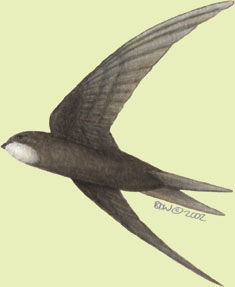
Sooty brown to blackish-brown overall, with a distinctive pale, whitish throat patch that is often difficult to see at a distance. The plumage is uniformly dark, lacking any lighter underparts or rump patch.
- 2
Forma del becco
Forma e colore del becco, un segno di campo chiave.
Small, black, and triangular when closed, but capable of opening very wide to capture insects in flight.
- 3
Colore degli occhi
Colore dell'iride e segni distintivi sugli occhi.
Dark brown to black
- 4
Colore delle zampe
Colore di zampe e piedi.
Blackish-brown, very short and weak, with all four toes pointing forward (pamprodactyl) for clinging.
- 5
Caratteristiche distintive
Tratti distintivi che separano questa specie.
Long, scythe-shaped wings, a short, forked tail (often appearing square or slightly notched in flight), and a uniformly dark plumage. Its flight is fast, powerful, and agile, characterized by rapid wing beats and long glides.
- 6
Aspetto giovanile
Come i giovani si differenziano dagli adulti.
Juveniles resemble adults but often have a slightly paler, more prominent throat patch and a fresher, darker plumage with a faint scaly appearance due to pale feather edgings, particularly on the wings and tail. The tail fork may also appear slightly deeper.
- 7
Cambiamenti stagionali
Variazione del piumaggio tra stagione riproduttiva e non.
No significant seasonal plumage changes. Plumage may appear slightly browner and more worn towards the end of the breeding season before the annual molt.
- 8
Dimorfismo sessuale
Differenze tra maschi e femmine.
None; males and females are identical in plumage and size.
Segni di campo chiave
- Overall Plumage. Look for a uniformly dark, sooty brown to blackish-brown bird. No white rump or pale belly. The pale throat patch is often hard to see unless close.
- Wing Shape. Distinctive long, narrow, scythe-shaped wings. When gliding, the wings are held stiffly, often slightly bowed.
- Tail Shape. Short, forked tail, which often appears square or slightly notched in flight, especially when spread. Not deeply forked like a swallow's.
- Flight Style. Extremely fast, powerful, and agile flight with rapid wing beats and long, sweeping glides. Often seen in large, screaming flocks.
- Vocalization. Listen for the characteristic high-pitched, piercing 'scree-scree-scree' calls, especially around buildings in summer evenings.
- Behavior. Spends almost its entire life in the air. Only lands at its nest site. Never seen perched on wires or branches like swallows.
Esplora Common Swift
Identifica uccelli ovunque
Gratis su iOS, Android e Web. Identificazione per foto e suono, database completo e la tua lista personale.