
Visto un uccello? Identificalo all'istante con l'app Birdby
Apri l'appInformazioni
The Eurasian Bittern, known in Italian as Airone Tarabuso, is a large, secretive heron species characterized by its cryptic brown and buff plumage, allowing it to blend seamlessly into its reedbed habitat. It is renowned for its booming call, which can carry for several kilometers, particularly during the breeding season. This species is largely crepuscular and nocturnal, making it difficult to observe.
Dimensioni e longevità
- Lunghezza
- 69-81 cm
- Apertura alare
- 100-130 cm
- Peso
- 870-1940 g (males typically larger, 969-1940 g; females 870-1170 g)
- Longevità
- Up to 11 years in the wild
- Dieta
- Carnivore (primarily fish, amphibians, insects, and small mammals)
Caratteristiche fisiche
- Piumaggio
- Overall cryptic, streaky brown and buff plumage. The upperparts are mottled with dark brown and black streaks on a buffy-brown background. Underparts are paler, buffy-white with broad dark brown streaks. The crown is dark, and there is a prominent dark malar stripe (moustache). The flight feathers are dark brown.
- Forma del becco
- Strong, dagger-like bill, yellowish-green to olive-brown, with a darker culmen.
- Colore degli occhi
- Yellowish-orange iris, often appearing duller in non-breeding birds.
- Colore delle zampe
- Greenish-yellow legs and feet, often appearing duller outside the breeding season.
- Caratteristiche distintive
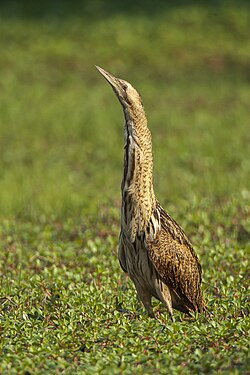
- Its cryptic plumage, stocky build, short neck (often held retracted), and distinctive 'booming' call are key features. When alarmed, it adopts a 'sky-pointing' posture, stretching its neck and bill vertically to blend with reeds.
- Aspetto giovanile
- Juveniles resemble adults but may have slightly less defined streaking and a generally duller appearance. Their plumage is often softer and less compact.
- Cambiamenti stagionali
- No significant seasonal plumage changes. The bill and leg coloration may become slightly brighter during the breeding season.
- Dimorfismo sessuale
- Males are generally larger and heavier than females, but plumage is identical. Males have a more powerful and resonant booming call.
Come identificare
- 1
Plumage
Look for the overall streaky brown and buff camouflage pattern. The dark crown and prominent dark malar stripe are good indicators.
- 2
Shape and Posture
Stocky build, short neck (often retracted), and a hunched appearance in flight. When alarmed, it adopts a characteristic 'sky-pointing' posture, stretching its neck vertically to blend with reeds.
- 3
Call
The deep, resonant 'booming' call is unmistakable and often the first (and only) sign of its presence. Listen for it at dawn, dusk, and during the night in spring.
- 4
Behavior
Its secretive nature, preference for dense reedbeds, and 'sit-and-wait' hunting strategy are characteristic. Rarely seen in the open.
- 5
Flight
Heavy, slow wing beats with a retracted neck, flying low over reedbeds.
Habitat e areale
- Biomi
- Wetlands, marshes, reedbeds, fens, and slow-moving rivers with dense emergent vegetation.
- Areale geografico
- Widespread across temperate Europe and Asia, from the UK and Western Europe eastward through Russia and Central Asia to Japan. Also found in parts of North Africa.
- Fascia altitudinale
- Typically found in lowlands, from sea level up to approximately 500 meters, rarely higher.
- Ambienti preferiti
- Extensive, undisturbed reedbeds (Phragmites australis) with shallow water and a mosaic of open water channels and dense vegetation. Requires dense cover for nesting and foraging.
Comportamento
- Periodo di attività
- Crepuscular and nocturnal, most active at dawn and dusk, and throughout the night. Rarely seen during the day unless disturbed.
- Abitudini alimentari
- A 'sit-and-wait' predator. It stands motionless at the edge of reedbeds or in shallow water, waiting for prey to come within striking distance. It then rapidly extends its neck and stabs its prey with its sharp bill. Diet includes fish (e.g., eels, pike, perch), amphibians (frogs, newts), insects (dragonflies, beetles), crustaceans, and occasionally small mammals (voles) or young birds.
- Comportamento sociale
- Primarily solitary and highly secretive. During the breeding season, males are polygynous, often mating with multiple females within their territory. Females raise the young alone.
- Tipo di volo
- Heavy, deliberate flight with slow, deep wing beats and retracted neck, similar to a heron but appearing more 'hunched'. Often flies low over reedbeds, especially at dawn and dusk.
- Migrazione
- Northern and eastern populations are migratory, moving to warmer southern Europe, North Africa, and southern Asia for winter. Western and southern European populations are largely resident or undertake short-distance dispersal.
- Territorialità
- Males establish and defend large breeding territories, primarily through their booming calls. Females defend smaller nesting territories.
Canto e richiami
- Canto
- The male's distinctive 'booming' call is a deep, resonant, low-frequency sound, often described as 'wumph-wumph-wumph' or 'rumb-rumb-rumb'. It is produced by inflating the esophagus and acts as a territorial display and to attract mates. It can be heard from several kilometers away.
- Richiamo
- Aside from the boom, other calls are rarely heard. When disturbed, it may emit a harsh 'kraak' or 'arrk' call. Chicks produce soft peeping calls.
- Quando vocalizza
- The booming call is most frequent during the breeding season (February to June), primarily at dawn and dusk, but also throughout the night.
Riproduzione
- Stagione riproduttiva
- Typically March to July, varying geographically.
- Abitudini di nidificazione
- Nests are built by the female, usually on a platform of broken reeds and other vegetation, well concealed within dense reedbeds, often over shallow water. Nests are bulky and well-hidden.
- Dimensione della covata
- 3-7 eggs, usually 4-6.
- Descrizione dell'uovo
- 3-7 (typically 4-6) eggs, olive-brown to greenish-brown, unspotted, and oval-shaped. Average size is about 52 x 38 mm.
- Periodo di incubazione
- 25-26 days, incubated solely by the female.
- Periodo di involo
- Chicks leave the nest and begin to explore the surrounding reeds at about 2-3 weeks old, but are not fully independent until 7-8 weeks.
- Cure parentali
- Only the female cares for the eggs and young. She feeds the chicks by regurgitation.
Dove trovarlo
Extensive Reedbeds
Large, undisturbed areas of Phragmites australis (common reed) are essential. Look for areas with a mix of dense reeds and shallow open water.
Freshwater Marshes
Well-vegetated freshwater marshes, fens, and the margins of large lakes and slow-moving rivers.
Nature Reserves
Many protected wetland areas and nature reserves specifically manage habitats for Bitterns and other reedbed specialists.
Consigli sul campo
- Listen for the boom. The most reliable way to detect a Bittern is by listening for the male's booming call, especially from February to June, at dawn, dusk, or during the night. Use a parabolic microphone if available.
- Be patient and quiet. Bitterns are extremely shy. Find a concealed spot overlooking a reedbed and remain still and quiet for extended periods. Use binoculars or a spotting scope.
- Look for movement. Scan the edges of reedbeds and open water channels for any subtle movement. They often stand motionless, but may occasionally take a step or strike at prey.
- Check flight paths. At dawn or dusk, you might catch a glimpse of a Bittern flying low over the reeds, moving between foraging areas or to/from the nest.
- Visit at the right time. Breeding season (spring) is the best time to hear them. Wintering birds are even more secretive.
Specie simili
Little Bittern
Ixobrychus minutus
Much smaller size (length 33-38 cm), different plumage (males have black back and crown, females streaky brown), and a higher-pitched, less resonant call. Favors smaller reedbeds and often perches higher in reeds.
Night Heron
Nycticorax nycticorax
Different plumage (grey body, black back and crown, white underparts), more compact build, and a distinct 'quark' call. While also crepuscular/nocturnal, it is less secretive and often found in more open wetland areas.
Green Heron
Butorides virescens
Found in the Americas, not Europe/Asia. Much smaller, with a dark green-glossed back and chestnut neck. Different habitat preferences and calls.
Fatti rapidi
- Primary Habitat:
- Dense reedbeds
- Key Identification Feature:
- Booming call and cryptic streaky plumage
- Activity Pattern:
- Crepuscular/Nocturnal
- Diet:
- Fish, amphibians, insects
- Conservation Threat:
- Habitat loss and degradation
Curiosità
- The Bittern's booming call is produced by inflating its esophagus, acting as a resonating chamber, and can be heard up to 5 km away.
- Its 'sky-pointing' camouflage posture is so effective that it can be standing in plain sight and remain undetected, mimicking the surrounding reeds.
- In folklore, the Bittern's boom was sometimes attributed to mythical creatures or spirits due to its eerie, distant sound.
- Despite its large size, the Bittern is one of the most difficult European birds to see due to its secretive nature and perfect camouflage.
Classificazione scientifica
- Regno
- Animalia
- Phylum
- Chordata
- Classe
- Aves
- Ordine
- Pelecaniformes
- Famiglia
- Ardeidae
- Genere
- Botaurus
- Specie
- Botaurus stellaris
Esplora Eurasian Bittern
Identifica uccelli ovunque
Gratis su iOS, Android e Web. Identificazione per foto e suono, database completo e la tua lista personale.