
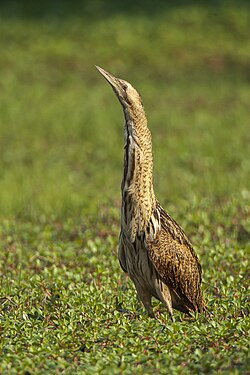
Dove vive Eurasian Bittern?
Botaurus stellaris
Visto un uccello? Identificalo all'istante con l'app Birdby
Apri l'appEurasian Bittern vive in habitat e regioni specifiche. Sapere dove e quando guardare migliora le possibilità di un avvistamento riuscito.
Biomi
Wetlands, marshes, reedbeds, fens, and slow-moving rivers with dense emergent vegetation.
Areale geografico
Widespread across temperate Europe and Asia, from the UK and Western Europe eastward through Russia and Central Asia to Japan. Also found in parts of North Africa.
Ambienti preferiti
Extensive, undisturbed reedbeds (Phragmites australis) with shallow water and a mosaic of open water channels and dense vegetation. Requires dense cover for nesting and foraging.
Fascia altitudinale
Typically found in lowlands, from sea level up to approximately 500 meters, rarely higher.
Dove guardare
Extensive Reedbeds
Large, undisturbed areas of Phragmites australis (common reed) are essential. Look for areas with a mix of dense reeds and shallow open water.
Freshwater Marshes
Well-vegetated freshwater marshes, fens, and the margins of large lakes and slow-moving rivers.
Nature Reserves
Many protected wetland areas and nature reserves specifically manage habitats for Bitterns and other reedbed specialists.
Consigli sul campo
- Listen for the boom. The most reliable way to detect a Bittern is by listening for the male's booming call, especially from February to June, at dawn, dusk, or during the night. Use a parabolic microphone if available.
- Be patient and quiet. Bitterns are extremely shy. Find a concealed spot overlooking a reedbed and remain still and quiet for extended periods. Use binoculars or a spotting scope.
- Look for movement. Scan the edges of reedbeds and open water channels for any subtle movement. They often stand motionless, but may occasionally take a step or strike at prey.
- Check flight paths. At dawn or dusk, you might catch a glimpse of a Bittern flying low over the reeds, moving between foraging areas or to/from the nest.
- Visit at the right time. Breeding season (spring) is the best time to hear them. Wintering birds are even more secretive.
Migrazione
Northern and eastern populations are migratory, moving to warmer southern Europe, North Africa, and southern Asia for winter. Western and southern European populations are largely resident or undertake short-distance dispersal.
Esplora Eurasian Bittern
Identifica uccelli ovunque
Gratis su iOS, Android e Web. Identificazione per foto e suono, database completo e la tua lista personale.