
Visto un uccello? Identificalo all'istante con l'app Birdby
Apri l'appInformazioni
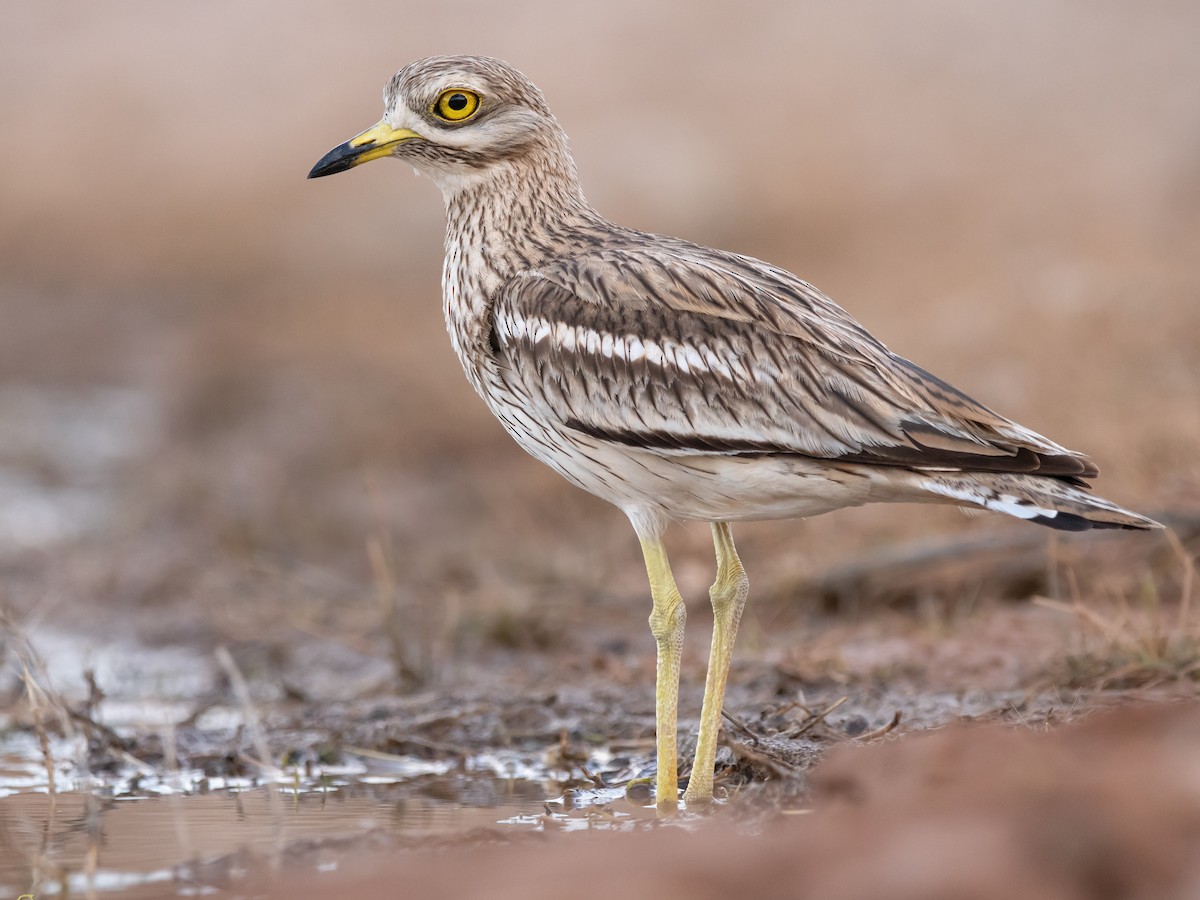
The Eurasian Stone-curlew, also known as the Stone-curlew or Thick-knee, is a medium-sized, nocturnal wader with a distinctive large head, prominent yellow eyes, and cryptic plumage. It is known for its haunting, wailing calls, particularly at dusk and dawn. Despite its wader classification, it prefers dry, open habitats rather than wetlands.
Dimensioni e longevità
- Lunghezza
- 38-46 cm
- Apertura alare
- 76-88 cm
- Peso
- 290-535 g
- Longevità
- Up to 15 years in the wild
- Dieta
- Carnivore (primarily invertebrates and small vertebrates)
Caratteristiche fisiche
- Piumaggio
- Cryptic sandy-brown to grey-brown plumage, heavily streaked with dark brown and black, providing excellent camouflage against stony or bare ground. The underparts are paler, whitish, with dark streaking on the breast. It has a prominent white supercilium and a dark eye-stripe. The wings show two distinct white bars bordered by black, particularly visible in flight.
- Forma del becco
- Relatively short, stout, and strong bill, yellowish at the base and black at the tip.
- Colore degli occhi
- Large, prominent, bright yellow eyes, adapted for nocturnal vision, surrounded by a yellow orbital ring.
- Colore delle zampe
- Long, thick, yellowish-green legs with noticeably swollen 'knees' (actually ankles), giving rise to the common name 'Thick-knee'.
- Caratteristiche distintive
- Large yellow eyes, thick 'knees', cryptic plumage, and distinctive white and black wing bars in flight. Its upright stance and large head are also characteristic.
- Aspetto giovanile
- Juveniles resemble adults but have a slightly duller plumage with more extensive buff or rufous fringing on the feathers, giving them a scaly appearance. The streaking may be less defined, and the eye color might be less intense yellow.
- Cambiamenti stagionali
- No significant seasonal plumage changes. Plumage remains consistent throughout the year, optimized for camouflage.
- Dimorfismo sessuale
- Males and females are generally monomorphic in plumage and size, making them difficult to distinguish visually in the field.
Come identificare
- 1
Overall Appearance
Look for a medium-sized, rather upright bird with long legs, a large head, and a relatively short, stout bill. Its cryptic sandy-brown plumage with dark streaking is key for camouflage.
- 2
Eyes
The most striking feature is its large, prominent, bright yellow eyes, often described as 'glowing' at night. These are surrounded by a yellow orbital ring.
- 3
Legs
Note the long, thick, yellowish-green legs with distinctively swollen 'knees' (ankles).
- 4
Plumage Details
Observe the dark streaking on the upperparts and breast, and the prominent white supercilium above the eye. In flight, look for the two distinct white wing bars bordered by black on the primaries.
- 5
Behavior
Often active at dusk and dawn, and throughout the night. During the day, it is usually motionless, relying on camouflage. Its characteristic slow walk, pause, and dash hunting technique is also a good clue.
- 6
Vocalization
Listen for its unmistakable, loud, mournful, wailing 'cur-lee' call, especially at night. This is often the first indication of its presence.
Habitat e areale
- Biomi
- Temperate grasslands, semi-deserts, steppes, open woodlands, agricultural lands.
- Areale geografico
- Widespread across Europe, North Africa, and Southwest Asia. In Europe, it breeds from the Iberian Peninsula eastwards to Russia, and south to the Mediterranean. Northern populations are migratory, while southern populations are often resident.
- Fascia altitudinale
- Typically found from sea level up to approximately 1,500 meters, though generally prefers lower elevations.
- Ambienti preferiti
- Dry, open, sparsely vegetated areas with stony or sandy soils, fallow fields, heathland, chalk downland, steppe, and sometimes open pine forests. Avoids dense vegetation and wetlands.
Comportamento
- Periodo di attività
- Predominantly nocturnal and crepuscular, becoming active at dusk and remaining so through the night. During the day, they are cryptic and often remain motionless, relying on their camouflage.
- Abitudini alimentari
- Primarily nocturnal or crepuscular feeder, foraging for a wide variety of invertebrates such as insects (beetles, crickets, grasshoppers), worms, and molluscs. It also preys on small vertebrates including lizards, frogs, small rodents, and bird chicks. It hunts by walking slowly, pausing, and then making a sudden dash to catch prey.
- Comportamento sociale
- Typically solitary or found in pairs during the breeding season. Outside of breeding, they may form small flocks, especially during migration or at communal roosting sites.
- Tipo di volo
- Strong, direct flight with rapid wing beats. In flight, the prominent white wing bars bordered by black are very conspicuous. It often flies at low altitudes.
- Migrazione
- Northern and eastern European populations are migratory, moving to North Africa and the Middle East for the winter. Southern European and North African populations are largely resident or undertake short-distance movements. Migration occurs mainly at night.
- Territorialità
- Territorial during the breeding season, with pairs defending a nesting area. Displays include calling, posturing, and sometimes short chases.
Canto e richiami
- Canto
- The primary vocalization, often referred to as a 'song', is a loud, far-carrying, mournful, wailing 'cur-lee' or 'koo-ree' call, often repeated. It has a haunting quality and is most frequently heard at night.
- Richiamo
- In addition to the 'cur-lee' song, they emit sharp 'kwick-kwick' alarm calls when disturbed, and various softer contact calls between pairs.
- Quando vocalizza
- Most vocal during the breeding season, particularly at night, from dusk until dawn. Calls can also be heard during migration.
Riproduzione
- Stagione riproduttiva
- Typically from March to July, varying geographically.
- Abitudini di nidificazione
- Nests are simple scrapes on the bare ground, often near a stone, clump of vegetation, or animal droppings for camouflage. No nest material is added, though sometimes small pebbles or bits of debris may line the scrape. Nests are usually in open, dry areas.
- Dimensione della covata
- 1-3 eggs, most commonly 2.
- Descrizione dell'uovo
- Usually 2 eggs (occasionally 1 or 3), oval to pyriform in shape. They are pale buff, stone-colored, or olive-brown, heavily marked with dark brown, black, and grey blotches and streaks, providing excellent camouflage against the ground.
- Periodo di incubazione
- 24-27 days, primarily by the female, though the male may assist.
- Periodo di involo
- Chicks are precocial and leave the nest scrape shortly after hatching. They are able to feed themselves within a few days but are cared for by both parents for 36-42 days until they can fly.
- Cure parentali
- Both parents share incubation duties (though female predominates) and care for the precocial young. Parents are highly protective and will perform distraction displays to lure predators away from the nest or chicks.
Dove trovarlo
Fallow Fields
Often found in agricultural areas with fallow land, stubble fields, or recently ploughed fields, especially those with stony patches.
Heathland and Chalk Downland
In parts of its range, it inhabits open heathland, chalk downland, and other dry, sparsely vegetated grasslands.
Steppe and Semi-desert
Common in natural steppe environments and semi-desert regions across its Asian and North African range.
Open Woodlands
Occasionally found in very open pine or oak woodlands with sparse undergrowth and bare ground.
Consigli sul campo
- Go at Dusk or Dawn. This species is primarily nocturnal and crepuscular. Your best chance of seeing or hearing them is during the twilight hours or even at night with a spotlight (used responsibly and without disturbing the birds).
- Listen for Calls. Their distinctive, haunting 'cur-lee' call is often the easiest way to detect their presence, especially when they are camouflaged during the day.
- Scan Open Ground. Use binoculars to scan large expanses of open, dry, stony, or sandy ground. They blend in incredibly well, so patience is key.
- Look for Movement. While they often stand still, look for subtle movements like head bobs or short dashes when they are foraging.
- Check Agricultural Areas. Fallow fields, stubble fields, and areas with minimal crop cover are prime habitats, especially in agricultural landscapes.
Specie simili
Great Stone-curlew
Esacus recurvirostris
Larger size, much heavier and upturned bill, and different geographic range (primarily South and Southeast Asia). The Eurasian Stone-curlew has a relatively straight bill.
Indian Stone-curlew
Burhinus indicus
Formerly considered a subspecies of B. oedicnemus, now recognized as a distinct species. It is slightly smaller, has a darker, more rufous plumage, and a more restricted range in the Indian subcontinent. Field identification can be challenging where ranges overlap.
Spotted Thick-knee
Burhinus capensis
Found in Africa. Has a more heavily spotted plumage, particularly on the underparts, and a different geographic distribution.
Fatti rapidi
- Activity:
- Nocturnal/Crepuscular
- Diet:
- Invertebrates and small vertebrates
- Habitat:
- Dry, open, sparsely vegetated areas
- Key Feature:
- Large yellow eyes, cryptic plumage
- Call:
- Haunting 'cur-lee' wail
Curiosità
- The name 'Stone-curlew' refers to its preference for stony habitats and its curlew-like call, despite not being closely related to true curlews.
- Its large yellow eyes are an adaptation for excellent night vision, allowing it to hunt effectively in low light conditions.
- The 'thick-knee' part of its common name comes from the prominent, swollen appearance of its tarsal joints (ankles), which are often mistaken for knees.
- When threatened, it often freezes, relying entirely on its superb camouflage to avoid detection. If approached too closely, it may run or fly a short distance.
- In some cultures, its nocturnal calls are associated with ghosts or spirits due to their eerie, wailing quality.
Classificazione scientifica
- Regno
- Animalia
- Phylum
- Chordata
- Classe
- Aves
- Ordine
- Charadriiformes
- Famiglia
- Burhinidae
- Genere
- Burhinus
- Specie
- B. oedicnemus
Esplora Eurasian Stone-curlew
Identifica uccelli ovunque
Gratis su iOS, Android e Web. Identificazione per foto e suono, database completo e la tua lista personale.