
Come identificare Eurasian Stone-curlew
Burhinus oedicnemus
Visto un uccello? Identificalo all'istante con l'app Birdby
Apri l'appPer identificare correttamente Eurasian Stone-curlew (Burhinus oedicnemus), controlla ciascuna di queste caratteristiche. Gli uccelli possono essere complicati da riconoscere, perché comportamento, habitat e canto spesso confermano ciò che una sola foto non può.
Dimensioni a colpo d'occhio
- Lunghezza
- 38-46 cm
- Apertura alare
- 76-88 cm
- Peso
- 290-535 g
Caratteristiche fisiche da controllare
- 1
Piumaggio
Colorazione e disegno generale del piumaggio.
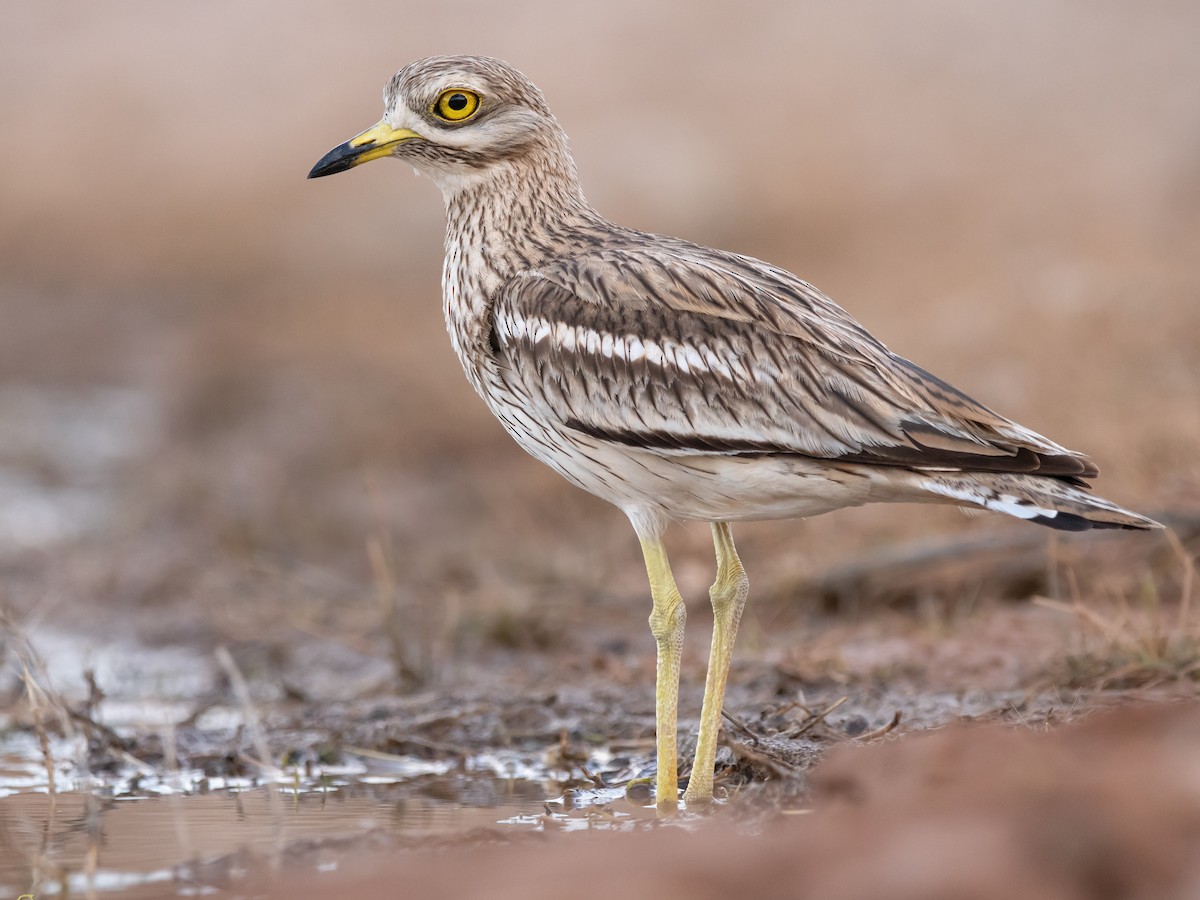
Cryptic sandy-brown to grey-brown plumage, heavily streaked with dark brown and black, providing excellent camouflage against stony or bare ground. The underparts are paler, whitish, with dark streaking on the breast. It has a prominent white supercilium and a dark eye-stripe. The wings show two distinct white bars bordered by black, particularly visible in flight.
- 2
Forma del becco
Forma e colore del becco, un segno di campo chiave.
Relatively short, stout, and strong bill, yellowish at the base and black at the tip.
- 3
Colore degli occhi
Colore dell'iride e segni distintivi sugli occhi.
Large, prominent, bright yellow eyes, adapted for nocturnal vision, surrounded by a yellow orbital ring.
- 4
Colore delle zampe
Colore di zampe e piedi.
Long, thick, yellowish-green legs with noticeably swollen 'knees' (actually ankles), giving rise to the common name 'Thick-knee'.
- 5
Caratteristiche distintive
Tratti distintivi che separano questa specie.
Large yellow eyes, thick 'knees', cryptic plumage, and distinctive white and black wing bars in flight. Its upright stance and large head are also characteristic.
- 6
Aspetto giovanile
Come i giovani si differenziano dagli adulti.
Juveniles resemble adults but have a slightly duller plumage with more extensive buff or rufous fringing on the feathers, giving them a scaly appearance. The streaking may be less defined, and the eye color might be less intense yellow.
- 7
Cambiamenti stagionali
Variazione del piumaggio tra stagione riproduttiva e non.
No significant seasonal plumage changes. Plumage remains consistent throughout the year, optimized for camouflage.
- 8
Dimorfismo sessuale
Differenze tra maschi e femmine.
Males and females are generally monomorphic in plumage and size, making them difficult to distinguish visually in the field.
Segni di campo chiave
- Overall Appearance. Look for a medium-sized, rather upright bird with long legs, a large head, and a relatively short, stout bill. Its cryptic sandy-brown plumage with dark streaking is key for camouflage.
- Eyes. The most striking feature is its large, prominent, bright yellow eyes, often described as 'glowing' at night. These are surrounded by a yellow orbital ring.
- Legs. Note the long, thick, yellowish-green legs with distinctively swollen 'knees' (ankles).
- Plumage Details. Observe the dark streaking on the upperparts and breast, and the prominent white supercilium above the eye. In flight, look for the two distinct white wing bars bordered by black on the primaries.
- Behavior. Often active at dusk and dawn, and throughout the night. During the day, it is usually motionless, relying on camouflage. Its characteristic slow walk, pause, and dash hunting technique is also a good clue.
- Vocalization. Listen for its unmistakable, loud, mournful, wailing 'cur-lee' call, especially at night. This is often the first indication of its presence.
Esplora Eurasian Stone-curlew
Identifica uccelli ovunque
Gratis su iOS, Android e Web. Identificazione per foto e suono, database completo e la tua lista personale.